Alion® Herbicide Use in Almonds
September 4, 2025
What is Alion® herbicide?
Alion® herbicide is a foundational product providing excellent broad-spectrum pre-emergent and residual control of grass and broadleaf weeds for up to six months. Alion® herbicide supports clean orchards and improved water and nutrient uptake, helping to increase yield potential. The active ingredient is indaziflam which is in the alkylazine chemical family (Herbicide Group 29) according to the Weed Science Society of America. The mode of action is cellulose-biosynthesis inhibition.1,2 This mode of action provides a solution for controlling weeds including those species with resistance to ALS-, ACCase-, and triazine-resistant species. To date, no weed species are known to be resistant to indaziflam. Alion® herbicide is formulated as a suspension concentrate at 1.67 pounds of indaziflam per gallon.
Which weed species are controlled by Alion® herbicide?
Approximately 30 broadleaf weed species and 12 grass species can be controlled by Alion® herbicide. Consult the Alion® herbicide label at https://cs-assets.bayer.com/is/content/bayer/Alion_Herbicide_Label1qpdf for a complete list of controlled weed species.
What are the application rates for using Alion® herbicide for almonds and other tree nuts?
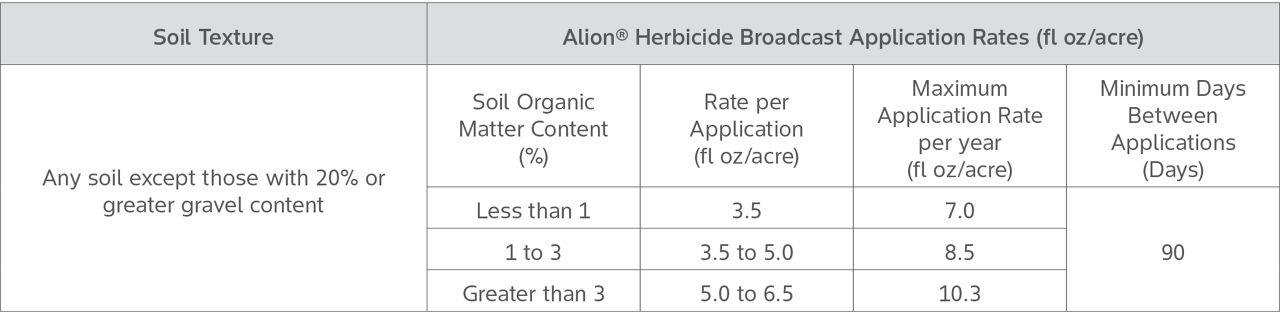
Application rates are dependent on the percent (%) organic matter (OM) contained in the soil based on sample cores taken from a depth of at least six inches (Table 1). When a range in rates is given, higher use rates may be needed in high clay-content soils compared to coarser soils with lower clay content. The higher end of the range should also be used if a field has a history of heavy weed populations or crop residue. Always read and follow all label directions.2
Table 1. Application rates for Alion® herbicide applied to almond orchards.2
What are some of the application instructions, precautions, or restrictions according to the label?
Almond orchards should be established for at least one year and exhibiting normal growth before Alion® herbicide can be applied. For best weed control results, apply to dry soil followed by 48 hours without irrigation or a rainfall event. Dry soil at application time is needed for the active ingredient to bind to soil particles and avoid downward movement to the almond tree roots. Following the 48-hour dry period, adequate moisture from rainfall or an irrigation event should take place within 21 days and before weeds germinate. If emerged weeds are present at the time of application, an approved foliar-applied herbicide can be tank mixed for additional control. Avoid direct contact with crop foliage, green bark, roots, or fruit. Only mature, brown bark can be treated with Alion herbicide. Cracks in the soil and depressions should be filled in prior to application.2
Use Restrictions
- Do not exceed the maximum amount of Alion® herbicide per application or per year (Table 1).
- Do not apply if almond nuts intended for harvest are on the ground.
- In the California counties of Kern, Inyo, Tulare, Kings, Fresno, and Madera, application can only be made after harvest and up to the initiation of pink bud stage in almonds.
- Minimum of 90 days between applications.
- Spot spraying is not allowed – application must be made with broadcast equipment.
- Application through any type of irrigation system or aerial equipment is prohibited.
- Do not apply to saturated soil.
- Do not apply within 25 feet of surface water sources such as rivers or ponds.2
Are tank mixes that can provide additional weed control permissible with Alion® herbicide?
Alion® herbicide provides little or no control of emerged weeds. To aid in controlling emerged weeds, tank mixes with post-emergent herbicide products that are approved for use in almonds are permissible. In order to manage the potential for herbicide resistance in the targeted weeds, tank mixtures should include approved products with a different mode of action.2
What is the mixing order for using Alion® herbicide with a permissible tank mix partner?
After filling the sprayer tank about half full of water, agitation should be started and maintained throughout the mixing process. Once Alion® herbicide has completely dispersed, add other approved herbicides, fertilizers, or additives according to label directions that are to be applied with Alion® herbicide. Add the remainder of the water volume while maintaining agitation.2
Are there planting/replanting restrictions after applying Alion® herbicide?
DO NOT apply within 36 months of rotation to another crop with the following exceptions:
- For cereal crops including wheat, corn, sorghum, and barley the minimum plant back interval is 22 months.
- For root crops including carrot, radish, potato, and sugar beet the minimum plant back interval is 22 months.
- For peas, lentils, and chickpeas the minimum plant back interval is 24 months.
Personal Protective Equipment (PPE)
Anyone handling or applying Alion® herbicide must wear PPE that includes a long-sleeved shirt and long pants, shoes, socks, and waterproof gloves.
Restricted Entry Interval (REI)
The REI for an area treated with Alion® herbicide is 12 hours. If the treated area is to be entered prior to that time, workers must wear the PPE described above.
Pre-Harvest Interval (PHI)
The PHI for almonds and other tree nuts is 14 days.
Sources
1Summary of herbicide mechanism of action according to the Weed Science Society of America. Weed Science Society of America. https://wssa.net/wp-content/uploads/WSSA-Mechanism-of-Action.pdf
22024. Herbicide mode of action table. CropLife Australia. https://www.croplife.org.au/resources/programs/resistance-management/herbicide-moa-table-4/
Web sources verified 07/18/2025.. 7323_479001.
Disclaimer
ALWAYS READ AND FOLLOW GRAIN MARKETING AND ALL OTHER STEWARDSHIP PRACTICES AND PESTICIDE LABEL DIRECTIONS.