3 MIN READ
Corn Injury from Anhydrous Ammonia Fertilizer
March 25, 2026
Get Year-Round Updates From Our Agronomic Experts
Potential Anhydrous Ammonia Hazards
Anhydrous ammonia (NH3) is a compound containing 82% nitrogen (N) that is commonly used as a fertilizer for some crops, as well as other industrial uses. It has an extremely high affinity, or attraction, for water, regardless of whether water is contained in the atmosphere, the soil, or living tissue. It will remove water from any water-containing tissue it comes in contact with and can severely injure skin, eyes, lungs, or plant roots and leaves. Injury to corn seedlings can occur shortly after application, particularly under cold and dry soil conditions. Separating the corn seed or seedling by either time or distance from anhydrous ammonia applications helps to reduce the risk of injury.
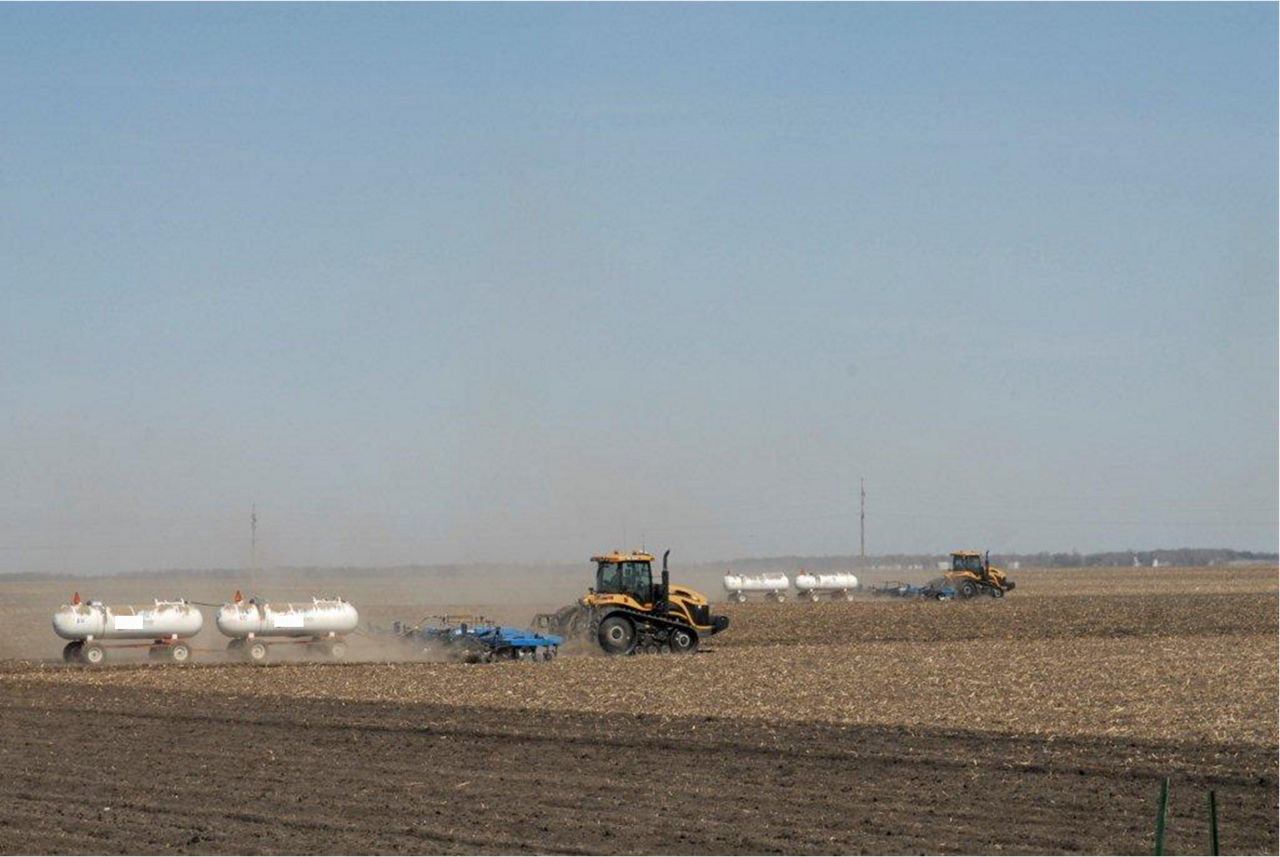
Causes of Anhydrous Ammonia Burn to Corn Roots
Anhydrous ammonia can burn corn roots when they encounter high concentrations of free ammonia. When injected into the soil, anhydrous ammonia is rapidly converted to ammonium (NH4+) by associating with hydrogen ions. Most hydrogen ions come from water (H2O) molecules and some come from soil cation exchange sites. When the hydrogen ions are separated from the water molecule, hydroxyl ions (OH-) are left behind. This reaction:
NH3 + H2O < ----- > NH4+ + OH
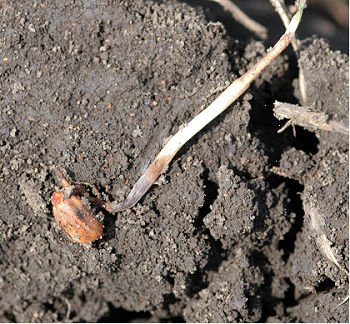
temporarily increases the pH of the soil (potentially as high as pH 9.0) at the point of injection which can sharply increase the amount of free ammonia in the soil possibly leading to injury or burn (Figure 2). The highest concentration of ammonia is within an inch or two of the injection point but can expand up to three to five inches in radius, known as the retention zone. The size of the retention zone is highly dependent on several factors including soil texture and organic matter content, with soil moisture content being the most critical. Coarse soil texture, dry soil conditions, and higher application rates of anhydrous ammonia tend to expand the retention zone. High ammonium concentrations along with high pH in the application band initially slows the conversion of ammonium to nitrate (NO3-) by soil microbes. As this conversion occurs the free hydrogen (H) lowers the soil pH; therefore, the net effect of the anhydrous ammonia application is a lower soil pH.1,2,3
Identifying Emerged Corn Anhydrous Ammonia Fertilizer Injury Symptoms
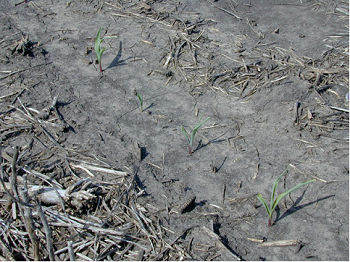
Anhydrous ammonia injury to corn can occur over the ammonia knife track and result in poor corn emergence. This crop response can often be seen by following the direction of the anhydrous ammonia application through the field. Anhydrous ammonia injury can result in uneven corn seedling emergence, slow growing plants, and wilted seedlings under dry soil conditions (Figure 3). Another injury symptom that is generally more pronounced in dry weather is “stubby” root systems which can limit water uptake since injured corn seedlings have root systems that are slow to develop or have been damaged (Figure 4).
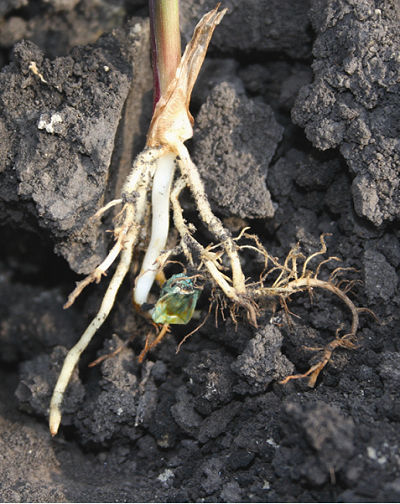
In dry soils, the conversion of ammonia to ammonium occurs rapidly. However, nitrification can occur relatively slowly when dry soils are also cool. Severely damaged roots turn black and may appear burnt. If injury to the corn stand is severe, replanting is a consideration with decisions based upon the uniformity of the plant stand, date, seed, and expected yield potential of the replanted crop. Please see Corn Replanting Decisions for additional replanting information.
Applying anhydrous ammonia to corn in the early vegetative growth stages (sidedressing) can also cause injury to the leaves if ammonia vapor escapes from applicator knives. If only a portion of the corn leaves are damaged, corn plants usually grow out of the injury. There is no advantage in trying to sidedress anhydrous ammonia close to the corn plants. It is recommended to inject anhydrous ammonia midway between corn rows to allow as much space as possible from the applicator knives to the corn leaves. Corn roots generally reach the fertilizer band by about V8 with a 30-inch row width.
Preventing Corn Injury from Anhydrous Ammonia Fertilizer
Many factors determine the risk of ammonia injury. There are several guidelines that can help to minimize injury from anhydrous ammonia application prior to corn planting.
- Apply lower rates of ammonia when soil conditions are favorable.
- Inject anhydrous ammonia at a depth greater than five inches and apply diagonally to planned corn row orientation.
- Minimize upward mobility of the ammonia and injury to the seed by ensuring complete closure of the slot left after the knife passes through the soil. After anhydrous ammonia is injected into the soil, there is a zone of free ammonia concentration up to about three to five inches in radius. In sandy soils and dry soils, ammonia moves further away from the injection point. This can make the zone of concentration oblong versus a circular concentration. In wet soils, the injection knife may smear the sidewall and allow ammonia to move back up the knife slot. Ammonia can also move up the knife track as wet soils begin to dry.
- Do not plant on top of shallow injection bands.
- Waiting as long as possible to plant corn after anhydrous ammonia application.3,4
Sources
1Sawyer, J. 2009. Corn seedling injury from ammonia. Iowa State University Extension. https://crops.extension.iastate.edu/files/inline-files/Ammonia-SeedlingInjury_5_22_09.pdf
2Sawyer, J. 2019. Understanding anhydrous ammonia application in soil. Integrated Crop Management. Iowa State University Extension and Outreach. https://crops.extension.iastate.edu/cropnews/2019/03/understanding-anhydrous-ammonia-application-soil
3Vitosh, M. L. What happens to anhydrous ammonia in soil. Michigan State University. https://www.canr.msu.edu/field_crops/uploads/archive/Anhydrous%20Ammonia%20in%20soil.pdf
4Sawyer, J. 2019. Anhydrous ammonia application – Spring 2019. Integrated Crop Management. Iowa State University Extension and Outreach. https://crops.extension.iastate.edu/cropnews/2019/03/anhydrous-ammonia-application-spring-2019
Web sources verified 2/16/2026. 1213_120480
Disclaimer
ALWAYS READ AND FOLLOW GRAIN MARKETING AND ALL OTHER STEWARDSHIP PRACTICES AND PESTICIDE LABEL DIRECTIONS.