The Benefits of Tillage: Managing Fall Residue for Disease Management in Corn
November 24, 2025
Overview
The pathogens Fusarium spp., Rhizoctonia spp., Pythium spp., Diplodia spp., Penicillium spp., and Trichoderma spp. survive in crop residue and in the soil and can infect a corn crop at several different growth stages. Infection can lead to seed decay, seedling rots and blights, foliar diseases, stalk rots, and ear rots.1 Managing crop residue through tillage has been shown to help lower these corn diseases.
Benefits of Tillage and Managing Crop Residue
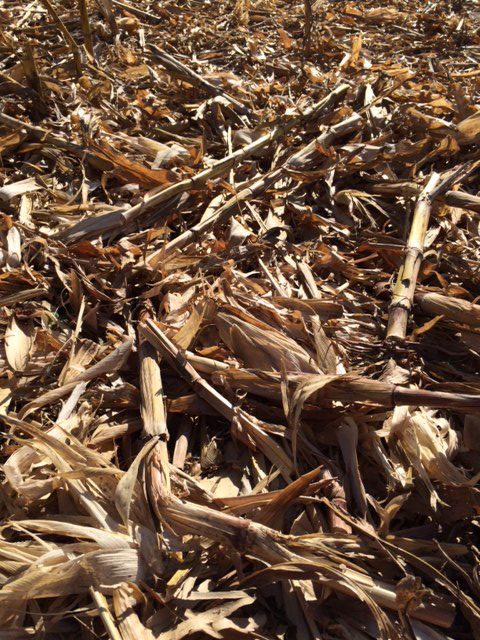
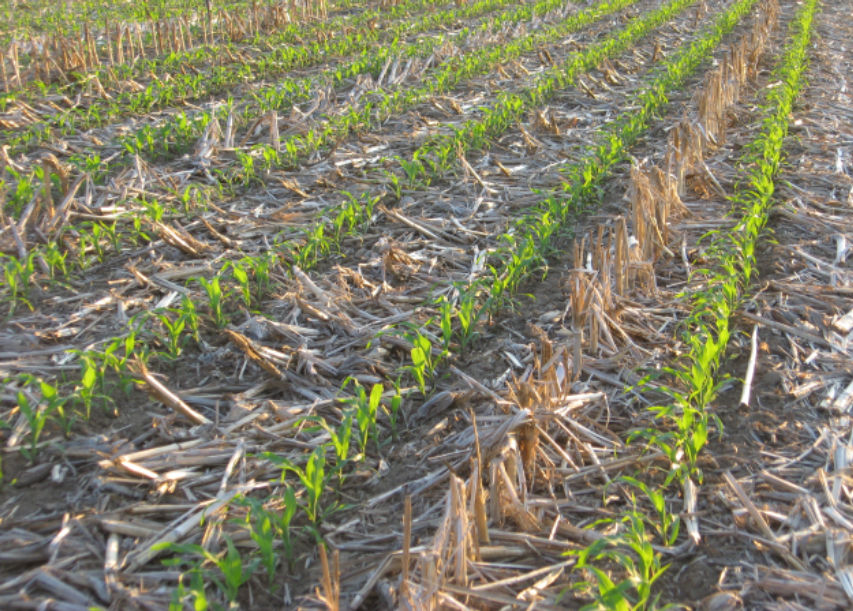
Tillage is used in crop production to incorporate crop residue in the soil where it can be broken down by soil organisms and release nutrients back into the soil. Incorporating crop residue also helps reduce the potential for a disease to infect a susceptible crop the following season by limiting the amount of crop residue available for pathogens to overwinter on. Tillage has the potential to expose the soil to wind and water erosion. To help limit erosion potential, conservation tillage practices such as no-till, strip -till, and limited-till can leave more crop residue on the soil surface or only partially bury the residue in the soil. In addition, tillage consumes carbon in the soil including soil organic matter (SOM). Stable organic matter, along with the associated microbial activity, benefits soil structure and soil physical properties by stabilizing soil colloids (water stable micro aggregates). Over time, reducing tillage may help increase SOM which can improve soil tilth, reduce soil compaction, and improve water holding capacity of the soil due to increased pore space. Increased water infiltration rates, improved root growth and productivity of the soil are several potential benefits of increasing pore space in the soil through reduced tillage. The benefits of leaving crop residue on the soil must be weighed against the potential for residue becoming a source of inoculum for several corn diseases during the following growing season. If opting for conservation tillage, then additional management decisions should be considered to manage increased potential for disease pressure.
Crop Residue Management for Seedling Rots and Blights
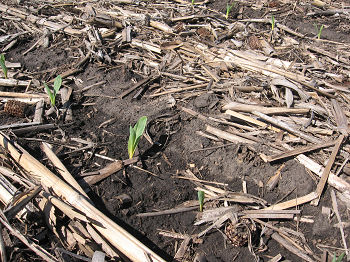
Seedling rots and blights, commonly known as damping off diseases, can reduce corn stands, especially in continuous corn production. Damping off disease incidence increases when corn is trying to emerge during cool, wet, and compacted soil conditions. Common pathogens that can cause damping off include Pythium, Fusarium, Rhizoctonia and Penicillium, which all survive on crop residue.2 A heavy cover of corn residue on the soil can delay soil warming and contribute to increased pathogen inoculum. Postemergence damping off causes plants to appear yellow and wilted with decay on the seminal and nodal roots. Fusarium and anthracnose can cause early season crown rot injury which can later show up as stalk rot pre-harvest. Acceleron® Solutions Offering Products for corn can help provide protection against soil and seedborne diseases, including Fusarium, Rhizoctonia, and Pythium. For more information about Acceleron® Corn Seed Protection Offering Products go to https://www.cropscience.bayer.us/seed-treatment/acceleron/corn.
Crop Residue Management for Foliar Diseases
Many important fungal foliar diseases in corn survive on crop residue. Historically, gray leaf spot has been central to this concern, but over the last few years tar spot has been a notable concern (Figure 4). Foliar diseases that overwinter in corn residue include anthracnose, northern corn leaf blight, tar spot, and gray leaf spot.1 Ways to control these foliar diseases include tillage, selecting resistant corn products, managing crop residue, crop rotation, and applying foliar fungicide when needed.
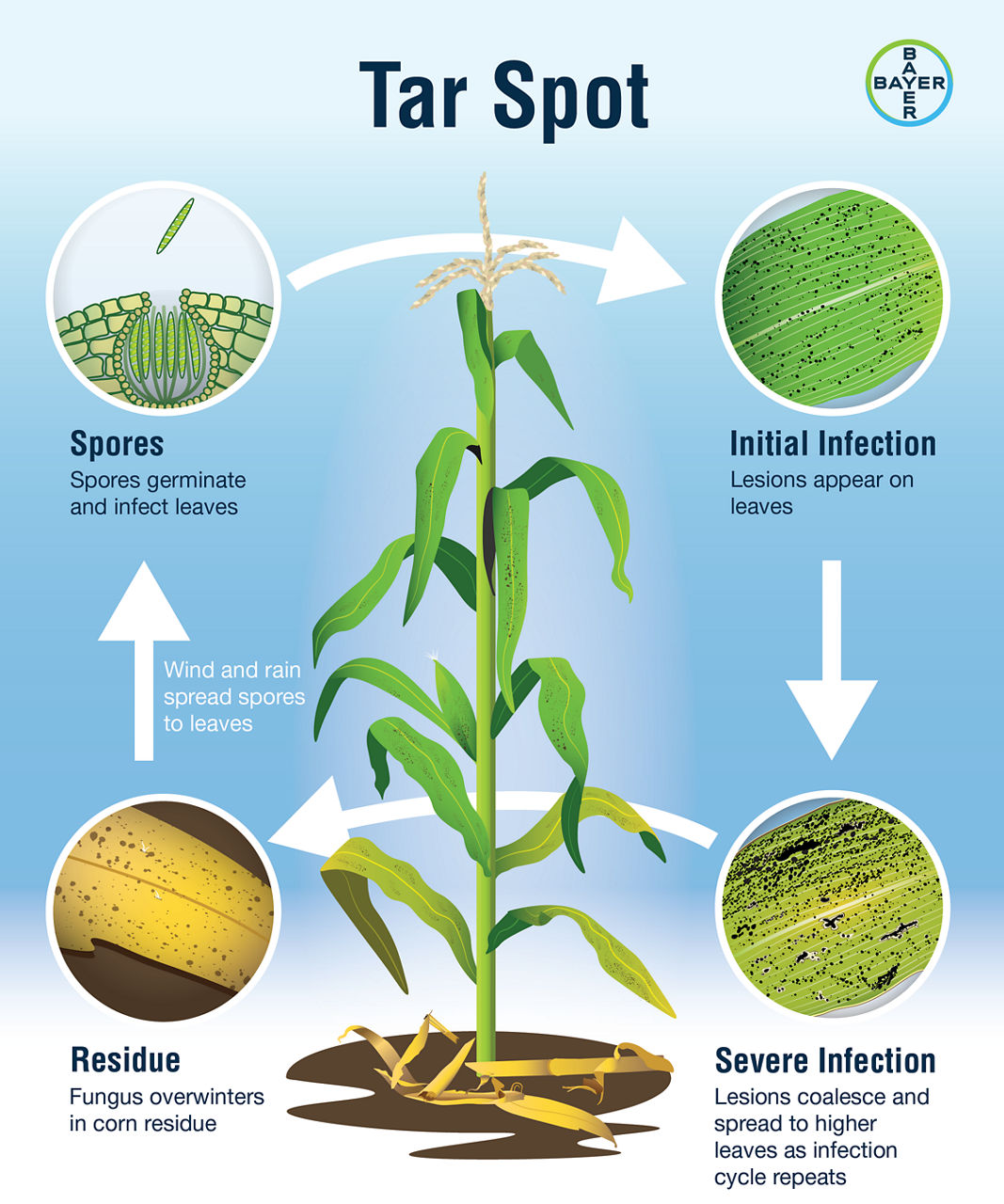
The inoculum level for foliar diseases will be greater in continuous corn fields, especially in fields with corn residue on the soil surface and where foliar diseases were a problem the previous season. As described in Figure 4, infection occurs when spores move from corn crop residue onto susceptible corn leaves, either by rain splash or wind. Many foliar diseases have a latent period of one to two weeks after initial infection before lesions appear depending on the disease and environmental conditions. Optimum temperature for disease development can vary by disease. Northern corn leaf blight infection is favored by wet, humid conditions with moderate to hot temperatures (64 to 81 °F) whereas tar spot favors cooler temperatures (60 to 70 °F). 3,4 Dry weather often slows the development of disease. Scouting is critical to ensure the correct identification of the foliar disease, and the correct fungicide product applied, if warranted. For more information about the use of fungicides for the control of corn diseases, please see How do fungicides help to reduce disease pressure in corn?
Crop Residue Management for Corn Stalk Rot
All major stalk rot pathogens overwinter on corn crop residue. This includes anthracnose, Fusarium, Gibberella, Diplodia, and charcoal stalk rots.1 Any production system that does not incorporate residue into the soil can increase the potential for stalk rot issues in corn-on-corn production. These pathogens use several pathways to infect the stalk including entry through the root systems which can happen during early growth stages of plant development. Physiological stalk rot is caused by stressful conditions that reduce photosynthesis and the production of carbohydrates during grain fill, predisposing corn to stalk rots. Cultural practices that help reduce plant stress are the most common management tool used to limit physiological stalk rots. Common stressful conditions include drought, foliar disease, hail damage, inadequate or unbalanced nutrition, excessive plant population, soil compaction, poor soil drainage and insect feeding by corn borers and corn rootworm larvae. Selecting corn products that have protection from corn rootworm and corn borer as well as high ratings for stalk strength and disease tolerance can help limit stalk rot problems.
Crop Residue Management for Corn Ear Rot
Diseases like Fusarium, Diplodia, Aspergillus and Gibberella ear rots persist in corn residue and can produce toxic chemicals found on grain known as mycotoxins which can harm humans and livestock.5 Like the other diseases that persist in crop residue, tillage is the primary management option to reduce the inoculum that causes the disease. If using conservation tillage to grow continuous corn, then other management strategies should be used to reduce the occurrence of ear rots. Many ear rot problems occur when insects such as corn earworms, fall armyworms, western bean cutworms, and European corn borer feed on the ear tip. This feeding opens the ear tip to the pathogens that cause ear rots. One important control option is to reduce ear rots by planting Bt corn products that help protect the ear from worm feeding. There are various levels of protection available for worm feeding on the ear. Fungicides are available that are effective against some of the diseases that cause ear rot. Application should be timed during R1 though R2 to protect silks when they are emerging. If a fungicide application is planned for ear rot control it is always important to follow the label directions as some fungicides can increase toxin levels if applied at the wrong time. To limit the damage caused by ear rots scout and prioritize fields for early scheduled harvest when it is determined that 10% or more ears are infected. If corn has been damaged by ear rots and the grain is stored on the farm, it is important to dry the grain to less than 13% moisture and cool to less than 30 °F as quickly as possible after harvest, which will deter the spread of these diseases in the grain bin. Always store ear rot damage grain separate from non-damaged grain.5
Sources:
1Robertson, A. Potential disease problems in corn following corn. Iowa State University. Extension and Outreach, Integrated Crop Management. https://crops.extension.iastate.edu/encyclopedia/potential-disease-problems-corn-following-corn
2Mueller, N. and Jackson-Ziems, T. 2016. Seedling diseases developing in corn. CROPWATCH. University of Nebraska-Lincoln. https://cropwatch.unl.edu/2016/seedling-diseases-developing-corn/#:~:text=Figure%201.,the%20healthy%20plant%20(right)
3Wise, K., Bergstrom, G., Price, T., Robertson, A. and Tenuta, A. 2023. An overview of Northern corn leaf blight. Crop Protection Network. A Product of Land Grant Universities. https://cropprotectionnetwork.org/publications/an-overview-of-northern-corn-leaf-blight
4Quinn, D., and Telenko, D. 2022. Tar spot of corn: What to know and new research. Purdue University. Extension Entomology. Pest & crop Newsletter. https://extension.entm.purdue.edu/newsletters/pestandcrop/article/tar-spot-of-corn-what-to-know-and-new-research
5Wise, Allen, T., Chilvers, M., et al. 2024. An overview of ear rots. Crop Protection Network. A Product of Land Grant Universities. https://cropprotectionnetwork.org/publications/an-overview-of-ear-rots
Websites verified 11/11/2025. 1211_176877
Disclaimer
ALWAYS READ AND FOLLOW GRAIN MARKETING AND ALL OTHER STEWARDSHIP PRACTICES AND PESTICIDE LABEL DIRECTIONS.