5 MIN READ
Cold Damage to Emerged Corn
September 9, 2025
Get Year-Round Updates From Our Agronomic Experts
Introduction to the Effects of Cold Temperatures on Corn Emergence
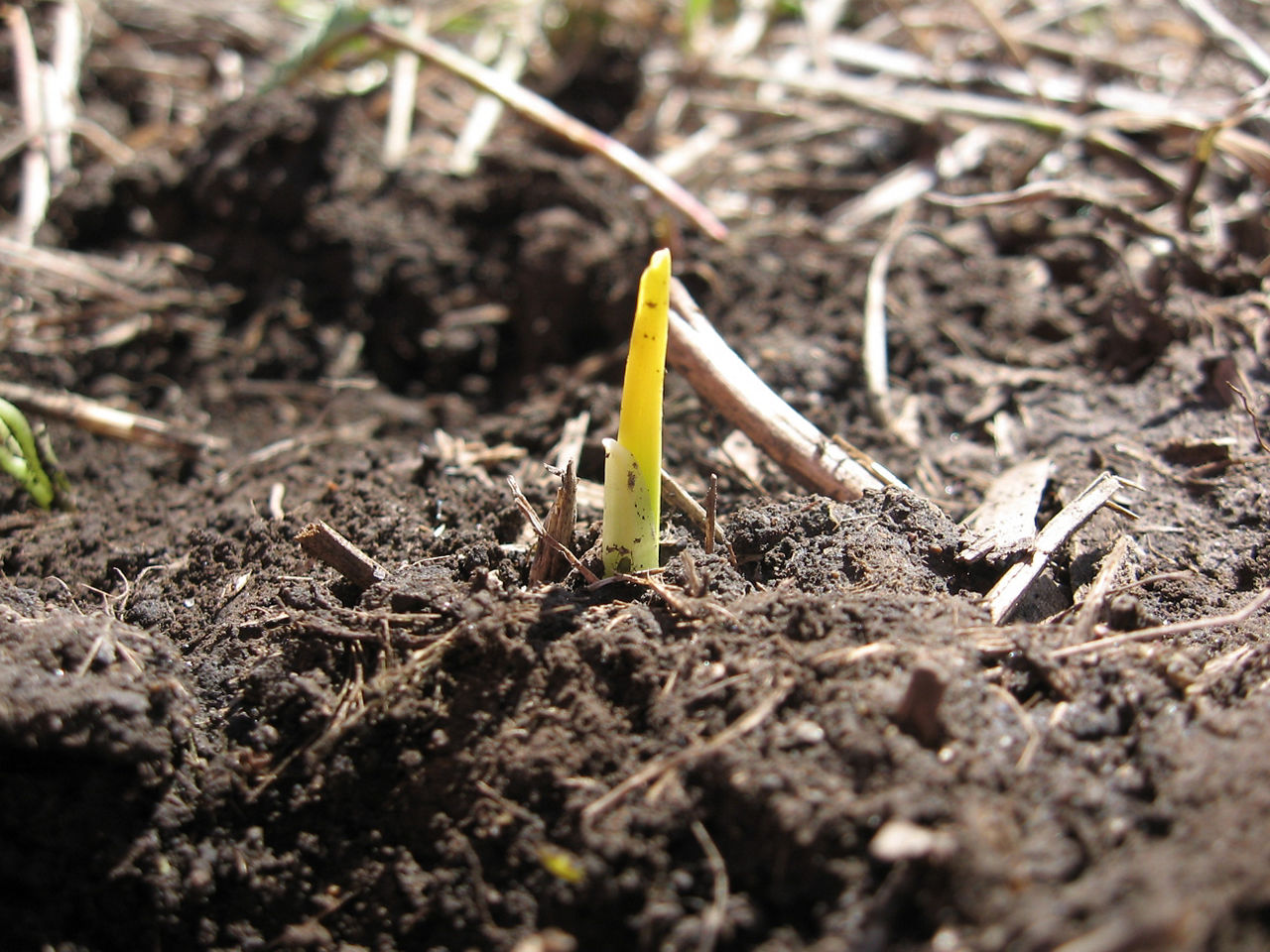
Cold air, water, and soil temperatures can all affect emerging corn seedlings. Cold temperatures can have different effects on individual plants in the same field, even plants that are side by side, because of microclimatic differences in soil condition, residue, air mass, and soil moisture. These effects can include visual changes to the emerging seedling, such as changes to leaf color, and slowed growing degree day accumulation after emergence. These effects should be considered when deciding whether or not to replant if a severe cold event occurs during corn seedling emergence.
How Do Air, Water, and Soil Temperatures Affect Corn Emergence?
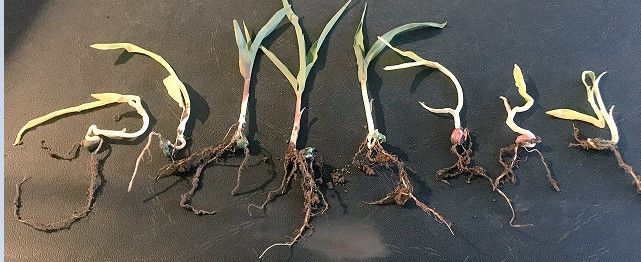
The air temperature after emergence can greatly affect corn seedling development. Moderately cold or warm temperatures can slow growth or increase growth, respectively. Very cold or very hot temperatures can be stressful and may cause plant death. Cold water filtering into the soil from rain or snowmelt can deform seedlings as they push through the soil or cause stress after emergence (Figure 2). In severe cases, cold water can result in seedling death, a phenomenon known as cold water shock or imbibitional chilling.
From the VE to V6 (six collared leaves) growth stages, the seedling growing point remains below the soil surface and is generally protected from freezing air temperatures.1,2 If the air temperature falls below 28°F(−2°C) for several hours, the growing point can be damaged or killed. While foliar injury or death can also occur when air temperatures remain above 28°F(−2°C), the growing point is usually protected by the warmth of the soil, which can allow new growth to appear within a few days.2 If this new growth occurs, dead leaves may constrict around the seedling, causing the new leaves to deform as they struggle to push through the dead tissue. This is one of several potential observable effects of cold on emerging seedlings.
Visual Effects of Cold Temperatures on Seedling Leaf Development
Leaf Discoloration
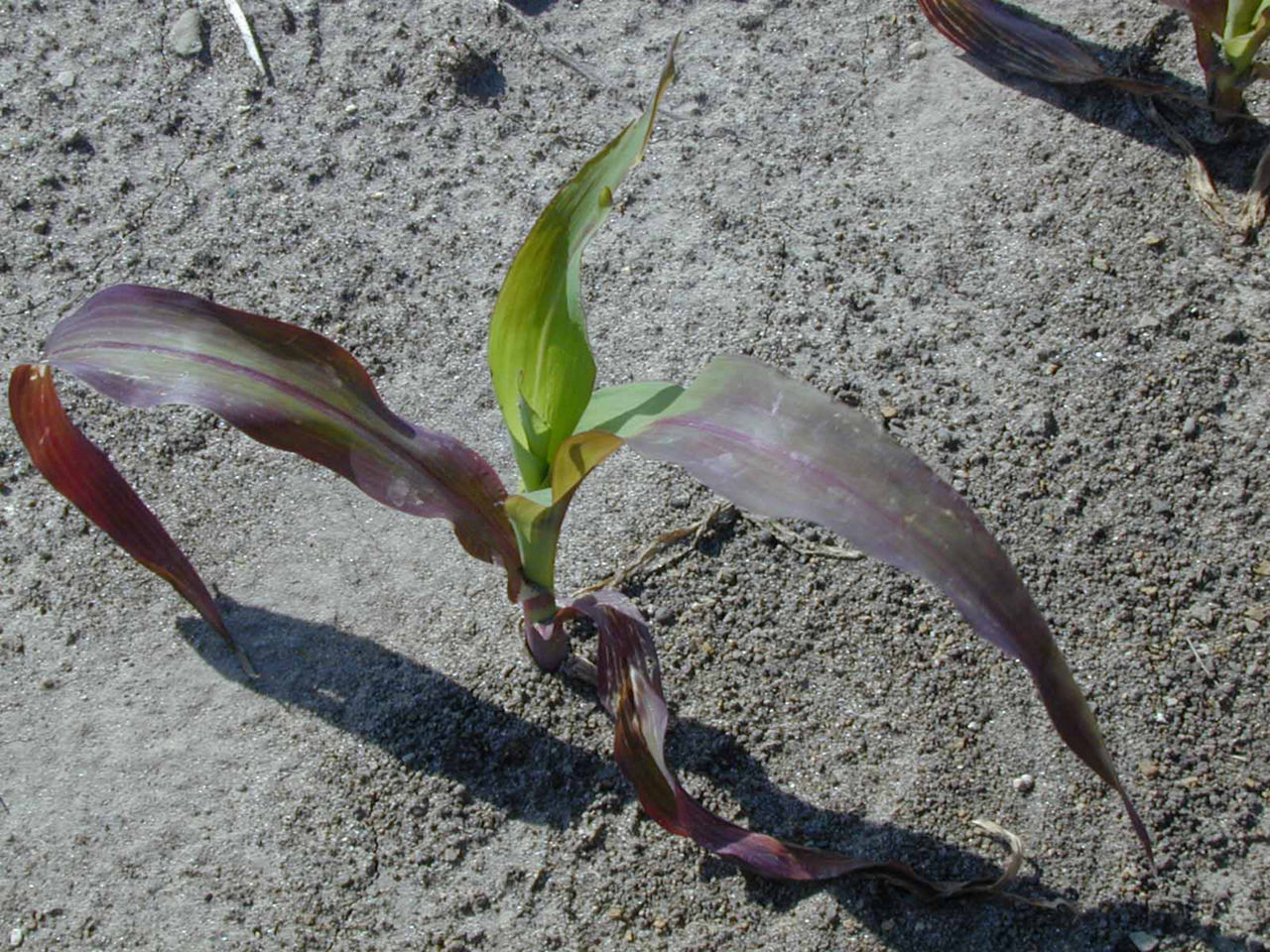
Leaf discolorations can vary after cold weather. Purple leaves may develop if bright, sunny conditions occur during the day and temperatures cool at night, as the weather causes the plant to accumulate reddish-purple anthocyanin pigments. Leaf purpling caused by changing temperatures will slowly disappear as temperatures warm, and not all corn plants will develop purple leaves even in these conditions, as some corn products are genetically incapable of producing anthocyanin.3
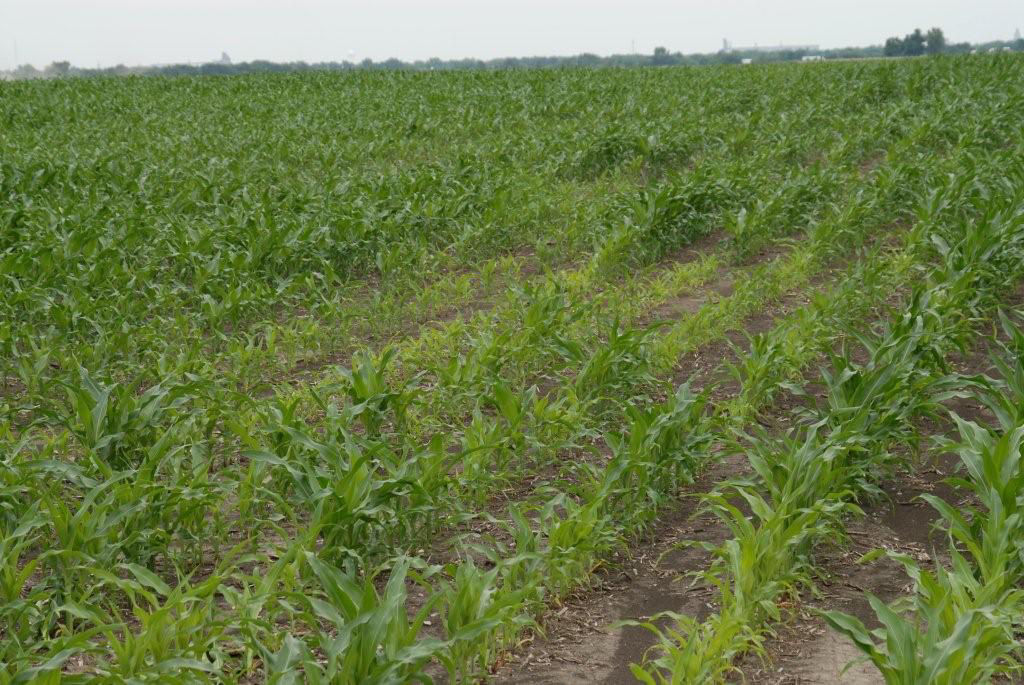
Yellow leaves can result from a combination of cloudy days and cool temperatures or may be caused by a reduction in nitrogen uptake due to poor root growth in cold, wet soils (Figure 4).
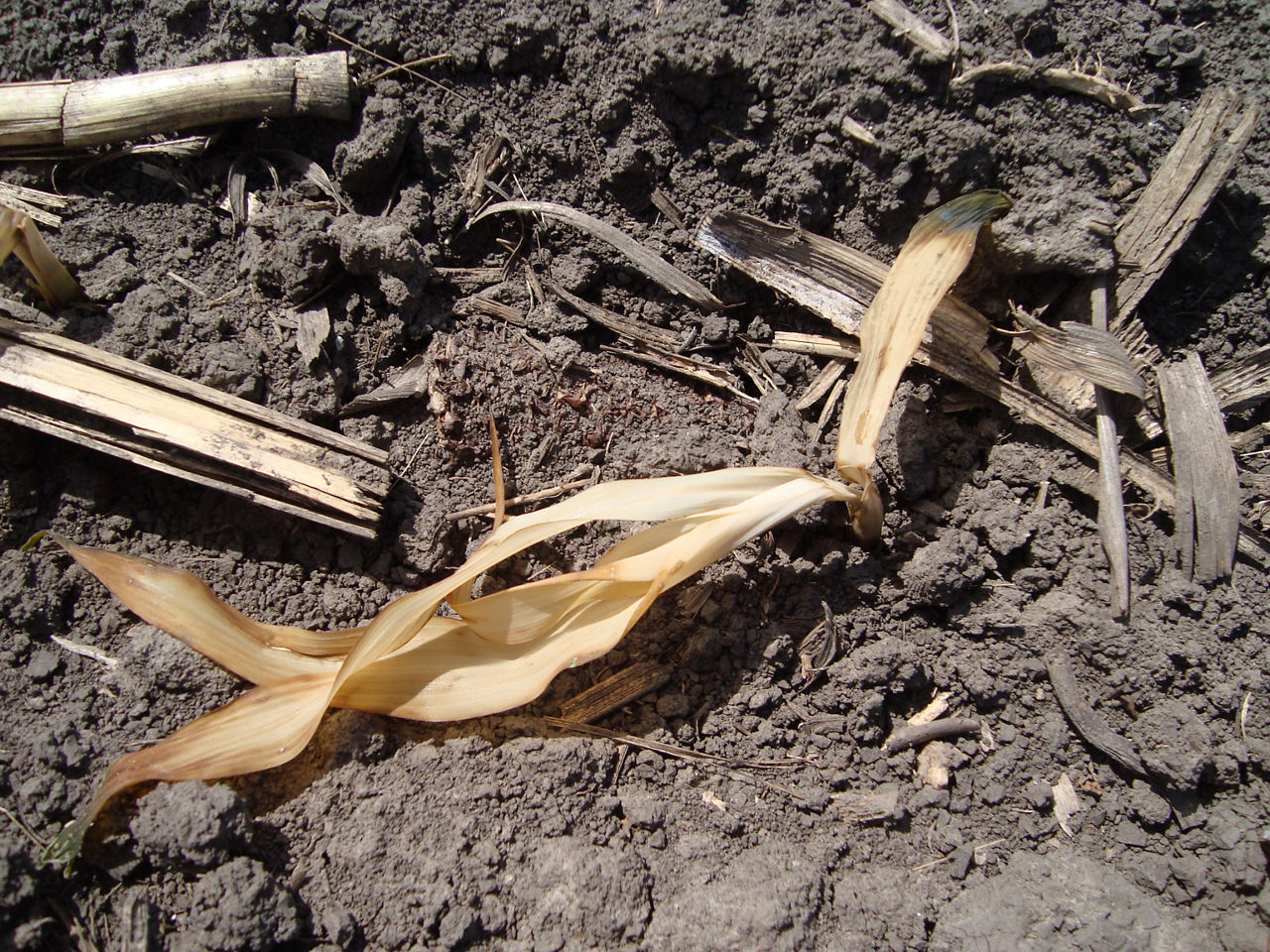
Brown leaves are likely dead. When brown leaves occur on emerging corn during cold temperatures, they indicate that temperatures were low enough to kill leaf tissue (Figure 5).
Leaf Scalding
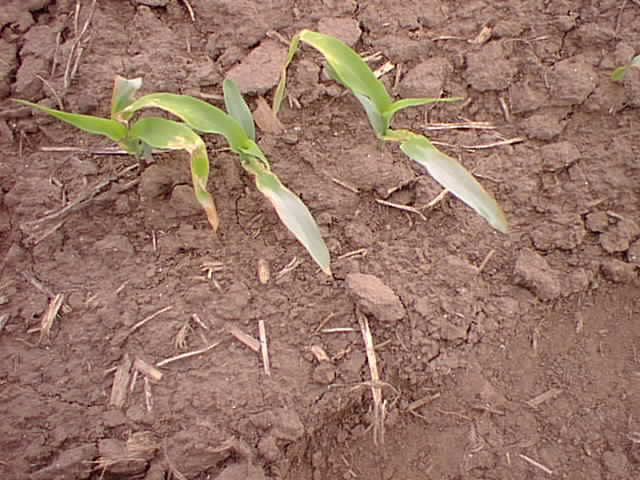
Leaf scalding is another phenomenon that can occur after a cool night. Overnight, cold temperatures can cause water droplets to condense on leaves. If the water droplets are then quickly warmed by bright sunshine before evaporating the next morning, the rapid increase in the temperature of the droplets may cause a silvery scalded appearance on the affected leaves (Figure 6).
The Effects of Air Temperature on Growing Degree Day Accumulation after Seedling Emergence
Growing degree days (GDDs) are calculated based on air temperature. Calculating GDDs is the most commonly used method to measure and predict corn growth.1 Research has shown that corn growth after emergence is very limited below 50°F (10°C) and slows above 86°F. Growing degree days are calculated using the average of the daily low temperature plus the daily high temperature, minus the base temperature of 50°F (10°C).
The formula for calculating growing degree days is:
GDD = ((Tmax + Tmin) ÷ 2) – Tbase
If the maximum temperature (Tmax) for the day is above 86°F (30°C), 86°F (30°C) is used. If the minimum temperature (Tmin) is lower than 50 °F (10°C), 50 °F (10°C) is used. Tbase is always 50°F (10°C).1
As an example, if the high temperature (Tmax) for the day was 76°F (24°C) and the low temperature (Tmin) was 48°F (9°C), the GDD calculation would be: ((76+50)÷2)–50=13 GDDs for the day.
Generally, GDDs accumulate slower with earlier planting dates and faster with later planting dates. However, long, cool periods can slow corn growth and extend the period between each growth stage. This can lead to misconceptions as to how “old” the plants are because of minimal growth, which may be a concern for herbicide applications.
An approximate calculation of maturity relative to a season-ending killing frost can be determined based on the GDD accumulation and the maturity of a corn product. A new web-based program developed by the Land-Grant Universities can help predict corn growth and development and is available at this site Corn Growing Degree Day Tool: Useful to Usable (U2U). Predicting corn flowering dates and maturity with the use of GDDs can be important when planting is delayed, or if replanting is being considered.
When to Assess Damage to Emerging Seedlings and Replanting Recommendations
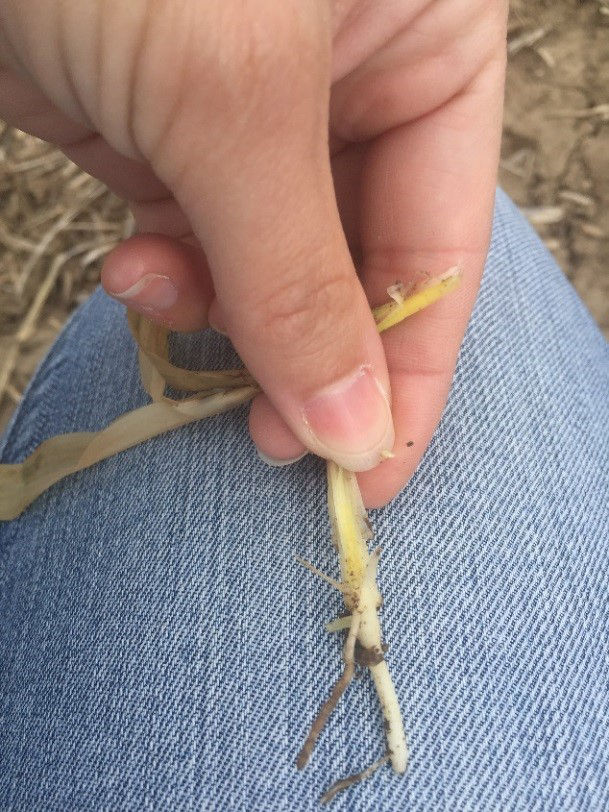
The current recommendation is to wait three to five days after a severe cold event before assessing plant injury.2 Plants may recover even if foliar tissue was killed, as long as the growing point was protected and is still alive (Figure 7). If new tissue appears within five days, the corn plants are recovering and replanting should not be considered as long as the surviving population is satisfactory.
Sources
1Lee, C. 2011. Corn growth stages and growing degree days: A quick reference guide. University of Kentucky College of Agriculture. AGR-202. https://publications.ca.uky.edu/agr-202
2Nielsen, R.L. 2002. Early season frost & low temperature damage to corn and soybean. Purdue University, Corny News Network Articles. https://www.agry.purdue.edu/ext/corn/news/articles.02/Frost_Freeze-0520.html
3Nielsen, R.L. 2022. Prevalent purple plants perennially puzzle producers. Corny News Network Articles. Purdue University. https://extension.entm.purdue.edu/newsletters/pestandcrop/article/prevalent-purple-plants-perennially-puzzle-producers/
Web sources verified 8/28/25. 1222_123686
Disclaimer
ALWAYS READ AND FOLLOW GRAIN MARKETING AND ALL OTHER STEWARDSHIP PRACTICES AND PESTICIDE LABEL DIRECTIONS.