Conditions Affecting Pre-emergent and Residual Herbicide Activation
June 4, 2026
Get Year-Round Updates From Our Agronomic Experts
Key Takeaways
- Half an inch to one inch of precipitation within seven to 10 days of PRE herbicide application activates many residual herbicides, although the exact amount of water needed can vary by active ingredient, formulation, and soil conditions.
- Delayed or reduced activation can reduce the effectiveness of residual or PRE herbicides, even when products are applied correctly.
- The quantity and timing of precipitation or irrigation after a herbicide application are critical for its effectiveness. Too little moisture can delay activation; too much rainfall shortly after application can increase the risk of movement below the target zone.
Activation of Soil-Applied Residual Herbicides
Residual (PRE) herbicides act when they are absorbed by plants vulnerable to their active ingredients. To activate and reach full effectiveness, PRE herbicides must:
- Reach the rooting zone where weed seeds are present, usually the top 0.25 to 0.75 inch of soil, and—
- Be absorbed by weed seedlings.
Activation requires about half an inch to one inch of rainfall within seven to 10 days of application, either from precipitation or irrigation, both to move the active ingredient to the correct depth and to mix it into a solution that weeds can absorb from the soil.1,2 Even growers who use pre-plant incorporation (PPI) to mechanically place herbicide at the target soil depth require moisture to mix with the herbicide and suspend it in the soil in a form weed seedlings can absorb.
Both the quantity and the timing of moisture are critical factors influencing the effectiveness of a herbicide application. Insufficient or delayed moisture may cause the PRE herbicide to remain on the soil surface for too long, reducing its effectiveness as weeds emerge without absorbing it, while its active ingredients are broken down by sunlight and lost to off-target movement.2,3 Conversely, too much precipitation shortly after application increases the risk that the herbicide will be washed below the target depth.
Interactions Between Rainfall and Herbicide Selection
Product choice and rainfall or irrigation timing both interact to influence how well PRE herbicides help control early emerging weeds. Herbicide products differ in how easily they move with water (water solubility) and through soil (soil mobility), which affects their moisture requirements for activation.1,4 The higher the water solubility and soil mobility, the more likely a product is to move within the soil profile.
Generally, products that are more soluble or more mobile need less moisture to activate, while those that are less soluble or less mobile require more. Herbicides that move less easily are more likely to stay near the soil surface, which can slow activation—especially in dry conditions. Conversely, herbicides that move more easily tend to be more easily activated but may also have a higher risk of moving below the target zone if heavy rainfall occurs after application. For example, acetochlor is moderately soil-mobile and water-soluble. In the Midwest, acetochlor-based herbicides (e.g. Harness® herbicide) can provide several weeks of residual control.
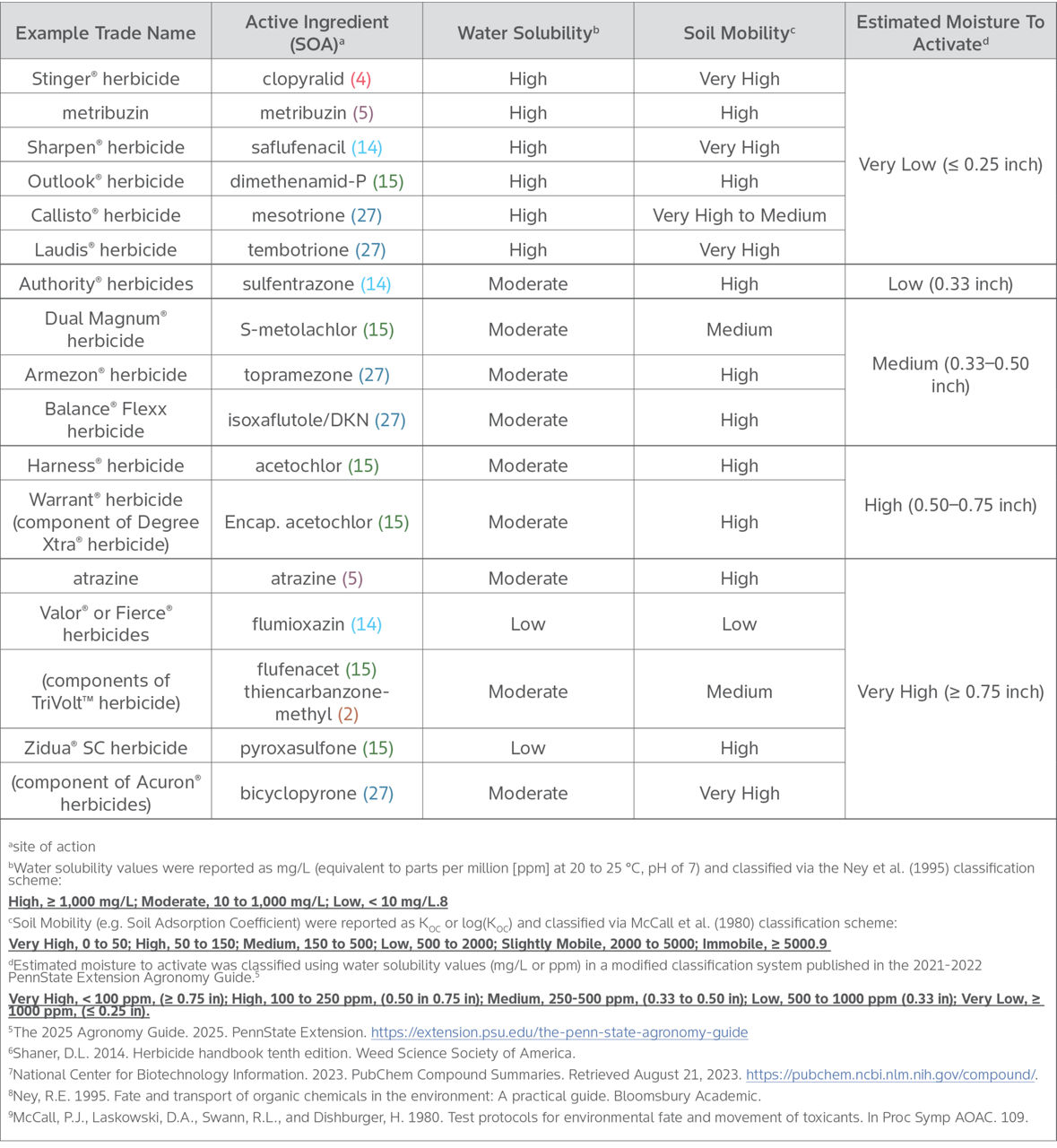
A summary of common soil-residual herbicides is provided in Table 1. Active ingredients were classified based on their water solubility and soil mobility using published classification guides. An estimate of moisture required for activation is also provided based on a scale published by Penn State Extension.5 Always read and follow all herbicide label directions.
Other Factors Influencing Residual Herbicide Performance
Along with the factors discussed above, several other factors can also influence the performance of soil-applied residual herbicides, especially under marginal moisture conditions.3
Soil
- Soil texture
- Soil organic matter (SOM) content
- Surface residue level (can intercept spray and slow movement to soil)
- Soil temperature (influences weed emergence rate and herbicide behavior)
Weed Species
- Seed size and planting depth
- Species-specific sensitivity (natural tolerance and/or resistance) to a given active ingredient
Herbicide
- Starting dose of the herbicide available
- Reactivation potential
- For example, herbicide products containing isoxaflutole (e.g. Balance® Flexx herbicide, Trivolt® herbicide) can reactivate with approximately half an inch of rain to control later-emerging weeds.
Always read and follow pesticide label directions. If you have any questions about your herbicide selection, please contact your local Bayer Crop Science Crop Protection representative.
Table 1. Water solubility and rainfall requirement estimates for common soil-residual herbicides used in either corn or soybean.6,7
Sources
1Butts, T., Pearson, A., Souza, M., and Cooper, E. 2025. Residual herbicides: Precipitation requirements for activation and the likelihood to receive it. Purdue University, Pest & Crop Newsletter. https://extension.entm.purdue.edu/newsletters/pestandcrop/article/residual-herbicides-precipitation-requirements-for-activation-and-the-likelihood-to-receive-it/
2Jones, E. and Rozeboom, P. 2025. Dry conditions may hinder the performance of recently applied preemergence herbicides. South Dakota State University Extension. https://extension.sdstate.edu/dry-conditions-may-hinder-performance-recently-applied-preemergence-herbicides
3Johnson, B. and Zimmer, M. 2022. Soil applied herbicides and rainfall for activation. Purdue University, Pest & Crop Newsletter. https://extension.entm.purdue.edu/newsletters/pestandcrop/article/soil-applied-herbicides-and-rainfall-for-activation-3/
42024. Water solubility. Oregon State University Extension Service, National Pesticide Information Center. https://www.npic.orst.edu/envir/watersol.html
5The 2025 Agronomy Guide. 2025. PennState Extension. https://extension.psu.edu/the-penn-state-agronomy-guide
6Shaner, D.L. 2014. Herbicide handbook tenth edition. Weed Science Society of America.
7National Center for Biotechnology Information. 2023. PubChem Compound Summaries. Retrieved August 21, 2023. https://pubchem.ncbi.nlm.nih.gov/compound/
8Ney, R.E. 1995. Fate and transport of organic chemicals in the environment: A practical guide. Bloomsbury Academic.
9McCall, P.J., Laskowski, D.A., Swann, R.L., and Dishburger, H. 1980. Test protocols for environmental fate and movement of toxicants. In Proc Symp AOAC. 109.
Web sources verified 05/20/26. 1123_289202
Disclaimer
ALWAYS READ AND FOLLOW GRAIN MARKETING AND ALL OTHER STEWARDSHIP PRACTICES AND PESTICIDE LABEL DIRECTIONS.