9 MIN READ
Corn Silage for Beef and Dairy Rations – Western US
May 21, 2026
Get Year-Round Updates From Our Agronomic Experts
- Agronomist and nutritionist duties are tied to one another and the herdsman.
- Several corn silage products can be grown to shape feed rations depending on milk productivity and weight gain goals of the herd.
- Harvest conditions, storage facilities, and quality analysis influence the corn silage feed ration.
Types of Corn Products Used for Silage Production
Flex-Acre Corn Silage Products
- Flex-acre corn products are evaluated for silage yield, whole plant digestibility, and starch along with the agronomic characteristics that are important for both grain corn and silage production.
- In addition to silage parameters, traditional tall corn-silage products are often developed with disease tolerance and insect resistance traits in mind for the corn-on-corn silage acre.
- Newer, short-statured corn products are also being developed for silage harvest. Short-statured corn silage products have dry matter yields, starch content, and digestibility comparable to tall-statured corn plants.1 Compared to brown mid-rib corn, short-statured corn is similar in dry matter yields and starch content. On a hybrid-by-hybrid basis, silage digestibility varies and short-statured corn is in some cases comparable to brown midrib corn.
Brown Midrib (BMR) Corn Products
- Brown midrib corn products were developed from a naturally occurring mutation discovered in dent corn in 1924.2 Insect and herbicide traits have been incorporated to modify BMR corn products.
- Named after the mid-rib/vein running down the center of leaves as it appears tinted brown instead of white.
- Contains immature lignin cells which increases digestibility and rate of passage.
- Brown midrib corn products are grown exclusively for silage production and are used to feed high producing dairy cattle.
Enogen® Feed Corn Products
- Enogen® Feed corn was developed to develop corn products for the ethanol industry.
- Alpha-amylase enzyme in grain portion of the plant allows complex carbohydrates such as starch and sugars to be converted to more available sugars.
- The improved carbohydrate digestibility is available right away without the entire ensiling process.
- There are additional stewardship requirements for these corn products to ensure that the end use of this corn remains in the cattle feed or ethanol industry.
Determining Whole Plant Dry Matter and Harvest Timing
A critical factor in putting up quality silage for beef or dairy rations is determining whole plant dry matter at harvest. The milk line or starch line in the kernel is often used to estimate whole plant moisture (Figure 1). However, using milk line as an indicator for whole plant moisture can be inaccurate which can cause the producer to put up the silage either too wet or too dry which and lower the quality of the silage.3,4 More accurate tools for measuring moisture content are a microwave oven, a drying oven, or a commercial forage moisture tester. The most important step when using any of these tools for estimating whole plant moisture is to use a representative sample from the field because the estimate is only as accurate as the samples taken. Whole plant moisture can vary depending on changing crop conditions, from one side of the field to the other or whenever a corn product change occurs. Silage corn should be harvested at a moisture content that ensures good storage and complete ensiling in the type of silo used for storage (Table 1).
Table 1. Target silage moisture for different storage structures.
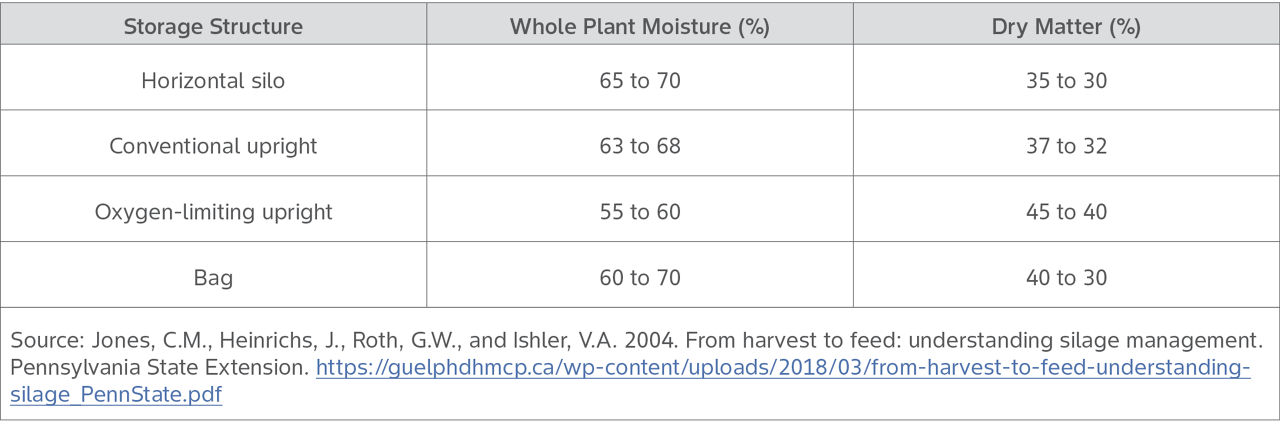
Silage ensiled too wet may ferment poorly and seep. Seepage removes nutrients, particularly soluble nitrogen and carbohydrates. Silage that is harvested when the whole plant moisture is too dry can have air pockets that prevent anaerobic fermentation and allow molds to develop. In addition, kernels become harder and less digestible.
Theoretical Length of Cut
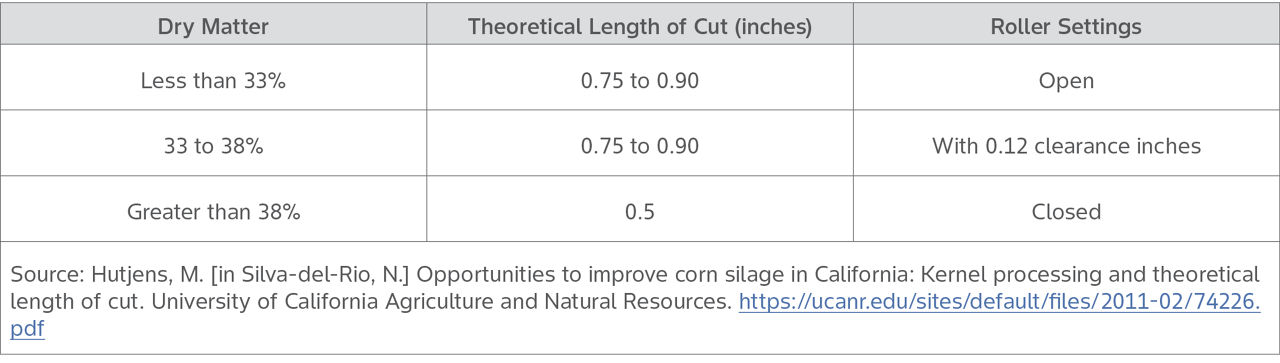
Theoretical length of cut (TLC) balances fiber for optical rumen function, packing, and fermentation.5 Adjustments to TLC are related to silage dry matter levels at harvest. Drier silage benefits from a shorter particle length to aid packing and fermentation. Longer particle lengths supply effective fiber for rumen function are needed when corn silage is the main roughage of a ration.
Table 2. Theoretical length of cut based on corn silage dry matter.
![Various stages of corn silage milk line.]](https://cs-assets.bayer.com/is/image/bayer/2021020401)
Kernel Processing
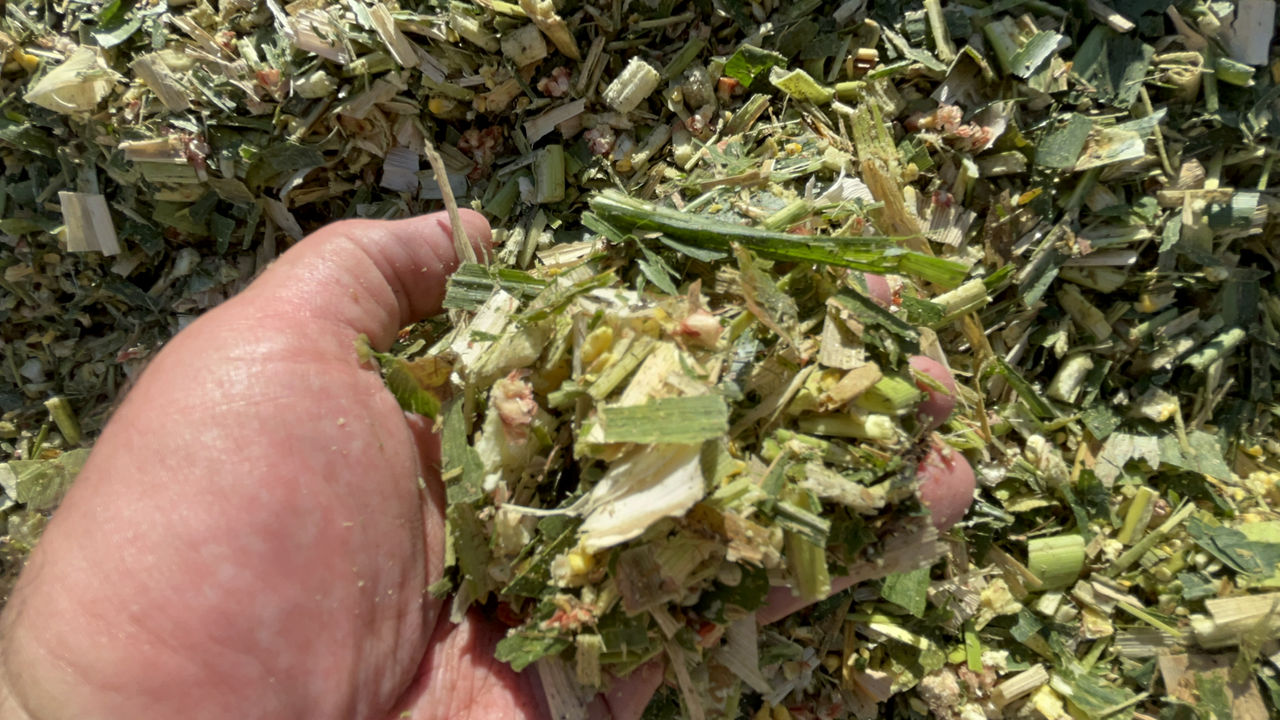
Corn silage kernel processing should result in improved starch utilization which can increase feed efficiencies and, in some cases, milk production.6 The kernel processor is mounted on the silage harvester and breaks up kernels into smaller pieces after the corn is chopped. This process opens the kernel up making starch more accessible to the digestive organisms in the rumen. This helps reduce the amount of starch eliminated through animal feces. Manure testing can evaluate starch amounts passing through livestock.
Laboratory Analyses for Silage Quality
While there are well over 30 different analyses that can be performed by commercial feed testing laboratories, there are four analyses important for comparing silage quality differences and for formulating a balanced cattle ration.
Dry Matter (DM)
- Everything (protein, fiber, fat, minerals) in the silage except water. In other words, total weight of feed minus weight of water in the silage.
- Harvest moisture targeted at 63 to 68% for upright silos and 60 to 70% for bags.4
- Target DM value between 30 to 40 percent, depending on moisture recommendation for storage unit.
Neutral Detergent Fiber (NDF)
- Residue or insoluble fraction remaining after boiling a feed sample in neutral detergent solution. The NDF is composed of plant cell wall components and some pectin.
- A close estimate of the total fiber constituents of the silage since it measures cellulose, hemicellulose, and lignin. As NDF rises, animals consume less silage. NDF generally increases with low grain silage, stress, or immaturity and can be an inverse predictor of intake.
- Target value between 41.3 and 54.1.6 It is expected ruminants consume a capped total of NDF near 1.2 percent of their body weight.8
In Vitro Neutral Detergent Fiber Digestibility (IVNDFD)
- Measures maximum potential digestion of the NDF portion. An in-vitro measurement (incubated in rumen fluid for 12, 24, 30, 48 hours).
- Higher values related to greater intake and more milk. Laboratory influences analysis, but a value less than the laboratory average indicates silage should be fed in lesser amounts. A greater than mean value indicates it can be fed at higher rates (a good option for early lactation cows).
- Target value varies depending on the average of the laboratory. A one percent unit change from laboratory-average increases dry matter intake by 0.26 lb/day.7
Starch
- A carbohydrate that is a polysaccharide composed of many glucose subunits and is a readily available source of energy.
- Higher levels may be better but would also require ration adjustments to avoid digestive upset and low energy intake. Silage with greater starch has lower NDF. If fiber is limited, supplementing could increase the cost of feeding this silage.
- Target value up to 35%.9 Lower values indicate poor grain fill on ears, higher values indicate overmature kernels.
Minimizing Silage Losses
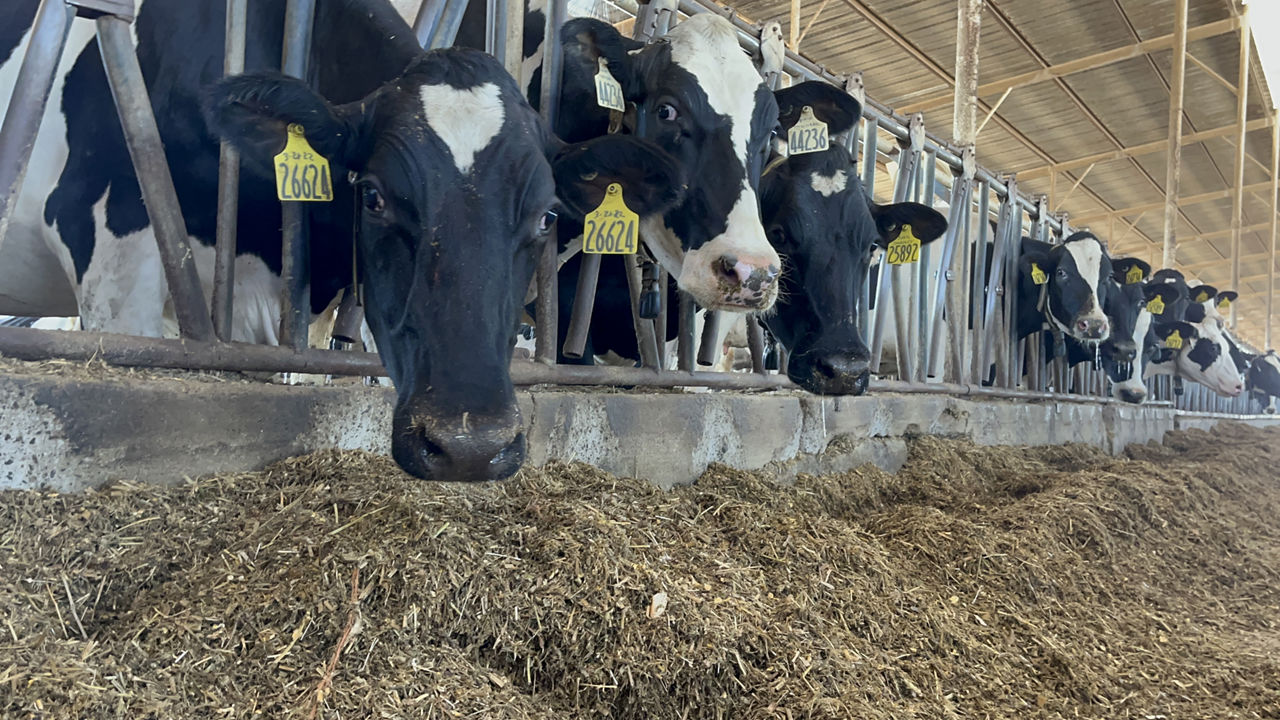
The most important practices for minimizing silage losses are to:
- Harvest at an appropriate dry matter
- Fill the silo quickly with appropriate packing
- Seal silage containers well
- Feed at an appropriate rate, while maintaining a firm silo face during feedout.
Sources
1[Badger Crop Connect]. Kaur, H. 2025. Agronomic fit of short corn as a BMR alternative [Video]. YouTube. University of Wisconsin-Madison. https://cropsandsoils.extension.wisc.edu/articles/the-agronomic-fit-of-short-corn-as-a-bmr-alternative/
2Lauer, J. and Coors, J. 1997. Brown midrib corn. Agronomy Advice. University of Wisconsin-Madison. https://corn.agronomy.wisc.edu/AA/A011.aspx
3Lauer, J. 1999. Kernel milkline: How should we use it for harvesting silage? Agronomy Advice. University of Wisconsin-Madison. https://corn.agronomy.wisc.edu/AA/A023.aspx
4Jones, C.M, Heinrichs, J., Roth, G.W., and Ishler, V.A. 2023. From harvest to feed: understanding silage management. Pennsylvania State University. https://extension.psu.edu/from-harvest-to-feed-understanding-silage-management#section-33
5Hutjens, M. [in Silva del Rio, N.] Harvesting corn silage: kernel processing and theoretical length of cut. University of California Agriculture and Natural Resources.
6Roth, G.W. and Heinrichs, J. 2001. Corn silage production and management. Pennsylvania State University. https://extension.psu.edu/corn-silage-production-and-management
7Shaver, R. 2007. Evaluating corn silage quality for dairy cattle. University of Wisconsin-Madison. https://fyi.extension.wisc.edu/forage/evaluating-corn-silage-quality-for-dairy-cattle/
8Garcia, A., Thiex, N., Kalscheur, K., and Tjardes, K. 2003. Interpreting corn silage analysis. South Dakota State University. ExEx 4027. https://openprairie.sdstate.edu/cgi/viewcontent.cgi?article=1124&context=extension_extra
9 Quality and feeding. University of Wisconsin. https://corn.agronomy.wisc.edu/Silage/
Web sources verified 2/26/26. 1210_90601
Disclaimer
ALWAYS READ AND FOLLOW GRAIN MARKETING AND ALL OTHER STEWARDSHIP PRACTICES AND PESTICIDE LABEL DIRECTIONS.