5 MIN READ
Drought Effects on Nitrogen Availability in Corn
July 20, 2026
Get Year-Round Updates From Our Agronomic Experts
Drought and nitrogen (N) can affect the growth and development of corn either separately or in combination. Drought can have a strong impact on plant nutrient relations. Water (drought) and N stresses under field conditions are common and understanding the interaction of these two inputs is important for efficient corn production.
Timing of Nitrogen Uptake in Corn
Nitrogen is the most important nutrient in corn production. Corn takes up N from the soil throughout its active growth. The majority of N is taken up during vegetative growth with about two-thirds of the total N uptake completed by flowering or the R1 growth stage of corn. The highest rate of N uptake occurs during rapid vegetative growth when corn is in approximately the V10 through V14 growth stages. Nitrogen uptake prior to corn flowering is critical to support ear shoot development, kernel number, and potential kernel size. During reproductive growth or post-flowering, corn takes up the remaining of its total N and uses it for grain development.1
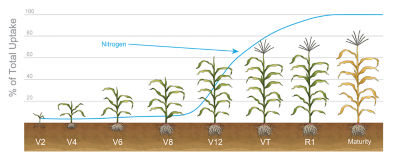
For additional information on nitrogen use by corn, please refer to Benefits of Nitrogen for Corn Production | Crop Science US
Drought Effects on Corn Yield Potential
Drought is one of the most common environmental stresses of plants and can negatively impact their growth, development, and reproduction. The amount of corn yield loss that occurs during dry weather depends on what stage the corn is in and how severe the dry conditions become. Drought conditions early in the season from emergence to the V8 corn growth stage can impact early root development and reduce plant size and leaf area available for photosynthesis. Extended drought conditions may result in leaf burning which can also reduce yield potential. Drought occurring during the V8 to V16 growth stages can reduce corn ear size and yield potential by 10 to 30 percent. The most drought sensitive corn growth stage is the R1 growth stage (silk) which can potentially result in severe yield reductions due to incomplete pollination and loss of kernel number. Drought during the reproductive growth stages affects kernel weight. Dry conditions immediately following silking has the largest impact, potentially reducing yield by 20 to 30 percent. Drought later in reproductive growth is less damaging but can hasten corn maturity.2
To find more information on the effects of drought stress on corn please go to Early-season Drought Stress in Corn | Crop Science US and Corn Grain Fill During Drought Stress | Crop Science US.
Effects of Drought Stress on Nitrogen Uptake by Corn
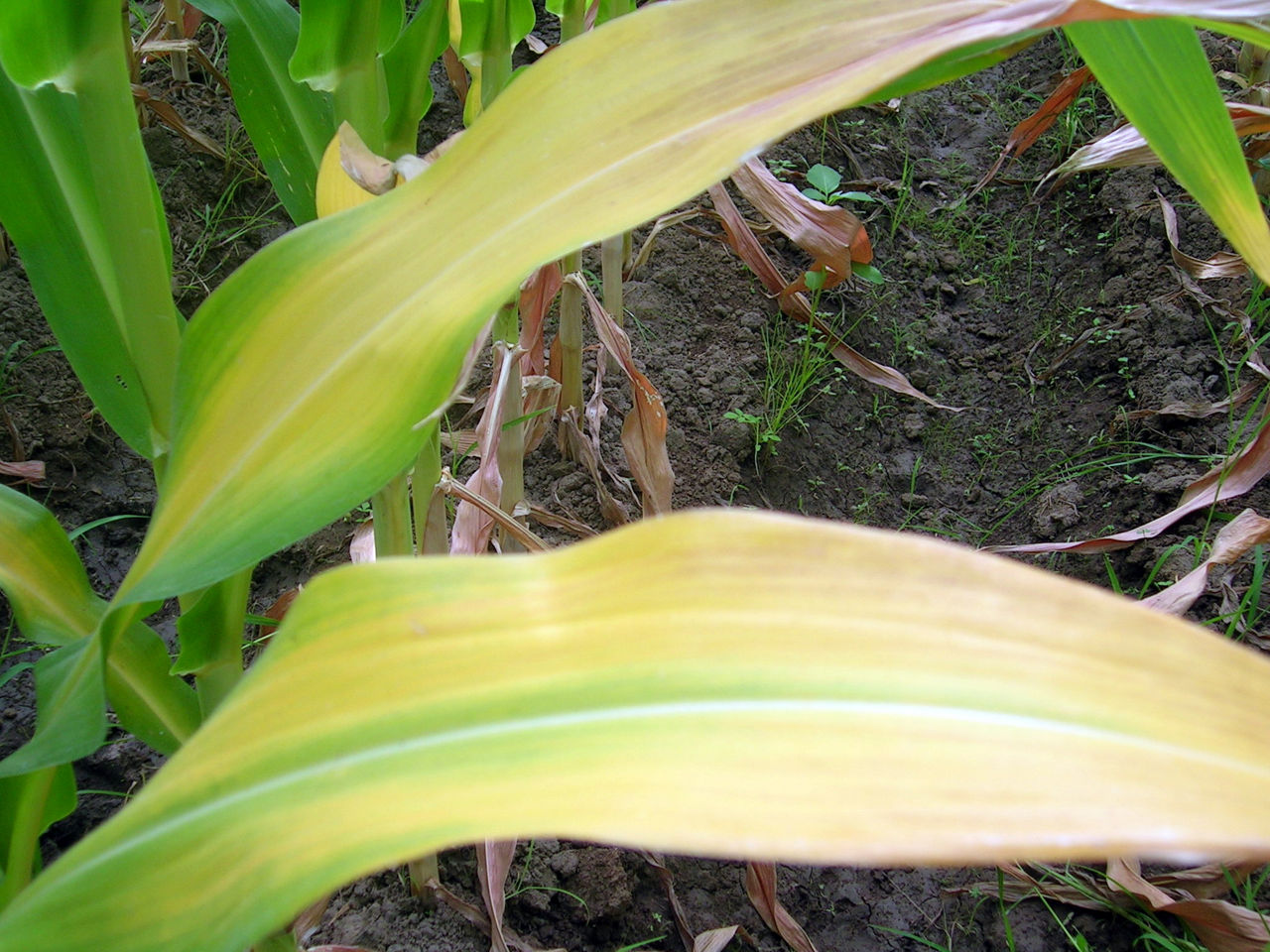
Drought stress can decrease N uptake from the soil and reduce the concentration of N in plant tissues.3 Nitrogen uptake in dry soil is reduced primarily by the inhibition of root growth along with a decrease in the movement of N in the soil to the root surfaces. Dry soil conditions can also reduce the rate at which mineralization of N from organic matter occurs. Severe drought can induce root shrinkage resulting in the loss of soil-root contact. Corn plants can quickly recover their ability to take up N after the rewetting of the soil, regardless of the length of time drought conditions occurred, through established older roots as well as the production of new roots. Mild drought stress can initially increase root growth; however, root growth can decrease as drought conditions become more severe or extended in the length of time. If moderate drought stress occurs during vegetative growth, rooting depth can also increase, allowing for more efficient uptake of water and nutrients from deeper within the soil profile. The uptake of N under dry conditions is also increased when soil N content is high. Nitrogen deficiency symptoms generally do not appear on corn under drought conditions with high N soil levels.
The response of corn to soil water availability is strongly dependent on N levels in the soil. Nitrogen deficient corn is more sensitive to water deficits than N sufficient corn. Both water (drought) and N stress can lengthen the time from emergence to tasseling and silking. Nitrogen stress delays tasseling, whereas drought stress delays both tasseling and silking. Severe drought stress in combination with low N reduces the amount of applied N taken up and accumulating in the crop. Reduced grain yield potential caused by drought is exacerbated by N deficiency. When N supply is limited, grain yield potential is more associated with N deficiency than drought stress, but with adequate N supply, drought stress is the main limiting factor.4
Management Tips to Maintain the Nitrogen Uptake Ability of Corn
Water and N inputs must be closely matched so efficient utilization of each input is realized. For a corn crop to take advantage of soil N, adequate water must be available. Both water and low N stress can lengthen the time from emergence to the VT growth stage. Low soil N availability substantially reduces leaf area due to reduced leaf size but may not affect the total number of leaves produced. The N accumulation rates for total biomass, grain yield, and N uptake can all interact with water and N.
A study examining the interaction of three soil water levels and two soil N levels found that water stress at vegetative stages with high N reduced both biomass (dry matter) and grain yield by about 20%, while rainfed conditions reduced biomass by about 66% and grain yield by 75%. Low N reduced biomass and yield with optimal irrigation. With high soil N, the efficiency of N use declined from 67% with optimal irrigation to as low as 26% in rainfed conditions. With severe water stress, the effects of low soil N become less evident.4 Management of irrigation (if available) frequency and the timing of N fertilizer application are important considerations to maintain nutrient uptake ability by corn plants growing under drought conditions.3
Many of the corn products today have improved stress tolerance and can be planted at higher seeding rates and are more efficient in taking up N compared to older products.5 They are able to maintain yield potential in the face of plant density stress and N stress. They can take up more N during reproductive growth, making it more advantageous to reserve some N applications for later in both optimum and adverse growing conditions. Drought-tolerant corn products can help reduce the risk of yield loss when drought occurs. DroughtGard® Hybrids corn products can help plants maintain growth when water is scarce, helping to support yield opportunity in dryland, limited irrigation or in well-watered conditions.
Sources
1Bender, R.R., Haegele, J.W., Ruffo, M.L., and Below, F.E. 2013. Modern corn hybrid’s nutrient uptake patterns. Better Crops. https://cropphysiology.web.illinois.edu/wp-content/uploads/2022/08/BenderHaegele2013NutrUptakeBetterCrops.pdf
2Heiniger, R. 2017. The impact of early drought on corn yield. North Carolina State University Extension. https://corn.ces.ncsu.edu/corn-production-information/the-impact-of-early-drought-on-corn-yield/
3Buljovcic, Z. and Engels, C. 2001. Nitrate uptake by maize roots during and after drought stress. Plant and Soil 229: 125-135.
4Bennett, J.M., Mutti, L.S.M., Rao, P.S.C., and Jones, J.W. 1989. Interactive effects of nitrogen and water stresses on biomass accumulation, nitrogen uptake, and seed yield of maize. Field Crops Research 19: 297-311. https://www.sciencedirect.com/science/article/abs/pii/0378429089901007
5Purdue University. 2016. Modern corn hybrids more resilient to nitrogen stress, crowded plant conditions. ScienceDaily®. https://www.sciencedaily.com/releases/2016/03/160309182807.htm.
Web sources verified 04/17/2026. 1221_126566
Disclaimer
ALWAYS READ AND FOLLOW GRAIN MARKETING AND ALL OTHER STEWARDSHIP PRACTICES AND PESTICIDE LABEL DIRECTIONS.