3 MIN READ
Early Season Insects of Soybean
April 14, 2026
Get Year-Round Updates From Our Agronomic Experts
- Early season insects can feed on soybean seeds and seedlings causing plant injury, stunting, delayed emergence, or stand loss.
- Scouting is necessary to determine the types of insects present and their population densities in order to make informed management decisions.
- Sampling methods include visual counts, soil sampling, and using baited traps.
Be on the Lookout for Early Season Soybean Insects
Early season soybean insects should be on a grower’s mind when examining seedling emergence and soybean stands in the spring. Early season insects of soybean feed on seeds and seedlings and can cause plant injury, stand loss, delayed emergence or stunting.
Early Season Soybean Insect Identification and Scouting
Bean leaf beetle (BLB). Adult BLB are about 1/4 inch in length. The most distinguishing characteristic is the presence of a small black triangle located at the base of the forewings. Some beetles have four black markings on their wings. Typically, the beetles are dark yellow but can range in hues of yellow, orange, and red. Early season injury to soybean is caused by the overwintered adults feeding on cotyledons, leaves, and stems (Figure 1). In addition, this pest can transmit bean pod mottle virus.1
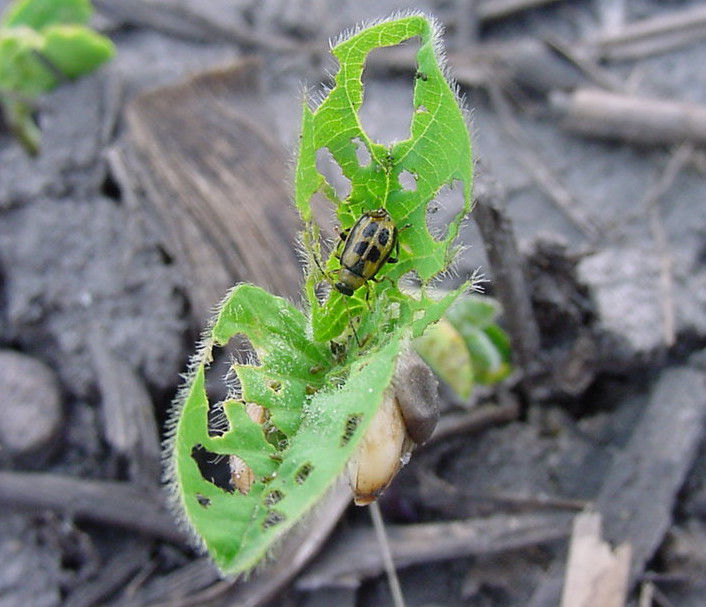
Bean leaf beetle scouting. Damage to young soybean plants by the adult beetle is usually due to feeding on cotyledons and leaves, so scouting should begin as soon as cotyledons have emerged and continue weekly. Count the number of adult beetles on the plants in several random locations throughout the field and assess the damage. For soybean seedlings, suggested economic thresholds include five or more beetles, or one damaged plant per foot of row.1 Observed stand losses of 30% due to cotyledon damage, or 30% defoliation may warrant treatment.2 Consult your local state extension service for thresholds specific to your location.
Wireworm. Wireworms (Figure 2) are the larvae of click beetles and can be problematic for a soybean crop, especially in fields previously planted to sod or small grains. Wireworms are hard-bodied, slender, brownish larvae that grow to about one inch long. They feed on seeds and small roots or other underground parts of seedlings, which can cause stunting or wilting leaving gaps in the stand.3
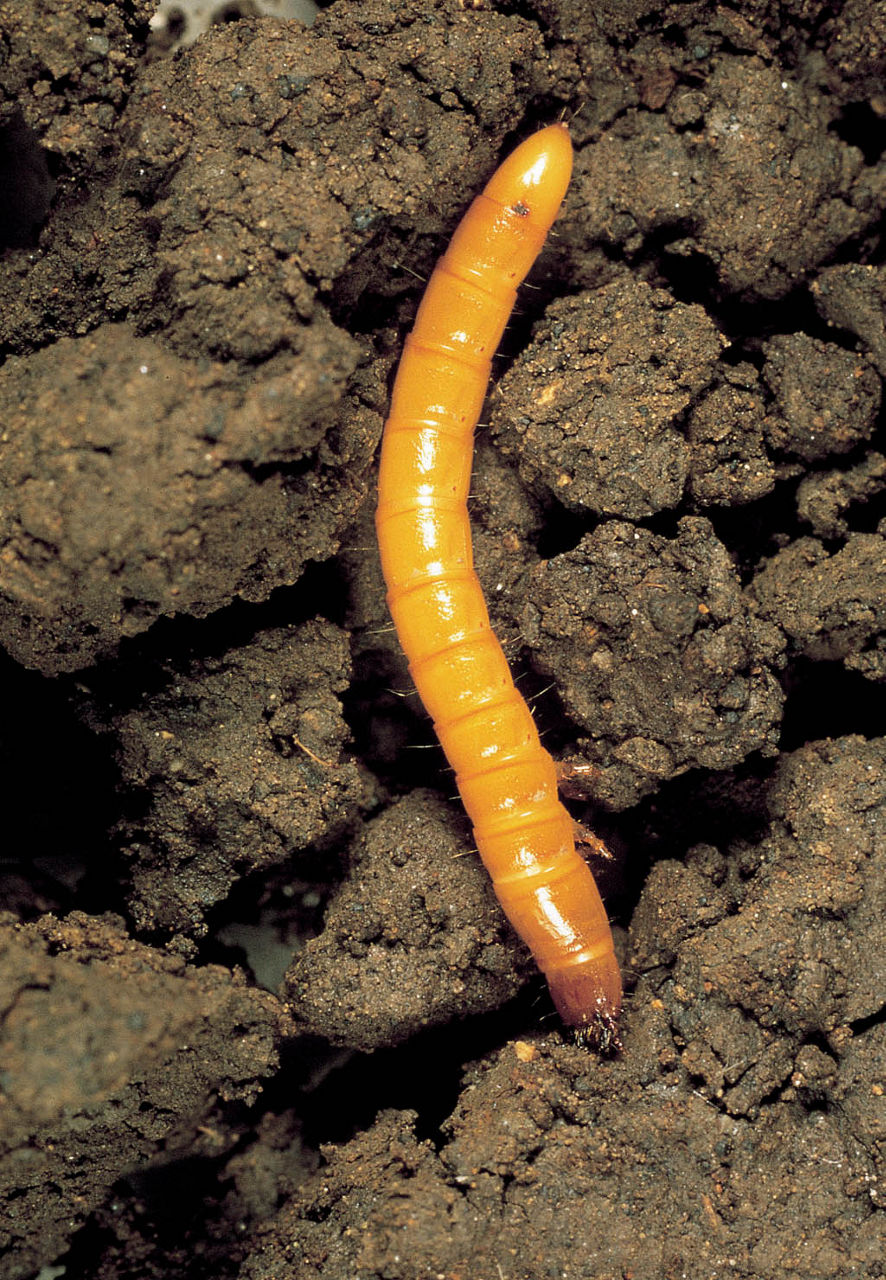
Determining the presence of wireworm. There are several methods that can be used to determine the presence of wireworm in a field. 1) Mix together approximately one-half cup each of untreated wheat and corn seeds (or one cup of white flour can be used as a substitute) and bury 6 to 12 inches deep in the soil. To increase soil temperature and facilitate germination, cover the trap with a piece of black plastic covered by a larger piece of clear plastic. Traps should be installed two to three weeks before planting and placed uniformly throughout the field. 2) An alternative method is to dig and examine a one-foot wide by two feet long by six-inch deep (one cubic foot) volume of soil. Sample in five randomly selected areas of the field a few days before planting.3 See Table 1 for treatment thresholds and recommendations.
White grub. True white grubs and masked chafer grubs can damage soybean seedlings by feeding on roots, especially when the soybean crop follows sod or a cover crop. They are the larvae of a scarab beetle which includes species such as Japanese beetles or May/June beetles. White grubs range in size from one-fourth to over one inch long and have white bodies with tan to brown heads (Figure 3). The pattern of rasters (bristle-like hairs) on the tip of the abdomen can help differentiate between white grub species.4
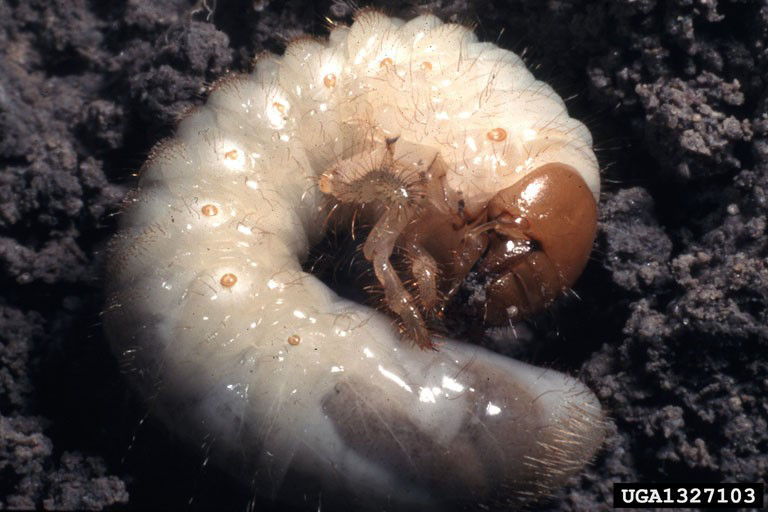
Examining a one cubic foot sample of soil, using the same method as described above for wireworm, can be used to determine the presence of white grub larvae. See Table 1 for treatment thresholds and recommendations.
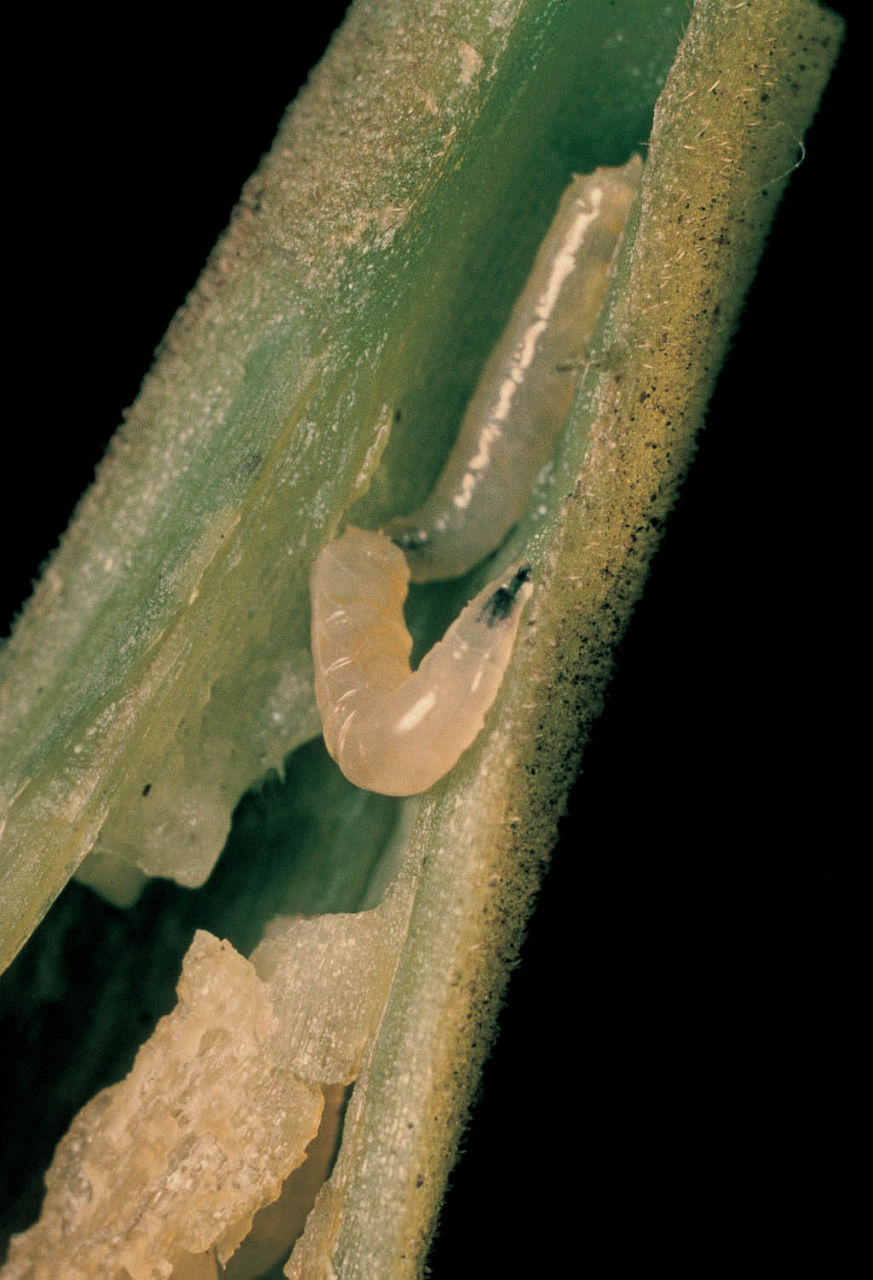
Seedcorn maggot. These maggots are yellowish-white, about 1/4 inch-long, and lack a defined head and legs (Figure 4). Seedcorn maggots feed on the germ of newly planted soybean seeds often resulting in gaps in the stand due to failed germination. Damaging infestations of seedcorn maggot usually occur in cool, wet springs in heavily manured or reduced tillage fields.5
Cutworm and armyworm. These caterpillars are generally 1 to 2 inches long. Cutworms can vary from gray to brown or black and marked with dark spots or lines (Figure 5). Various species of armyworms can feed on soybean seedlings often severing cotyledons or stems, and come in a range of colors, often with bright stripes down the body (Figure 6). Treatment thresholds have been primarily established for defoliation at later soybean growth stages.
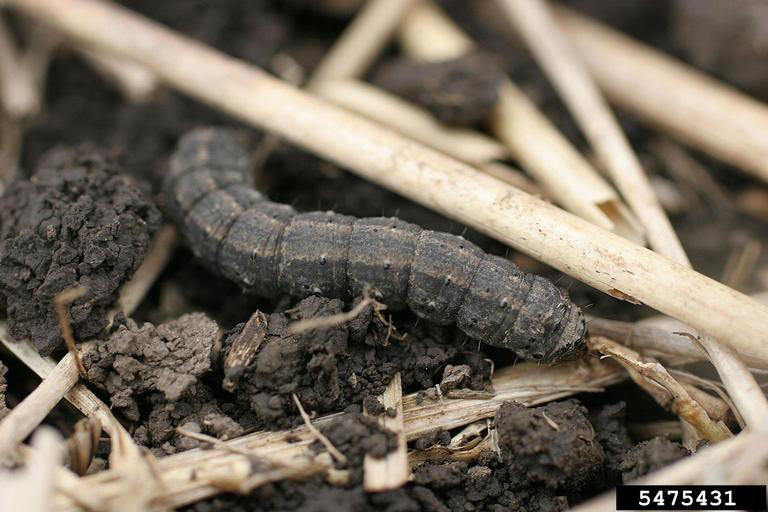
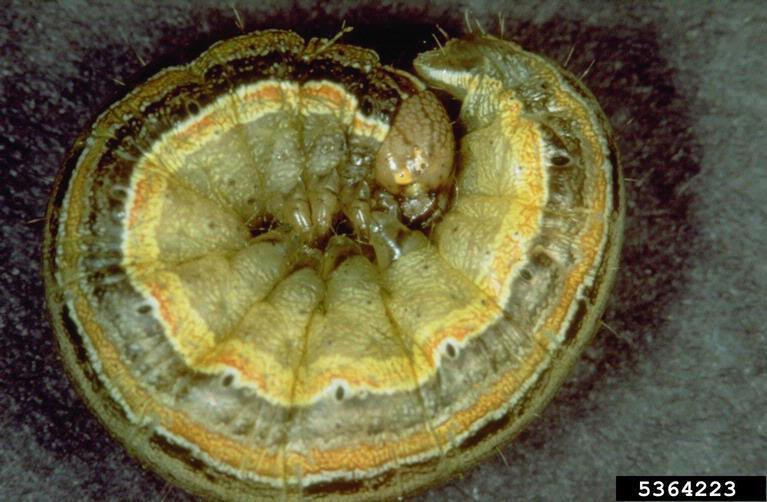
Cutworm and armyworm scouting. Beginning with seedling emergence, observe 20 plants in five different areas throughout the field for evidence of leaf feeding or cutting and measure the size of the worms. To find larvae during the day, dig 2 to 3 inches into the soil.
Soybean aphid (SBA). Soybean aphids are very small, less than one-sixteenth inch long, soft-bodied, and pear-shaped (Figure 7). They vary in color from pale yellow to light green with black cornicles, or “tailpipes,” on the back of the abdomen. Early season aphid feeding can lead to stunted plants with fewer nodes, which can result in fewer pods. Soybean aphids can also transmit virus diseases to soybean plants.6,7
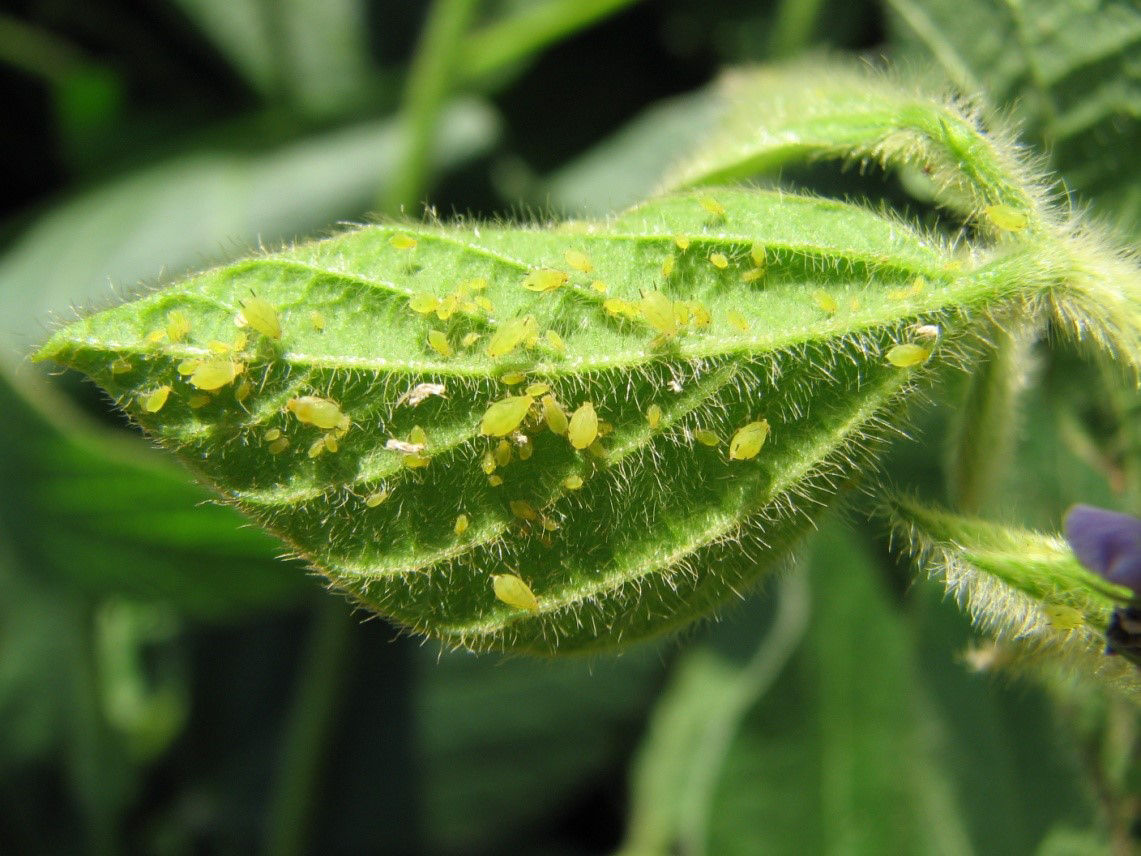
Early season soybean aphid scouting. Use a magnifying glass to inspect the undersides of the topmost trifoliate leaves where early season aphids are most likely to be found. Check 30 plants in 10 to 20 locations throughout the field on a weekly basis. Lady beetles are natural predators of aphids and may aid in finding early season aphid colonies while scouting.6,7
Early Season Soybean Insect Pest Management
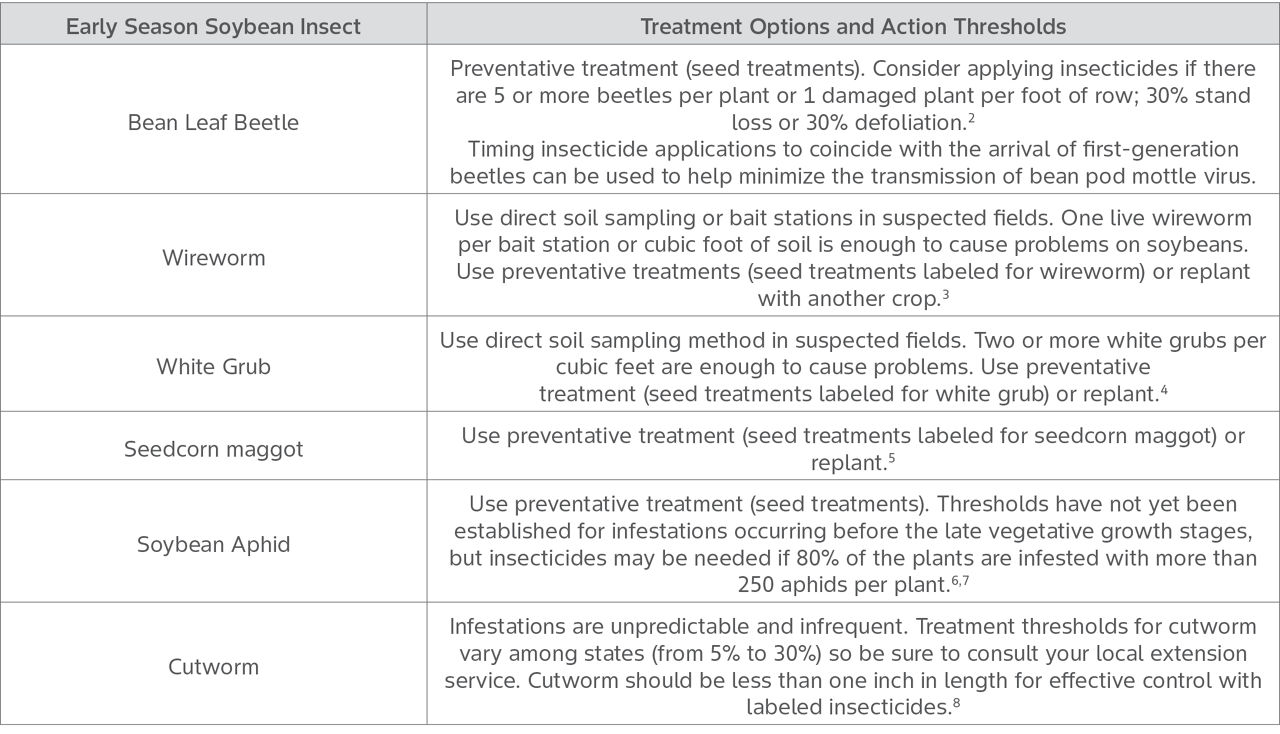
Preventative treatments, such as seed treatments, may be available to help provide above ground protection from early season BLB and SBA for up to 30 days after planting. After emergence, scouting can help determine if action thresholds are met and insecticide application is warranted. However, treatment action thresholds (Table 1) can vary by state, pest, and stage of crop development. Consult with an Extension entomologist and/or agronomist for local recommendation.
Preventative treatments, such as seed treatments, may be available to help provide above ground protection from early season BLB and SBA for up to 30 days after planting. After emergence, scouting can help determine if action thresholds are met and insecticide application is warranted. However, treatment action thresholds (Table 1) can vary by state, pest, and stage of crop development. Consult with an Extension entomologist and/or agronomist for local recommendation.
Table 1. Treatment recommendations and action thresholds for early season insects.
Sources
1Boyd, M.L. and Bailey, W.C. 2000. Soybean pest management: Bean leaf beetle. G7150. University of Missouri Extension. https://extension.missouri.edu/media/wysiwyg/Extensiondata/Pub/pdf/agguides/pests/g07150.pdf
2University of Kentucky Department of Entomology. 2025. Bean leaf beetle in soybeans. Integrated Pest Management Program. University of Kentucky. https://ipm.mgcafe.uky.edu/content/bean-leaf-beetle-soybeans?_gl=1*13tur07*_ga*NTkyNjA0MTg5LjE3NjcxMTYwODg.*_ga_Z0F2747JGH*czE3NjcxMTYwODckbzEkZzEkdDE3NjcxMTYxMzMkajE0JGwwJGgw
3Field Crops IPM. Wireworms (soybean). Purdue University Extension Entomology. https://ag.purdue.edu/department/entm/extension/field-crops-ipm/soybean/wireworms.html
4Field Crops IPM. White grubs (soybean). Purdue University Extension Entomology. https://ag.purdue.edu/department/entm/extension/field-crops-ipm/soybean/white-grubs.html
5Field Crops IPM. Seedcorn maggots (soybean). Purdue University Extension Entomology. https://ag.purdue.edu/department/entm/extension/field-crops-ipm/soybean/seedcorn-maggots.html
6Koch, R., and Potter, B. 2018. Scouting for soybean aphid. University of Minnesota Extension. https://extension.umn.edu/soybean-pest-management/scouting-soybean-aphid
7DiFonzo, C. 2009. Heavy soybean aphid infestations on early-season soybeans. Michigan State University. https://www.canr.msu.edu/fieldcropsent/uploads/files/14EarlySeasonSBA.pdf
8Soybean Research & Information Network. Cutworms. https://soybeanresearchinfo.com/soybean-pest/cutworms/
Web sources verified: 1-2-2026. 1315_126311
Disclaimer
ALWAYS READ AND FOLLOW GRAIN MARKETING AND ALL OTHER STEWARDSHIP PRACTICES AND PESTICIDE LABEL DIRECTIONS.