Evaluating Grain Sorghum Hail Damage
May 28, 2026
Get Year-Round Updates From Our Agronomic Experts
- Hail can severely damage young grain sorghum plants.
- In many cases, hail damaged grain sorghum can recover with little loss in yield potential.
- Grain sorghum plants surviving after a hail storm should be managed much like a normal crop.
- Hail damage may not be uniform across an entire field so multiple areas of a field should be evaluated.
Early Season Injury to Grain Sorghum by Hail
A hail storm in early spring can severely damage young grain sorghum plants. In some cases, entire plants can be broken off at ground level. Small sorghum plants that have their growing points below the soil surface can be very resilient and often are able to recover nearly all of the original yield potential. The growing point of grain sorghum is typically below ground until the five-leaf stage (with visible leaf collar), which occurs approximately 20 to 25 days following emergence and around a plant height of seven to nine inches.1,2
Knowing the Growth Stages of Grain Sorghum is Important When Evaluating Hail Damage
Making an accurate determination of the growth stage of grain sorghum is essential when evaluating potential yield loss from hail injury. Several online sources that can assist you in determining the growth stage of grain sorghum include Sorghum Growth Stages and MF3234 Sorghum Growth and Development poster from Kansas State University.
Locate and Evaluate the Growing Point of the Grain Sorghum Plant
As mentioned previously, hail damage prior to the growing point reaching the soil surface will likely be cosmetic and have little to no impact on yield potential. However, once the growing point reaches the surface, the potential for yield loss increases. To evaluate the growing point for older plants (six weeks or more), cut the stalk lengthwise and look at it. The growing point should be white and firm; if it is brown and mushy, it is not viable.
Evaluating Potential Grain Sorghum Yield Loss From Hail Due to Leaf Area Loss (Defoliation)
Immediately following a hail storm, the initial appearance of a tattered crop is usually at its worst and it may continue to look that way for several days. With sufficient sunshine, heat, and moisture, signs of recovery in the form of new growth may be seen three to four days after the storm event. After making an initial assessment of crop damage, it is highly recommended that farmers wait at least seven to 10 days before making a final evaluation. Like some other crop plants, grain sorghum does not need all of the leaf surface area it produces. Leaves that are shredded or broken are still capable of conducting some photosynthesis if they remain connected to the plant.
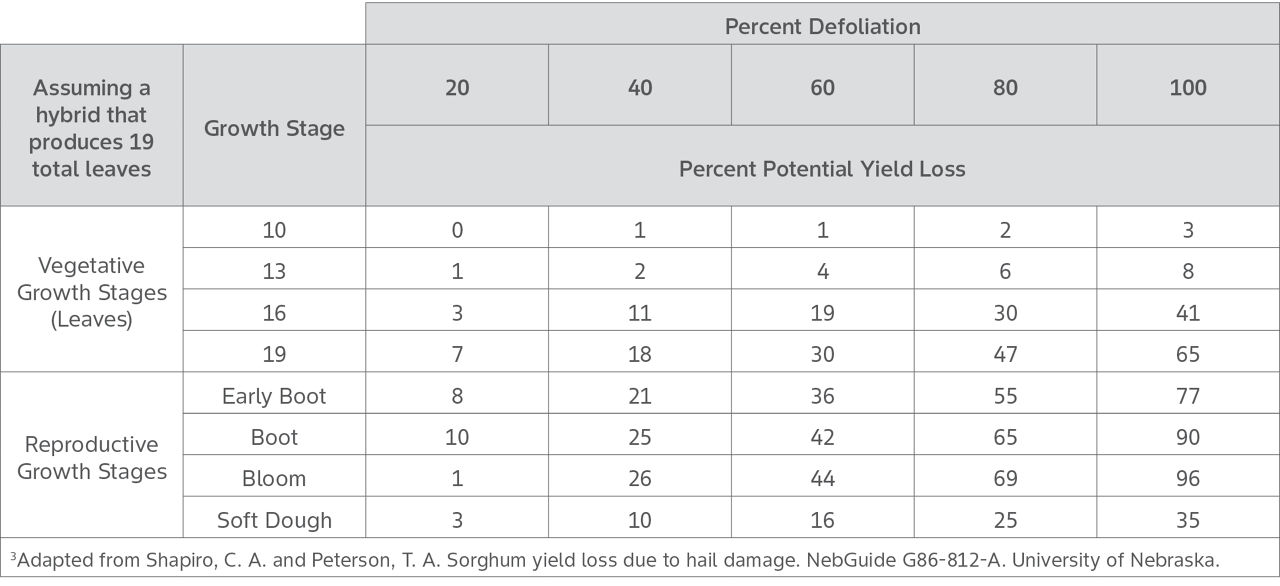
Table 1 illustrates that there is a rapid change in yield loss potential as the plant progresses from mid- to late-vegetative stages (13-leaf to 16-leaf). Yield losses from defoliation will likely be highest from the boot to bloom stages during the reproductive phases of growth and then decline as the plant approaches physiological maturity.3
Table 1. Potential percent gross yield loss from defoliation of grain sorghum at various growth stages.
Evaluating Potential Grain Sorghum Yield Loss from Hail Damage Due to Stand Reduction (Population)
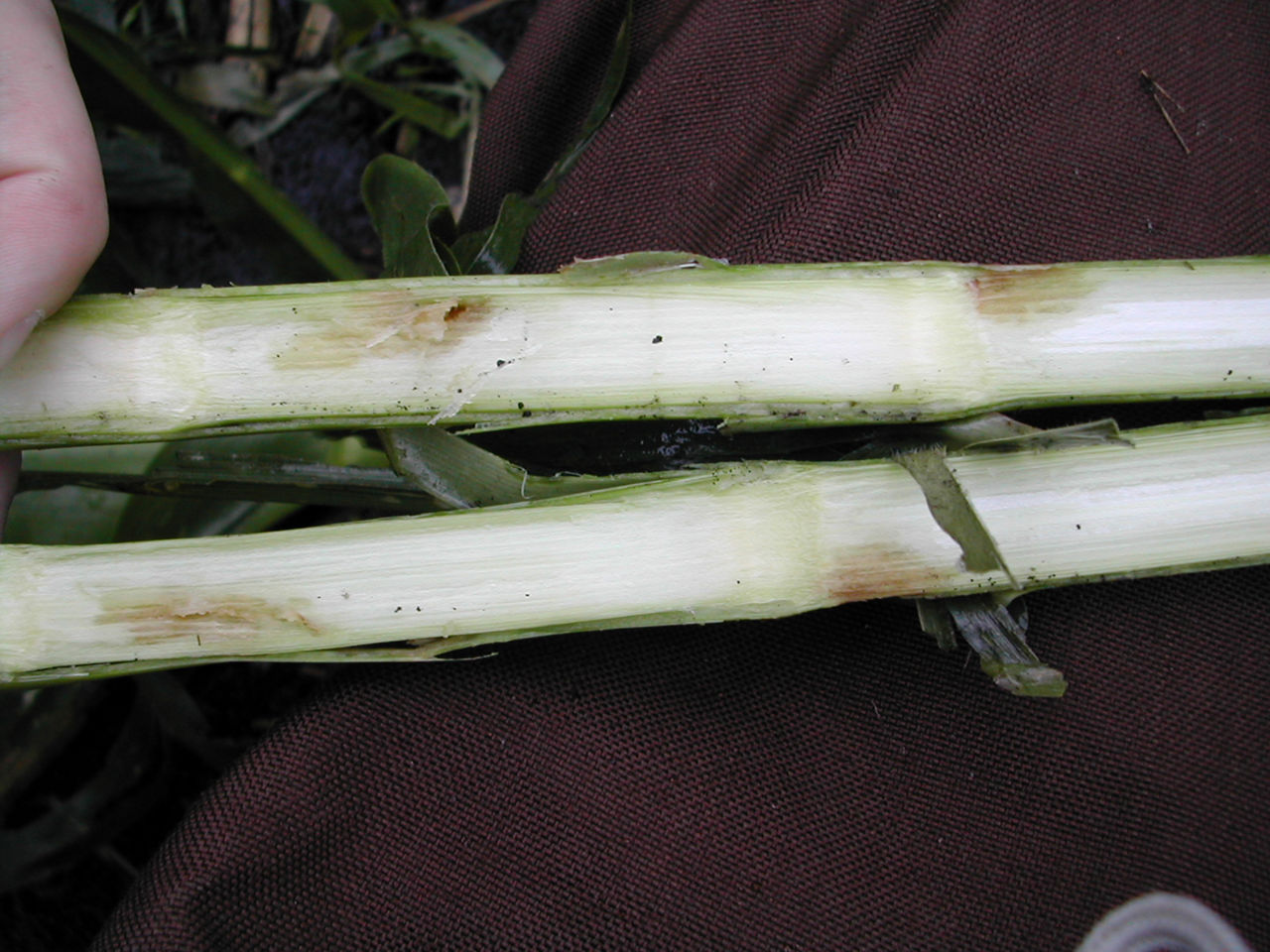
Evaluating a grain sorghum stand for potential losses can be difficult because hail—especially when driven by wind—can cause stalk bruising, which appears as a discoloration of the interior stalk tissue (Figure 1). Minor bruising can result in the scarring of leaf sheaths but does not cause internal injury to the stalk. More serious, deeper bruising may not kill the stalk either; however, it can lead to lodging later in the season. If stand loss occurs early in the season, sorghum can compensate through its ability to produce tillers which can contribute to yield. If stand loss occurs later in the season, tillers may not reach physiological maturity at the same time as the main stalk, reducing their ability to contribute to yield. If stand loss occurs at a time when yield components are still being set, some yield compensation can occur due to the sorghum plant’s ability to adjust the potential number of kernels in the panicle.1
When sorghum is between the 10-leaf growth stage and the reproductive growth stages, the percent of yield loss is likely to be less than the percentage of stand reduction. For example, a 50% reduction in stand may result in a yield potential reduction of approximately 30% during this time. However, in the reproductive stages, yield loss is directly proportional to stand loss; a 50% stand loss in the reproductive stages would equate to about a 50% loss in potential yield.3
Managing Grain Sorghum After Hail Damage
Hail damaged sorghum may be delayed in crop development, so a harvest delay of a week to 10 days may occur.
Farmers may want to consider applying foliar nutrients to stimulate the injured plants or apply a fungicide to protect the damaged tissue from being infected by disease pathogens. Fields should be scouted weekly for weeds, as the loss of crop canopy may give weeds a competitive advantage they would not experience under a full canopy. Be on the lookout for insects as well and apply treatments if economically feasible.
Sources
1Bean, B. 2022. Assessing grain sorghum hail damage. United Sorghum Checkoff Program. https://www.sorghumcheckoff.com/agronomy-insights/assessing-grain-sorghum-hail-damage/
2Growth and development. United Sorghum Checkoff Program. https://www.sorghumcheckoff.com/our-farmers/grain-production/growth-and-development/
3Shapiro, C.A. and Peterson, T.A. 1986. G86-812 sorghum yield loss due to hail damage. NebGuide 766. University of Nebraska-Lincoln Extension. https://digitalcommons.unl.edu/cgi/viewcontent.cgi?article=1764&context=extensionhist
Web sources verified 5/21/2026. 2122_872000
Disclaimer
ALWAYS READ AND FOLLOW GRAIN MARKETING AND ALL OTHER STEWARDSHIP PRACTICES AND PESTICIDE LABEL DIRECTIONS.