Frost Effects on Winter Wheat Near Heading Stage
September 18, 2025
Get Year-Round Updates From Our Agronomic Experts
Considerations for Potential Frost Injury
Consider the forecast. Radiant frosts occur at night typically under calm conditions with clear skies and dry air. On sunny days, the ground absorbs heat from the sun, then on a clear night the heat is radiated back into the atmosphere. As the ground cools it chills the layer of air above it. The layer of cool air thickens in the absence of wind. Conversely, clouds absorb the radiation and re-radiate it back to the surface.1
Winter wheat can tolerate temperatures between 28 and 30 °F (-2 and -1 °C) or two hours if it is in the boot-stage (Feekes 10.0) or heading-stage (Feekes 10.1 to 10.5), respectively.2,3 Less injury is expected when exposure to subfreezing temperatures is brief. Alternatively, a longer exposure time can cause plant injury at temperatures greater than these mentioned.
Consider the landscape. Fields prone to frost damage may be near river bottoms, valleys, depressions and low-lying areas. Soil conditions also change the amount of heat available to plants overnight:
- Loose and dry soil surfaces are expected to have lower surface temperatures than compacted soil.
- Excessively wet soils gain less sun energy during the day, and less heat is released to the crop at night.
- Soils that are poor heat conductors with very low heat storage (peat) may experience lower temperatures compared to mineral soils.
Identifying Injury Symptoms to Winter Wheat after Frost
As winter wheat goes through rapid growth in the spring and approaches the boot and heading stages, it becomes more sensitive to freezing injury.3 It is important to scout fields after a frost event, although continued cold temperatures could delay the development of injury symptoms. A severely damaged crop may have alternate uses, such as hay or silage, or the field can be replanted to a different crop.
Jointing Stage (Feekes 6)2,3
- Temperatures drop to 24 °F (-4 °C) for two hours or more.
- Growing point injury or death – a normal growing point is light green, firm, and is very sensitive to cold. If it is off-white, brown or appears to be water-soaked the growing point has been damaged.
- Leaf yellowing or burning.
- Lesions, crimps, or bends of lower stems indicate damage and tend to lodge.
Boot Stage (Feekes 10)2,3,4
- Temperatures drop to 28 °F (-2 °C) for two hours or more.
- Abnormal emergence of the heads, or heads trapped inside the boot.
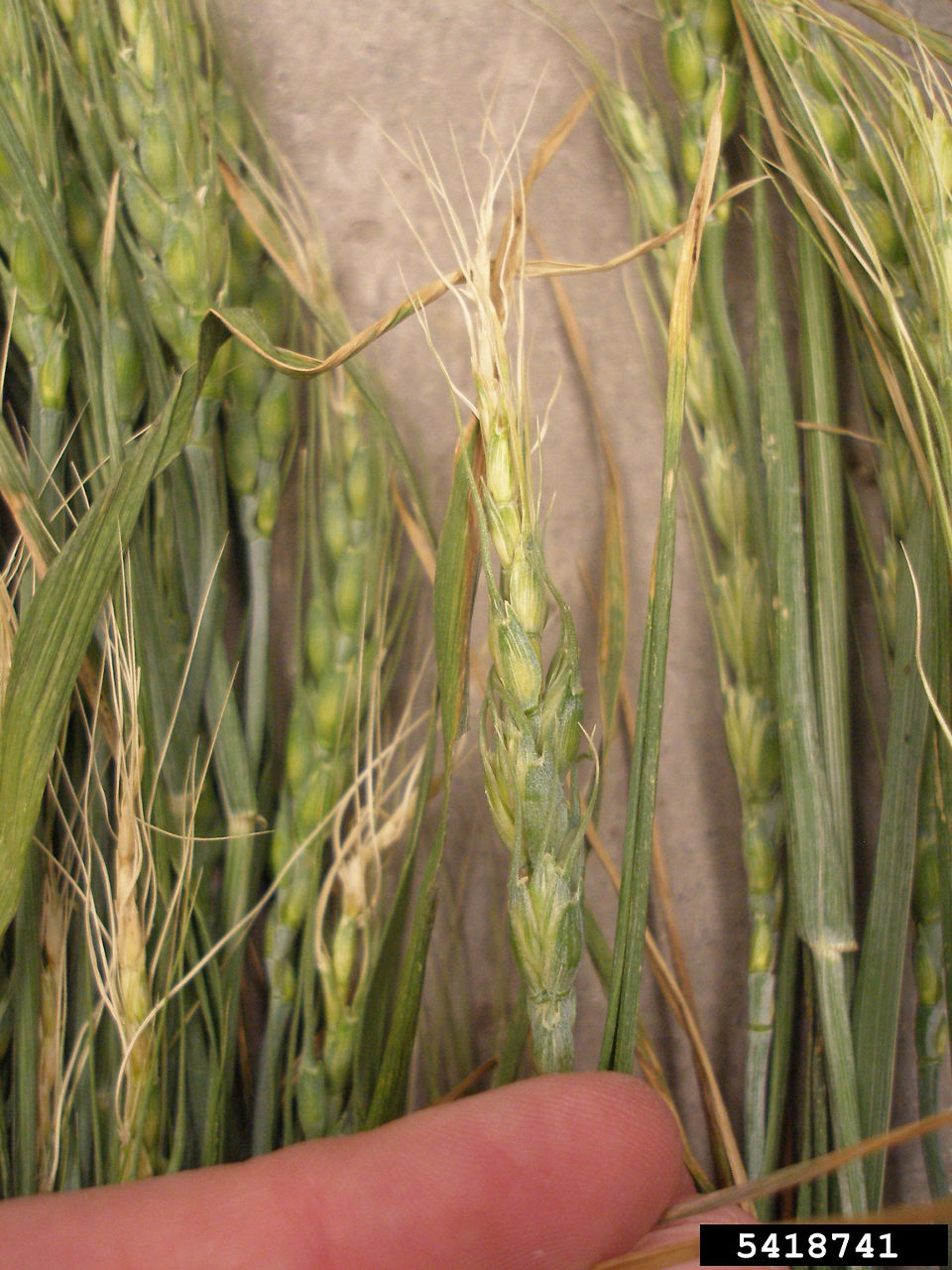
- Frost damaged heads may emerge normally but are yellow or white compared to a normal green color.
- Twisted awns (Figure 1).
- Leaf discoloration and damage to the lower stem. Temperatures cold enough to injure leaves are usually fatal to male flower parts.
- Floret sterility - specifically male flower parts (anthers) are sensitive to freezing temperatures and may be damaged without damage to foliage. Anthers, still green, become twisted and shriveled within 48 hours of a freeze. Following the first two days after a frost event, they quickly turn white to light-brown and are not extruded from florets.
- Poor kernel set.
Heading and Flowering Stages (Feekes 10.1 to 10.5.1)2,3
- Temperatures drop to 30 °F (-1 °C) for two hours or more.
- Emerged heads may remain yellow or white (portions or entire head affected).
- Bleaching of awns – turn white instead of normal green color (Figure 1).
- Leaf discoloration, damage to stems. A ‘frost ring’ or white/yellow tissue one to two inches below heads days after frost event.
- Floret sterility (male anthers).
- Poor kernel set can happen depending on the timing of freezing temperatures. Flowering moves from florets in the center of wheat heads to the top and bottom florets over a two- to four-day window. Grain set may lack at the top and bottom if flowering had not started there. Alternatively, flowering and pollination may be complete in other parts of the heads and those should fill with grain.
Assessing Injury
An assessment of injury should be made after three to four days of seasonal temperatures. Cut the stem lengthwise with a razor or sharp knife to inspect the head. The head should be bright pale green and firm. If injured by the frost, heads turn white to brown colored and are soft or easily squeezed under finger pressure. Inspect the stems; if injured, lower stems discolor and may even split where injury is severe. Stem growth ceases upon injury to the head, so this may be hidden by subsequent growth uninjured of tillers.5
Management and Harvest
Damage can be widespread or spotty within a field. Unfortunately, lush green and growing plants are higher in moisture and may experience more damage compared to drier plants hardened by drought stress. Reductions to grain yield potential could be moderate to severe at the boot stage (Feekes 10). Severe reductions of yield potential can occur when winter wheat is at heading and flowering stages (Feekes Scale 10.1 to 10.5). Small differences in temperature, duration of exposure, and other factors lead to major differences in the amount of injury during the flowering stage. Surviving fields should still be scouted until harvest. Full heads could break over at the ‘frost ring’ later in the growing season, especially during windy conditions.3
Patience may be the best management practice if injury is only partially affecting fields. Unless severe, frost-damaged wheat usually produces yields that exceed additional harvesting and hauling costs. Grain produced by frost injured wheat may be of lower test weight and the kernels may be shriveled or off-color. If the grain is to be used for seed, a germination test should be done before planting. Shriveled grain can be fed to livestock and may be of higher-than-normal protein content. Total losses could warrant quickly moving toward haying or forage harvest if weather cooperates. Nitrates should be tested if the crop is ensiled or used for livestock feed. Where the growing season is long enough, replanting is an option after herbicides are used to completely kill what is left of the crop.3
Sources:
1 Longstroth, M. 2015. What are radiation freezes? Michigan State University Extension. https://www.canr.msu.edu/news/what_are_radiation_freezes.
2 Lollato, R. 2018. Wheat growth and development. Kansas State University Research and Extension. MF3300. https://bookstore.ksre.ksu.edu/pubs/wheat-growth-and-development-poster-20x30_MF3300.pdf.
3 Freeze injury on wheat. Texas A&M AgriLife Research and Extension Center at San Angelo. https://sanangelo.tamu.edu/extension/agronomy/agronomy-publications/freeze-injury-on-wheat.
4 Shroyer, J. P., Mikesell, M. E. and Paulsen, G. M. 1995. K-State Research and Extension publication C-646. Kansas State University. https://bookstore.ksre.ksu.edu/pubs/spring-freeze-injury-to-kansas-wheat_C646.pdf.
5 Klein, R. Freeze injury to Nebraska wheat. University of Nebraska Extension. EC132. http://extensionpublications.unl.edu/assets/pdf/ec132.pdf.
Web sources verified 07/09/2025. 1714_175600
Disclaimer
ALWAYS READ AND FOLLOW GRAIN MARKETING AND ALL OTHER STEWARDSHIP PRACTICES AND PESTICIDE LABEL DIRECTIONS.