
Glyphosate Efficacy and the Effects of Cold and Wet Spring Conditions
August 10, 2026
Get Year-Round Updates From Our Agronomic Experts
Key Takeaways
- Glyphosate is a systemic, foliar applied herbicide that controls weeds by translocating from the leaves to the growing point(s), shoots and roots where it inhibits the enzyme enolpyruvyl shikimate-3 phosphate synthase (EPSPS).
- Translocation of the herbicide takes place through the phloem tissue over hours, or days, and is enhanced by good growing conditions that encourage active weed growth.
- Cold temperatures can reduce glyphosate performance by slowing weed growth, herbicide uptake, and movement within the plant.
- Wet spring conditions can affect weed control because saturated soils, cloudy weather, and stressed weeds may reduce herbicide activity.
- Rain before the rainfast period is complete may lower herbicide efficacy, especially when cool conditions slow product absorption.
- Frost-damaged weeds are often less responsive to glyphosate applications, making weed recovery an important consideration before spraying.
- Timing applications around favorable weather conditions can improve glyphosate efficacy and overall weed control. Always follow product label directions.
How Rain Affects Glyphosate Performance
Springtime weather is anything but predictable, and this can be frustrating for growers trying to implement a successful weed control program. Wet weather can negatively impact herbicide performance.
Glyphosate, like many other foliar applied herbicides, must be completely absorbed into the leaf to maximize the chances for expected weed control. The herbicide must cross the leaf cuticle which is a thin, often waxy layer of cells on the surface of the leaf, to the inner leaf tissue, and ultimately into the phloem for translocation. Rainfall (or overhead irrigation) can dilute or wash off the herbicide solution if it has not completely passed through the cuticle, potentially resulting in reduced weed control. Once absorption has taken place, the impact of rainfall on glyphosate herbicide performance will be greatly reduced.
How the Rainfast Period Impacts Herbicide Performance
The rainfast period for an herbicide is the amount of time that the leaf surface of the targeted weed should remain dry between application and a rainfall event (or overhead irrigation) to ensure the best possible chances for good product performance. Most herbicide product labels will list the recommended rainfast periods.1
Generally, product rainfast ratings are based on good growing conditions. Daytime temperatures in the range of mid-60s to mid-80s °F generally promote active weed growth, therefore enhancing herbicide absorption and translocation. Cooler temperatures may slow down both of these processes, which may extend the amount of time it takes for glyphosate to become rainfast. Humidity can also play a role in how long a droplet of herbicide solution remains on the leaf surface prior to being absorbed, with low humidity favoring quicker absorption. Weeds having a waxy leaf surface, or weeds that are drought stressed, can slow glyphosate absorption into the leaf as well. For many products, any amount of rainfall soon after spraying has the potential to reduce weed control. When tank mixing glyphosate herbicide products with permissible tank-mix partners, be sure to consider the rainfast period of those herbicides when planning an application. Check the glyphosate product label for any label guidance and performance expectations.1
What Temperature Range Is Best for Glyphosate Applications?
Glyphosate products can perform well under a wide range of temperatures. Daytime temperatures ranging from 60 to 75 °F for several hours typically results in the best weed control for glyphosate herbicides. At these temperatures, most plants will be actively growing and not experiencing temperature stress.1,2 While daytime temperatures may be favorable, overnight low temperatures should also be taken into account. Nighttime temperatures in the 40s °F will still allow for active weed growth and helps to maximize the efficacy of a glyphosate application.3
When the air temperature is below 60 °F, plant growth slows, resulting in slower herbicide uptake and translocation within the plant. This slower activity can potentially reduce expected control if conditions remain unfavorable. 1,2
Managing Glyphosate Applications After a Frost or Freeze Occurs
The impact that a frost will have on glyphosate efficacy depends on the duration of the frost (hours), the severity (low temperatures), the preceding weather and the targeted weed species. Generally, perennials, biennials and winter annuals will possess a higher degree of frost tolerance than spring-germinating annuals.
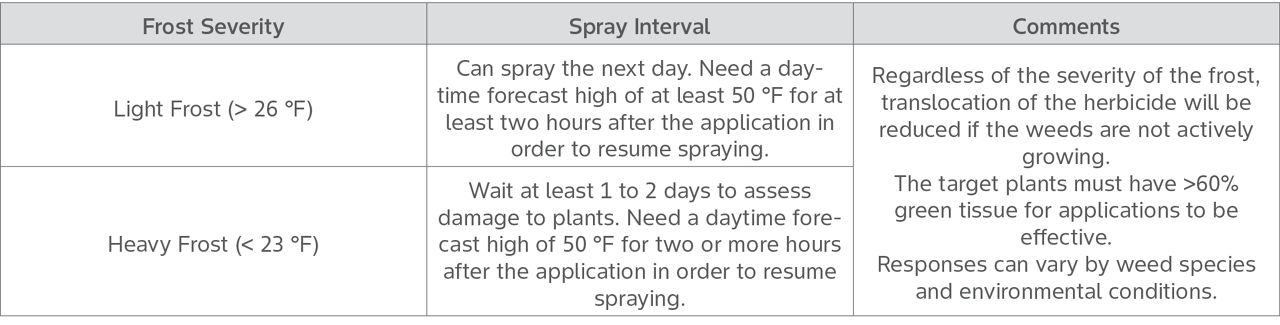
Generally, a light frost of 26 to 32 °F will not usually harm a plant. Growers can resume application later in the day if temperatures are forecast to reach at least 50 °F for at least two to four hours after the application.
Hard frosts (< 23 °F) can cause more severe damage to most plants, including perennials. Avoid spraying for at least 48 hours after a heavy frost to assess any injury that has occurred. If at least 60% of the plant is still green and actively growing, and daytime temperatures are forecast to reach at least 46 °F, spray applications can continue. Weeds experiencing excess moisture, drought stress, disease or insect pressure will take longer to resume active growth after a frost, so a longer interval may be needed to achieve effective weed control.4
A frost that occurs soon after an application of glyphosate (within 24 hours on annuals, or within three days on perennials) can also impact control. If only a light frost is predicted, ensure that there will be at least two hours of temperatures of 50 °F or higher after application to allow the product to enter the plant. Once the temperature increases the next day, translocation will resume. If a severe frost is predicted immediately following an intended application, growers may want to avoid spraying. If the plant is damaged before the product has properly translocated, control may be reduced.4
Table 1. Frost severity and herbicide applications.
Sources
1Jhala, A. 2020. How temperature and rain can affect burndown herbicides. Cropwatch. University of Nebraska-Lincoln Extension. https://cropwatch.unl.edu/2018/weather-and-burndown-herbicides/
2Shaffer, G. 2022. Temperature and herbicide performance. South Dakota State University Extension. https://extension.sdstate.edu/temperature-and-herbicide-performance
3Johnson, B. and Zimmer, M. 2023. Spring burndown considerations: Air temps and herbicide efficacy. Pest&Crop Newsletter. Extension Entomology. Purdue University https://extension.entm.purdue.edu/newsletters/pestandcrop/article/spring-burndown-considerations-air-temps-and-herbicide-efficacy/
4Gaultier, J. 2015. Are herbicides still effective after a fall frost? Top Crop Manager. Manitoba Agriculture Food and Rural Development. https://www.topcropmanager.com/are-herbicides-still-effective-after-a-fall-frost-18047/
Web sources verified 7/16/2026. 1026_420956
Disclaimer
ALWAYS READ AND FOLLOW GRAIN MARKETING AND ALL OTHER STEWARDSHIP PRACTICES AND PESTICIDE LABEL DIRECTIONS.