Grain and Head Diseases of Wheat
June 17, 2025
Ergot
Causes of Ergot
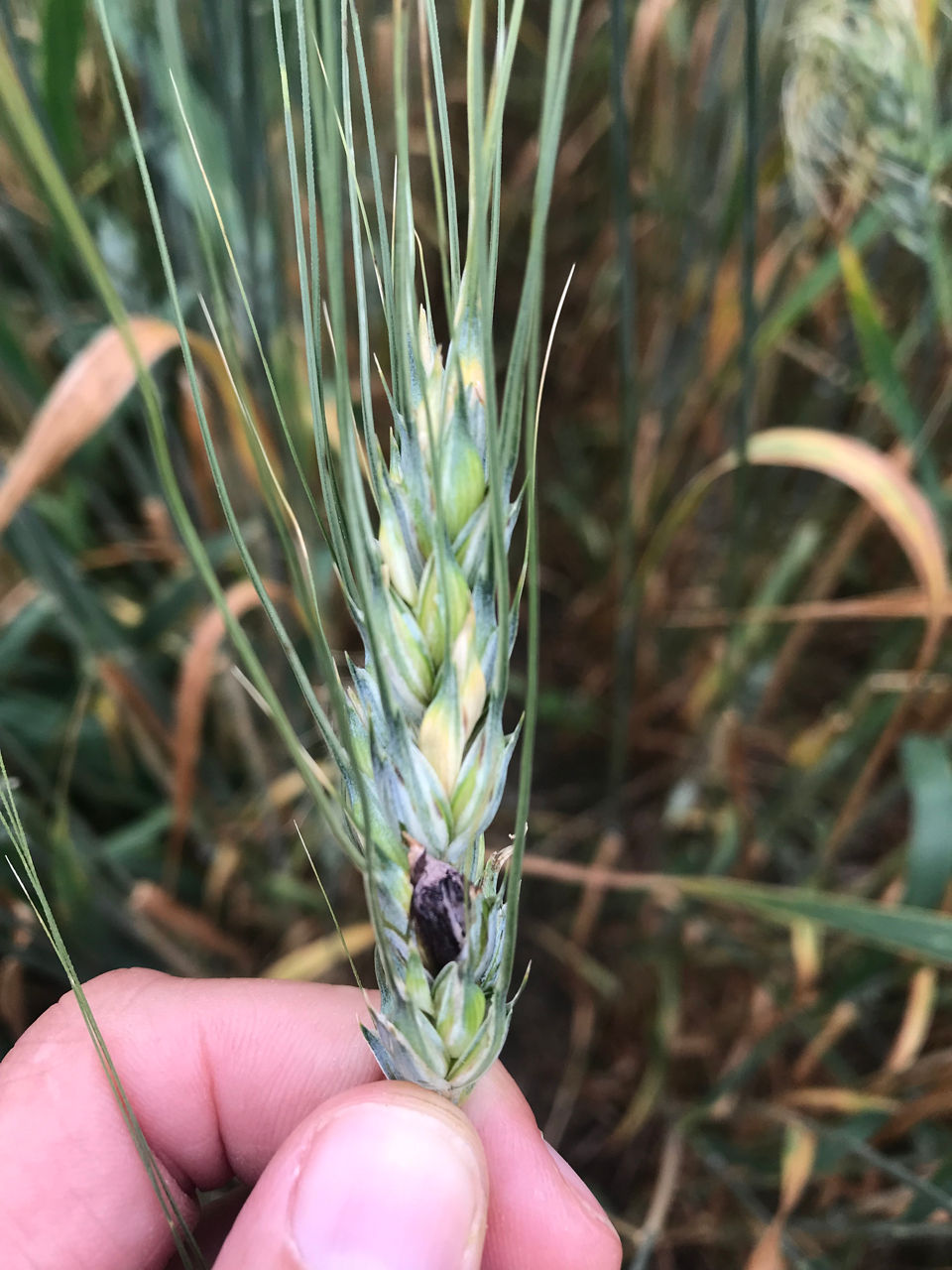
Claviceps purpurea is a fungus that infects small grains and grassy weeds and replaces kernels with ergot bodies. Plants are susceptible to infection during flowering, and wet conditions with temperatures of 60 to 80 °F are most favorable for the development of this disease.1
Symptoms
The first sign of infection is a yellow drop of “honey dew” on the spike. At this stage, infection can be transmitted to other flowering plants by insects. During grain fill, the infected flower develops into a dark ergot body where a kernel would typically develop. Ergot infections tend to be more severe on field edges.
Effects on Wheat Yield
Ergot is toxic to livestock and humans and can therefore cause downgrading of grain at the point of sale. Ergoty wheat is a special grade given when wheat has greater than 0.05 percent of ergot.2 Amongst head and kernel diseases in the United States, ergot was ranked as the second-leading for yield loss with 2,108,000 bushels lost to the disease in 2024.3
Management
Management includes rotating to a broadleaf crop between small grain crops, incorporating ergot bodies into the soil, managing grassy weed hosts, using ergot-free seed, and applying fungicide seed treatments and foliar fungicides. Harvesting and storing grain on field edges with high disease incidence separately may spare the rest of the grain from downgrades. Some ergot can be removed by cleaning the grain.
Loose Smut
Causes of Loose Smut
Loose smut in wheat is a fungal disease caused by Ustilago tritici. This disease is favored by cool (60 to 71 °F), humid weather with light rain showers or heavy dew.4 The current disease seen in a field is a result of U. tritici infection from the previous year. During anthesis, loose smut teliospores infect ovaries (seeds), but the infection remains dormant until the seed germinates. Even after germination, infection is systemic and symptomless until head emergence.
Symptoms
Head emergence of plants infected with loose smut is slightly earlier than for healthy plants. The glumes and grain of the diseased head are replaced with dusty black powder. These are teliospores and are easily spread by wind, infecting flowering wheat. Loose smut contributes to yield loss as smutted heads produce no seed.

Effects on Yield
Generally, this disease results in a small economic impact due to overall yield loss; however, yield losses as high as 40 percent have been reported.4 Loose smut would be especially damaging to seed production fields as the resulting grain becomes unfit for the next sowing. Consider the nature of infection; fields with one percent of heads infected with loose smut can have a 10 percent seed infection.
Management
This fungal infection is not surface-borne; therefore, contact fungicides applied in-season are not recommended. Management includes using resistant cultivars, using certified seed, and using a registered fungicide seed treatment. Raxil® 2.6F and Raxil® PRO MD seed-applied fungicides are labeled for managing loose smut in wheat.
Fusarium Head Blight
Causes of Fusarium Head Blight
Fusarium head blight (head scab) can become a serious problem when favorable conditions for spore production occur while wheat is blooming. Inoculum from Fusarium spp. is widely present in most soils and crop residue (commonly on corn stubble). During flowering, spores initially infect ovaries (seeds); however, mycelia may permeate and spread the infection throughout spikelets. Warm (50 to 82 °F), humid weather conditions are most favorable for the development of this disease.5
Symptoms
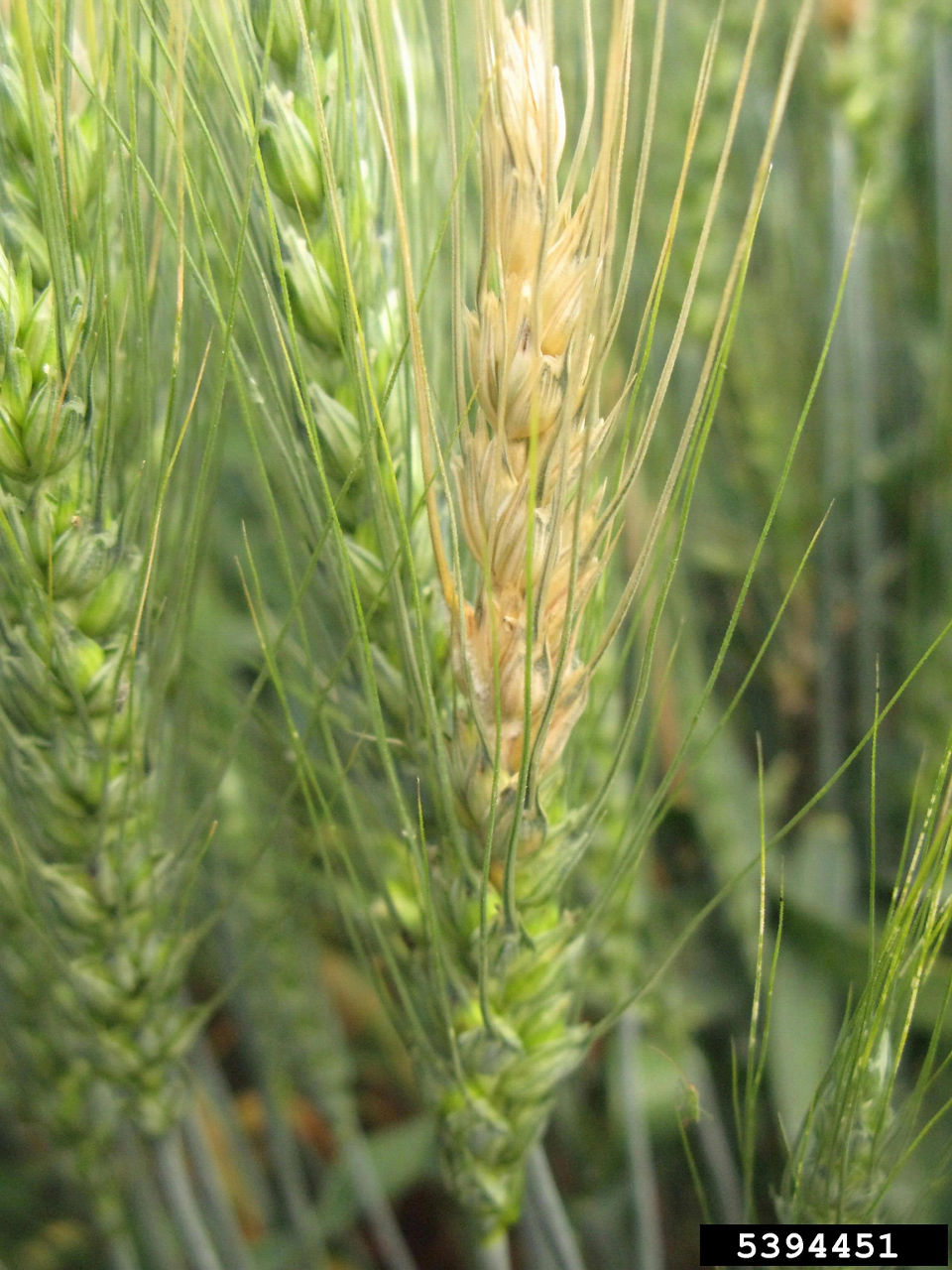
During grain fill, glumes darken and may have an oily appearance. An individual spikelet or entire heads may become infected and suddenly have a bleached appearance.6 This makes the disease easy to spot across a wide portion of the field. Humid weather can cause pink spores to develop on bleached heads. The peduncle immediately below the head can take on a brown to purple color.
Effects on Wheat Yield
Fusarium head blight (FHB) is the number one wheat disease affecting heads and kernels.3 In 2024, FHB is estimated to have caused a loss of 30,848,000 wheat bushels in the United States. Grain may appear white to pinkish and shriveled with low test weight or fail to develop altogether. A crop with more than five percent infected kernels may contain enough mycotoxins to be harmful to humans and animals.5 Grain containing mycotoxins may result in substantial dockage or rejection at the elevator.
Management
Management involves avoidance of -
- susceptible wheat products
- overhead irrigation during flowering
- planting wheat after corn
And the use of –
- a registered fungicide applied at early flowering when weather conditions are conducive for spore productions. Bayer fungicides registered for control on fusarium head blight include Prosaro® 421 SC fungicide and Prosaro® PRO 400 SC fungicide. Proline® 480 fungicide is labeled for suppression of FHB.
- crop rotation away from small grains, corn, and sorghum for several years
- high-quality, FHB disease-free seed
The effectiveness of tillage and crop rotation may be limited because spores can blow in from neighboring fields. Read here https://www.cropscience.bayer.us/articles/bayer/fusarium-head-blight-in-wheat to find out more information on Fusarium head blight management.
Sooty Head Mold
Causes of Sooty Head Mold
Sooty head mold is a complex of weakly parasitic and saprophytic fungi typically Cladosporium and Alternaria species. Mature wheat delayed in harvest or injured wheat is more susceptible to saprophytic fungi. These fungi naturally function to break down dead and decaying plant tissue. This disease complex is favored by wet conditions when grain is mature or maturing.
Symptoms
Symptoms are dark green or black mold and occasionally pink or white mold on the surface of the wheat head. Black point or kernel smudge can result from the infection and occurs when the germ (embryo) and surrounding kernel becomes brown to black colored.

Effects on Wheat Yield
Sooty mold does not cause yield loss as grain is already mature, prematurely senescing, or injured at the time of infection. Grain quality can be affected by sooty mold if it causes black point. Discolored kernels can be considered damaged at the elevator with 2 and 4 percent damaged kernels allowed for U.S. grade No. 1 and No. 2, respectively.2,7
Management
Over-irrigation should be avoided especially during heading stage. This disease is limited where the crop remains healthy through grain maturation. Therefore, management should focus on limiting stress and injury to the crop. Once sooty head mold is noticed, a timely harvest is the recommended in-season management.8
In storage, grain affected by sooty head mold should be kept at 12 percent moisture.7 Storage should be well ventilated, cool, and dry to keep affected grain from developing storage mold issues. Seed production fields may be limited by the disease, but a systemic fungicide seed treatment can be applied to grain used for seed. Trilex® Flowable fungicide can be used as a seed and seedling treatment in wheat for control of Cladosporium spp. and Alternaria spp.
Sources
1Friskop, A., Endres, G., Hoppe, K., Mostrom, M., Ransom, J., Stokka, G. 2018. Ergot in small grains PP1904. North Dakota State University Extension. www.vdl.ndsu.edu › Ergot-in-Small-Grains-Publication-12-2018.
22014. U.S. Standards Subpart M – Official U.S. standards for grain wheat. United States Department of Agriculture. Agricultural Marketing Service, Federal Grain Inspection Service. https://www.ams.usda.gov/sites/default/files/media/WheatStandards.pdf
3Anderson, N., Sisson, A., Turkington, K., et al. 2025. Wheat disease loss estimates from the United States and Canada – 2024. (D. Mueller and K. Wise, reviewers). doi.org/10.31274/cpn-20250324-0
4Reports on plant diseases RPD No. 112- Loose smut of wheat. 1990. http://ipm.illinois.edu/diseases/series100/rpd112/.
5Prescott, J.M., Burnett, P.A., Saari, E.E., Ranson, J., Bowman, J., de Milliano, W., Singh, R.P., and Bekele, G. 2011. Wheat diseases and pests: a guide for field identification. CIMMYT. https://rusttracker.cimmyt.org/wp-content/uploads/2011/11/CIMMYT_Wheat_Diseases_Pests_ID_GUide.pdf
6Wegulo, S.N., Hein, G.L., and Lyon, D.J. 2010. Distinguishing between head disorders of wheat. University of Nebraska – Lincoln. EC1872.
7Wegulo, S. 2009. Wheat blackpoint. University of Nebraska – Lincoln. https://cropwatch.unl.edu/8-28-09wheat-blackpoint/
8Strunk, C. 2022. Sooty mold: a saprophytic fungi observed in wheat. South Dakota State University Extension. https://extension.sdstate.edu/sooty-mold-saprophytic-fungi-observed-wheat
Sources verified 4/24/2025. 1711_504150
Disclaimer
ALWAYS READ AND FOLLOW GRAIN MARKETING AND ALL OTHER STEWARDSHIP PRACTICES AND PESTICIDE LABEL DIRECTIONS.