How Does Weed Management Influence Corn Insects and Diseases?
July 15, 2024
The primary reason for controlling managing is to help protect the potential crop yield from the negative effects of weed competition. Weeds compete with crops for limited resources such as light, water, and nutrients. Weed management is also essential for another important, but often overlooked, reason. Several common weed species can serve as host plants for insects and diseases. If not controlled in a timely manner, weeds can sustain large numbers of migrating insect pests and plant viruses transmitted by insect vectors. Weeds can also serve as alternate hosts for other types of plant pathogens.1
What corn pests may be more problematic in fields where weed management is lacking?
Black Cutworm: In much of the corn growing region, moths start migrating from the southern United States in early April. Strong southerly winds influence the transportation, distribution, and severity of black cutworm infestations. Female moths deposit eggs onto weeds (e.g., henbit, common purslane) and crop residues prior to corn planting. Upon hatching, black cutworm larvae feed on weeds. When the weeds are removed with tillage or herbicide, the larvae will move to emerging corn seedlings in May and early June. Black cutworm larval feeding results in cutting of corn seedlings, which may occur at or below the soil surface. Usually, larvae do not cut the seedling at the V5 growth stage and beyond as the plant is too large at that point. However, even then the larvae can tunnel into the plant, causing hollow heart and in some cases destroying the growing point. For more information about cutworms and how to manage them, please read this Agronomy Spotlight: Do I need to apply an insecticide to manage early-season corn insects such as cutworms? - Corn Belt | Crop Science US (bayer.us)
Nematodes: Most plant-parasitic nematodes of corn have a wide host range or a host range that is not well studied. For these reasons, it can be difficult to find suitable rotations for managing nematode problems. If sting, stubby-root, or lesion nematodes are problematic on corn, grass species such as sorghum, sugarcane, or forage grasses should be avoided as these nematodes thrive on grasses. Weed management is an important supplement to crop rotation because plant-parasitic nematode population densities can be maintained or increased on some weed hosts, including volunteer corn, growing in a non-host crop.2
Can tillage impact problematic pests of corn?
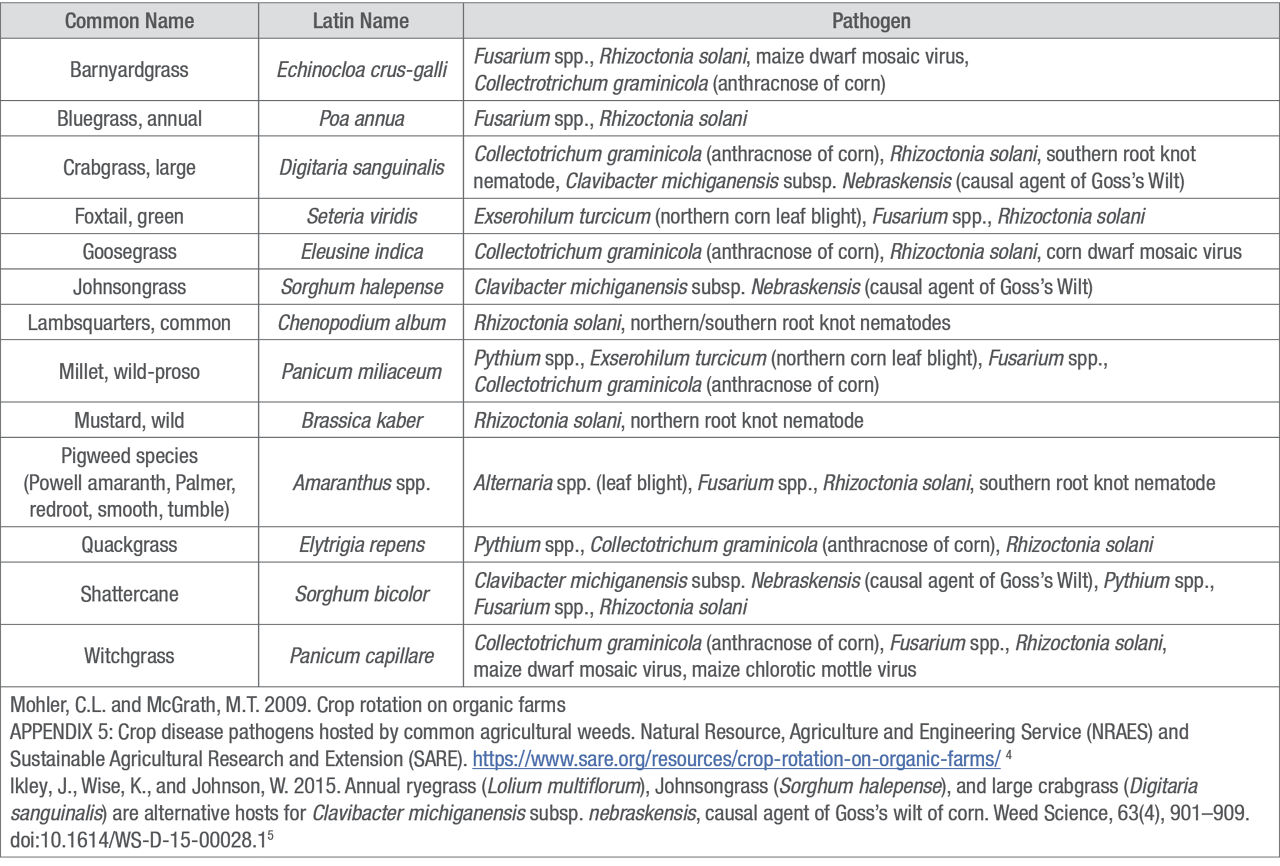
An environment where the soil is not disturbed between harvest and planting is favorable for winter annual weed survival. Weeds can harbor diseases that can be transferred to corn plants by insects feeding initially on weeds and then on the crop. Weed species (Table 1) can serve as alternate hosts and sources of inoculum of insect- and mite-vectored plant pathogens including maize chlorotic mottle virus, maize dwarf mosaic virus, sugarcane mosaic virus, and wheat streak mosaic virus. Aphids, whiteflies, leafhoppers, and thrips are the most common vectors of plant pathogenic viruses due to these insects’ piercing-sucking mouthparts. Elimination of the source of the disease and vectors is one of the most effective approaches to management, and this often includes weed management.
No-till, continuous corn has the potential to increase nematode problems. Rotation to a non-host crop is one of the best strategies for reducing nematode populations below economic thresholds. Different nematodes have different host ranges. Some nematodes are able to parasitize a wide range of field crops (e.g. corn, cotton, soybean), so it is important to identify the species of nematodes present in a field before implementing a crop rotation strategy. Many weed species can serve as alternate hosts for nematodes (Table 1) that attack corn, which makes weed management particularly important for nematode control in no-till cropping systems.
What are some considerations for managing the weed-insect-disease relationship?
Weeds that harbor plant diseases vectored by insects are a special concern and should be managed at the earliest possible stage before insect vectors infest them. This would include weeds in field margins, road ditches, and other non-crop areas. However, care should be taken when managing weeds such as milkweed that are used by butterflies (e.g., monarch) or other pollinators.
The first line of defense against corn diseases is genetic resistance, especially in corn-on-corn situations. Diseases such as seedling blights, gray leaf spot, northern corn leaf blight, many common stalk and ear rots, and in some areas Goss’s wilt are potentially more severe in corn-on-corn production, and some of these diseases can be harbored by weeds (Table 1).
Late season weeds, such as giant ragweed, can serve as a pollen source for western and northern corn rootworm adults. These weeds attract female beetles into corn fields, where they can deposit eggs that could impact next year’s crop in a continuous corn production system. Corn rootworm larvae can survive on green, yellow, or giant foxtail roots if no other food source is available to them. Additionally, if a field is planted from corn to soybean, volunteer corn in the following soybean crop can host corn rootworm larvae from eggs that were deposited in the corn field the previous year. This situation has the potential to allow corn rootworm to develop resistance to corn traits meant to manage them. Because volunteer corn from seed intended to resist corn rootworm usually has reduced expression of rootworm-resistant traits, some rootworms may survive feeding on the corn and pass their tolerance to the next generation, allowing resistance to build up in the local corn rootworm population.3
Starting with a clean field by utilizing burndown herbicide applications and preemergent herbicides with multiple modes of action will help reduce the number of weed species present to harbor problematic insects and diseases.
Seed treatment fungicides are a critical component of an integrated disease management strategy in corn, especially when problematic weed species are present in large populations. The fungicides present in Acceleron® Solutions Offering products provide two modes of action to help protect against key soilborne and seedborne seedling-infecting pathogens, Fusarium, Pythium, and Rhizoctonia solani. Protection against Colletotrichum graminicola, the causal agent for anthracnose diseases in corn, is also provided by Acceleron® Solutions Offering Elite for early to mid-season infections. Acceleron® Solutions Offering products also contain an insecticide that protects against early season insect damage, which may lower the threat of root injury that serves as entry point for disease infection.
For more information on scouting for weeds and identifying weeds, check out: Making Decisions Based on Weed Scouting in Corn
Table 1. Corn pathogens hosted by common weed species.
Sources
1Capinera, J.L. 2005. Relationships between insect pests and weeds: An evolutionary perspective. Weed Science. 53 (6): 892–901. http://www.jstor.org/stable/4046991
2Thomas, S., Schroeder, J., and Murray, L. 2005. The role of weeds in nematode management. Weed Science. 53(6): 923–928. http://www.jstor.org/stable/4046996
3Jhala, A, Wright, B., and Chahal, P. 2015. Volunteer corn in soybean: Impact and management. University of Nebraska. https://cropwatch.unl.edu/volunteer-corn-soybean-impact-and-management
4Mohler, C.L. and McGrath, M.T. 2009. Crop rotation on organic farms, APPENDIX 5: Crop disease pathogens hosted by common agricultural weeds. Natural Resource, Agriculture and Engineering Service (NRAES) and Sustainable Agricultural Research and Extension (SARE). https://www.sare.org/resources/crop-rotation-on-organic-farms/
5Ikley, J., Wise, K., and Johnson, W. 2015. Annual ryegrass (Lolium multiflorum), Johnsongrass (Sorghum halepense), and large crabgrass (Digitaria sanguinalis) are alternative hosts for Clavibacter michiganensis subsp. nebraskensis, causal agent of Goss's wilt of corn. Weed Science. 63(4): 901–909. doi:10.1614/WS-D-15-00028.1
Additional Resources
Norris, R. and Kogan, M. 2000. Interactions between weeds, arthropod pests, and their natural enemies in managed ecosystems. Weed Science. 48(1): 94–158. http://www.jstor.org/stable/4046162
Web sources verified 6/23/2024. 1211_120235
Disclaimer
ALWAYS READ AND FOLLOW GRAIN MARKETING AND ALL OTHER STEWARDSHIP PRACTICES AND PESTICIDE LABEL DIRECTIONS.