5 MIN READ
Soybean Planting Equipment Guidelines
April 29, 2026
Get Year-Round Updates From Our Agronomic Experts
Soybean Planters Can Help Maximize Soybean Yield Potential
Maximizing soybean yield potential is dependent on manageable and non-manageable factors. Two manageable factors are 1) proper servicing and maintenance of planting equipment according to the manufacturer’s equipment manual and the manuals of any aftermarket equipment and 2) reviewing the seed tag or bag information for soybean seed size, germination percentage, and seed treatment information. Weather is the largest non-manageable factor.
Planter Adjustments and Settings for Desired Soybean Planting Rate
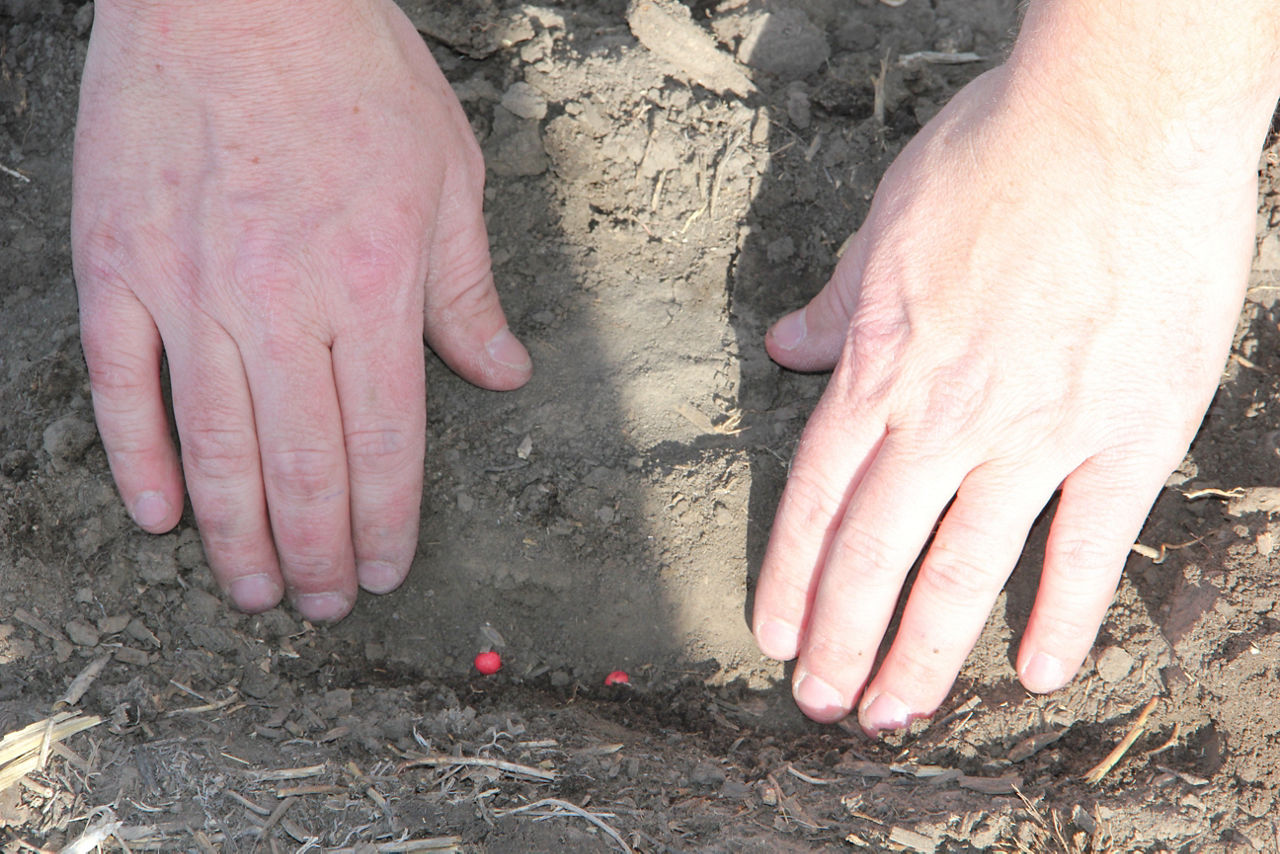
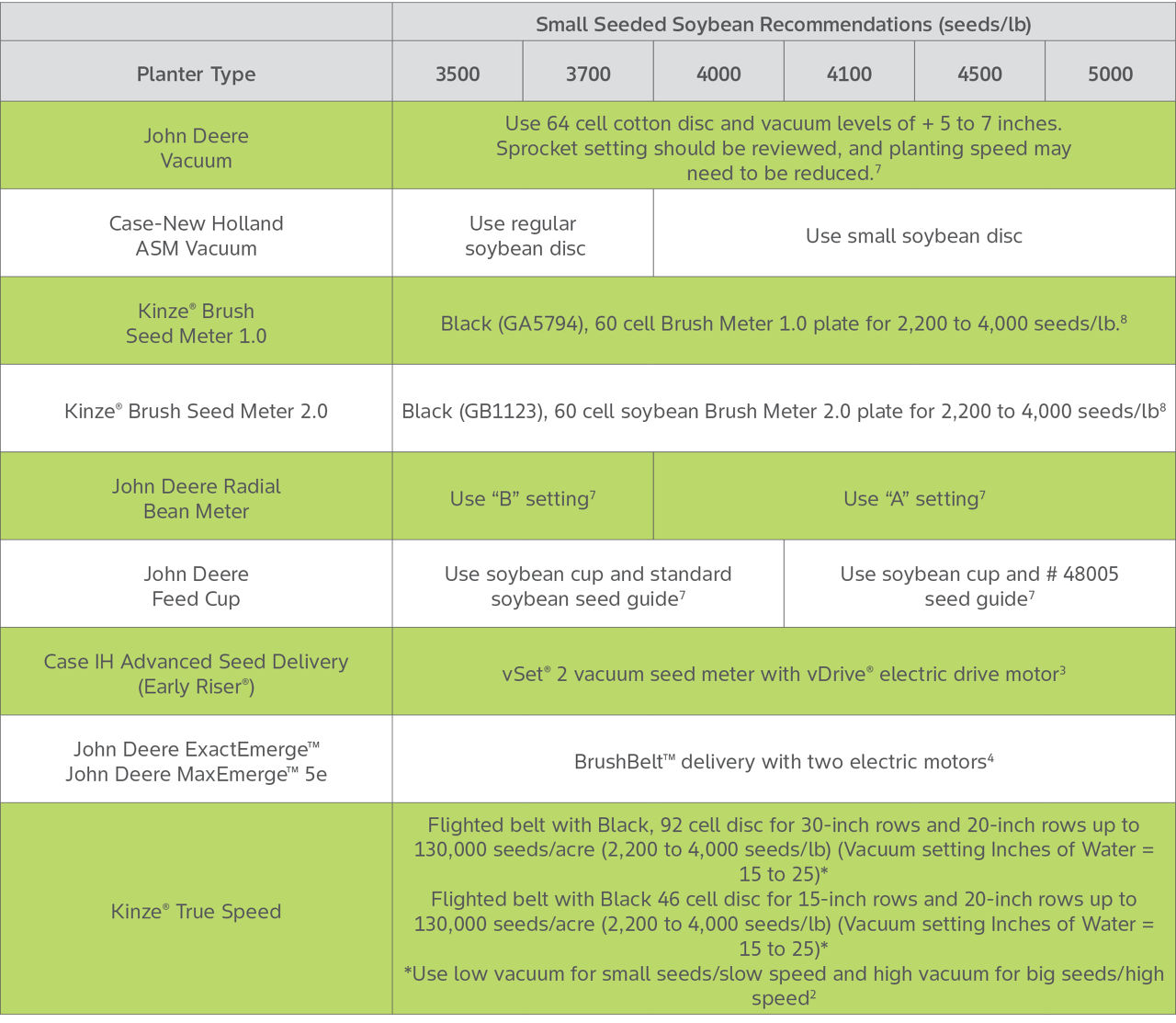
Soybean planting rates should be based on the number of seeds per acre or foot of row rather than pounds of seed per acre. Equipment manuals should be consulted to help determine the recommended equipment settings for the desired seeding rate. Electronic monitors provide valuable information regarding seeding rates; however, it is always recommended to visually examine, and measure actual seed drop and placement after planting at full speed (Figure 1). Tables 1 and 2 may be referenced for initial planter recommendations.
Soybean Planter Seed Lubricants
Seed lubricants help to reduce friction and improve uniformity of planting. Fluency Agent Advanced Seed Lubricant from Bayer can replace talc and graphite lubricants. Seed lubricants can help reduce the amount of dust and seed treatment given off during planting.
If Fluency Agent Advanced Seed Lubricant is not used, graphite should be used in finger pickup planters and talc in vacuum planters. Additional graphite or talc should be used with seed-applied insecticides. Maximum recommended graphite or talc amounts should be used on high applications of seed-applied insecticides.
High Speed Soybean Planting
Planters equipped with rubber or brush belts in the seed tube can help place the seed in the seed trench with minimal bounce or rolling at higher planting speeds. The belt carries the seed to the bottom of the seed trench and releases it at the same speed as the planter is moving. Because of higher planting speeds, the downforce on each row unit and closing wheel force should be increased.1 Kinze® True Speed® Meter uses a flighted belt and 92 cell soybean disc (disk) for 30-inch and 20-inch rows or a 46 cell soybean disc for 15-inch and 20-inch rows.2 Case IH Advanced Seed Delivery™ (2000 Series Early Riser® planter) uses Precision Planting® SpeedTube® flighted belt with vSet® 2 vacuum seed meter with vDrive® electric drive motor.3 John Deere ExactEmerge™ planter uses BrushBelt™ delivery with two electric motors.4
Soybean Planters with Vacuum Metering Units
Pneumatic metering type planters can plant most seed sizes when the recommended disc size and air pressure settings are used per the manufacturer’s recommendations specified in the manual. Air or vacuum leaks in the system can affect planting rates.
To select the proper seed disc, seed should be placed into the disc cells and observed for fitness. A larger hole disc should be selected if one seed doesn’t fit properly into a cell and a smaller hole disc selected if two seeds can fit in a cell. If sizing determines that two discs are nearly equal in fit, the smaller hole disc should be selected. It is better to increase the amount of vacuum to compensate for skips rather than to decrease the amount of vacuum to help guard against double seed drops.
The top planting speed may have to be reduced if a seed disc with fewer cells is selected to plant larger seeds to help ensure that the capabilities of the seed meter being used are not exceeded.5 A disc with fewer cells must rotate at more revolutions per minute (RPM) to maintain a given seeding rate relative to a disc with more cells. For example, if 140,000 seeds per acre is the desired seeding rate in a 30-inch row spacing and seeds are to be placed 1.49 inches apart, an Advanced Seed Meter with a 100-cell disc should be operated at 40.30 RPM at a planting speed of 5.7 MPH. If a 130-cell disc is used for the same seeding rate and spacing, the RPM and MPH are 40.25 and 7.4, respectively. The operational range for a hydraulic drive Advanced Seed Meter is from 12 to 60 RPM and the ideal range would be 20 to 40 RPM.5
There are two discs for the discontinued Kinze® EdgeVac™ Seed Metering System when there are 2,200 to 4,000 seeds/lb, the black 60-cell disc and the dark blue 120-cell for high rate seeding.6 The discs used to plant edible bean seed could potentially be used for very large soybean seed (Dark Green 54-cell disc is recommended for 1,200 to 2,500 seeds/lb of edible bean seed).6 Daily planter maintenance should include disc and brush cleaning and a check for damage.
Case IH 1200 series planters use Precision Planting vSet® Meter and vDrive® Electric Drive System.3
Soybean Planters with Feed Cup or Radial Meter Mechanisms
Sprocket and speed settings are important for feed cup mechanisms. The manufacturer’s manual should be referenced for initial sprocket settings based on soybean seed size. Seeds coated with seed treatment products could change how the seed is metered through the cups; therefore, field checks should be completed to determine actual planting rate. Planting speed should be adjusted accordingly to maintain the RPM of the feed cup if the sprocket size is changed. A slower moving feed cup could pick up more seed as it revolves, increasing seeding rate. Planting speed should not be greater than the maximum speed for the sprocket as defined in the manufacturer’s manual.
John Deere indicates radial bean meters allow for the seed to be singulated compared to seed cups. At higher planting speeds, seeding rates may be reduced with large soybean seed.7 At lower planting speeds, seeding rates may be increased with small soybean seed. To adjust for different seed sizes, the indicator should be moved to (A) for small seeds (~3,700 to 4,500 seeds/lb), (B) for medium-small seeds (~2,800 to 3,700 seeds/lb), and (C) for large seeds (~2,000 to 2,800 seeds/lb).7 Daily maintenance should include inspection of the brushes, seed bowls, and the knockout assembly.
For Kinze® planters with 1.0 Brush Seed Meters, two soybean seed plates are available. The black 60 cell soybean seed plate is recommended for seed weighing 2,200 to 4,000 seeds/lb, and the dark blue 48 cell soybean seed plate is recommended for seed weighing 1,400 to 2,200 seeds/lb.8
For Kinze® planters with 2.0 Brush Seed Meters, three soybean seed plates are available. The dark blue 48 cell seed plate is recommended for seed weighing 1,400 to 2,200 seeds/lb, the dark grey 54 cell soybean plate is recommended for seed weighing 2,000 to 3,000 seeds/lb, and the black 60 cell soybean plate is recommended for seed weighing 2,200 to 4,000 seeds/lb.8
Soybean Grain Drills
Grain drills are designed for planting narrow rows (7 to 10 inches). One challenge with drills is obtaining a uniform seeding depth. Depth can be too shallow with firm soil and too deep in loose soil unless control wheels or bands are on the drill. Additionally, if planting into tilled, loose soil, tractor wheel tracks should be removed with a leveling device ahead of the drill. To help maintain good seed-to-soil contact, press wheel down-pressure should be adjusted.
If drills are equipped with fluted metering devices, large seeds can be cracked, and seed placement may not be uniform; however, small seeds are generally uniformly distributed. Drills with vacuum or seed-singulation devices should position seed more uniformly in the soil.
Through the years, drill technology has improved to the point that seed drop for some drills can be controlled with electronics from the tractor cab. However, it is still wise to verify the seeding rate and spacing. Several methods based on partial acreage measurements are available to calibrate and determine seeding rate. In the field, seeds can be dug up and counted within a set distance and a calculation made to determine planting rate per acre. Prior to going to the field, seed can be collected from seed tubes and weighed after traveling a set distance. By using the seeds per pound from the seed tag, the distance traveled, and an acreage calculation, the seeding rate can be calculated. A Michigan State University article, Calibrating Soybean Drills, is a good reference article to review.9
Table 1. Planter recommendations for larger soybean seeds.
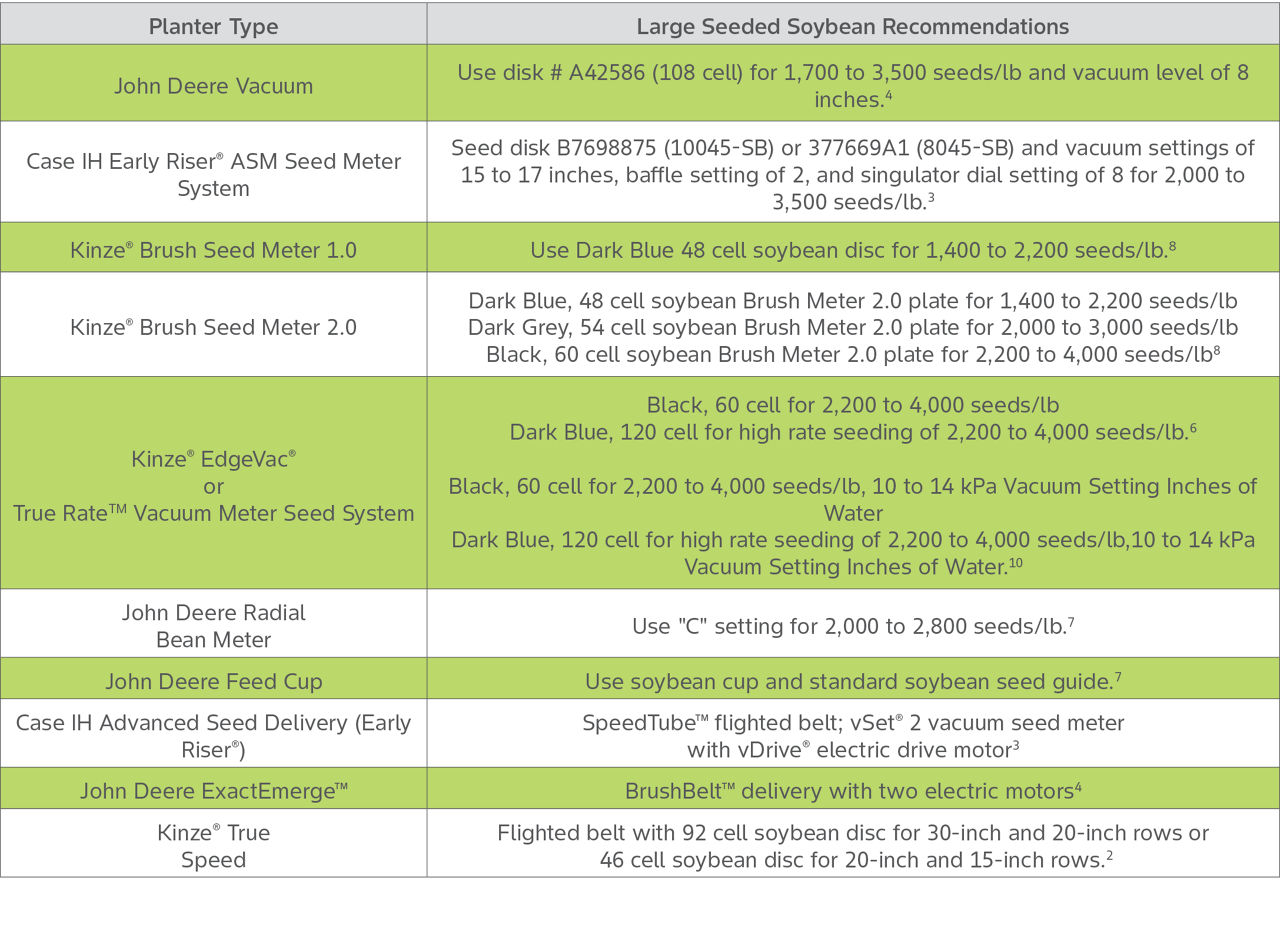
Table 2. Planter recommendations for smaller soybean seeds.
Sources
1Darr, M. and Bergman, R. 2020. High speed planting technology. Integrated Crop Management. Iowa State University Extension and Outreach. https://crops.extension.iastate.edu/cropnews/2020/03/high-speed-planting-technology.
2Kinze. True Speed® (High Speed Seed Delivery). Operator Manual. MO308. Revised 2025. https://www.kinze.com/.
3Case IH Agriculture. CNH Industrial America LLC. https://www.caseih.com/en-us/unitedstates
4Deere & Company. John Deere Planting Equipment. https://www.deere.com/en/agriculture/
5McClelland, Tony. 2012. Crop Production Sales Specialist. Case IH. Personal Communication
6Kinze. 2011. Metering systems. Service manual. Edgevac seed meters.
7OMA86807. 2008. Deere/Bauer Planters John Deere Components. Deere & Company. http://www.deere.com/servlet/com.deere.u90785.productcatalog.view.servlets.PublicationsSearchServlet?.
8Kinze Model 3000 Rigid Frame Planter Parts Manual. 2019.
9Staton, M. 2011. Calibrating soybean drills. MSU Extension. Michigan State University. https://www.canr.msu.edu/news/calibrating_soybean_drills.
10Kinze. 2023. True rate and finger pickup performance rate charts supplement manual. MO292. https://www.kinze.com/
Other Sources
Sloan Express. https://www.sloanex.com/
Web sources verified 2/18/26. 1314_109093
Disclaimer
ALWAYS READ AND FOLLOW GRAIN MARKETING AND ALL OTHER STEWARDSHIP PRACTICES AND PESTICIDE LABEL DIRECTIONS.