Red Leaf Blotch of Almond
May 6, 2026
Get Year-Round Updates From Our Agronomic Experts
- Red leaf blotch is a relatively new foliar disease of almonds in North America.
- Red leaf blotch infects the leaves, which can result in defoliation of almond trees and yield loss.
- Cultural practices to reduce levels of inoculum and the preventative application of fungicides can help in the management of red leaf blotch of almonds.
Red leaf blotch (RLB) is a foliar disease of almonds that was detected for the first time in North America in 2024 on almond trees in Merced and Madera counties in California.1,2 The disease has since spread to other California counties in the San Joaquin Valley. RLB is caused by the fungus Polystigma amygdalinum, which is only known to cause disease on almond trees and is considered endemic to the almond growing regions in the Mediterranean basin and the Middle East.2,3 The disease only affects the leaves and is not lethal to the tree. However, premature defoliation associated with severe RLB infections can result in substantial yield losses.4 There is a concern that RLB will become a major disease of almonds and an economic concern in the western US in the coming years.2
Symptoms of Red Leaf Blotch on Almonds
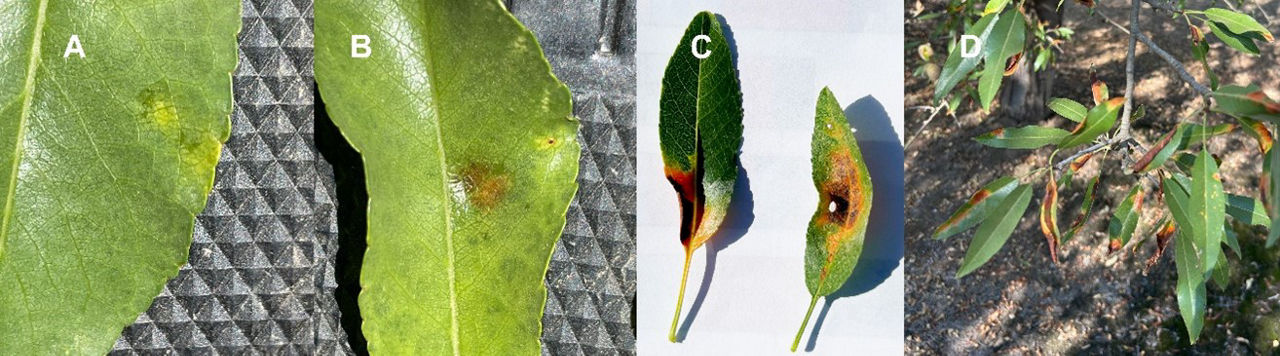
The initial symptoms of RLB are pale green to yellowish spots or blotches on both the upper and lower leaf surfaces (Figure 1). Over time, the blotches grow up to one inch (2 cm) in diameter and turn yellow-orange with reddish-brown centers, hence the disease name, red leaf blotch. As they expand, the lesions can have various shapes and can result in some leaf deformation and curling. Eventually, they can cover most of the leaf area. When severe, RLB can cause premature defoliation of affected trees, reducing the capacity for photosynthesis and resulting in yield loss. Infected leaves can deteriorate quickly in the summer when temperatures are high.2,3
Disease Cycle for Red Leaf Blotch
RLB is a monocyclic disease, meaning that there is only one cycle of infection and inoculum production per growing season. There is no tree to tree spread during the season. The fungal pathogen overwinters on infested leaf debris on the orchard floor. Over the winter and early spring, the fungus forms structures that will produce the sexual spores (called ascospores) in the spring. Ascospores are the primary inoculum for RLB.2,3 The ascospores are released and carried by air currents following rainy periods starting about the time that almond trees begin flowering. Spore production and release peak at the petal fall stage, when young leaves are starting to emerge. The spores land on and infect the developing leaves. Spore production and infection are favored by rain and moderate temperatures, and rainfall is required for the release and dispersal of the ascospores.2,4
Although infection takes place in the spring, symptoms on the leaves usually do not develop until 30 to 40 days after the time of infection. These are called latent infections, and the latent period is the time between infection and symptom development. A second spore stage (the asexual conidiospore) is produced on infected leaves in the summer, but these spores are not infective and do not result in any additional disease. The fungal pathogen is biotrophic, meaning that it requires living tissue to grow. Therefore, the pathogen can not be grown on culture media. This makes the disease more difficult to work with and study.2,3
Management of Red Leaf Blotch
Management strategies for RLB focus on reducing the amount of primary inoculum present and protecting the newly forming leaves from infection by the ascospores.3 Cultural practices to help reduce the amount of inoculum include the removal of infested leaf litter at the end of the season or the application of urea to help increase the rate of decomposition of the leaf debris. These practices may only be effective if implemented over a wide area because the primary inoculum (ascospores) can be carried from one orchard to another in the wind.2
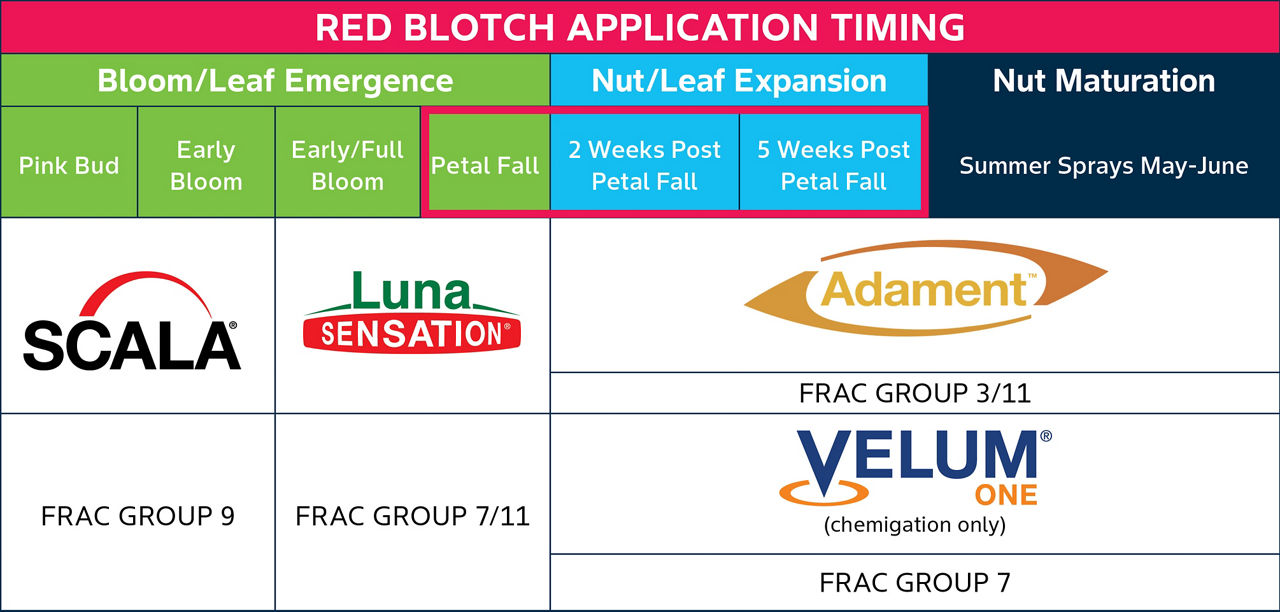
Preventative fungicide applications, starting at petal fall, have been shown to provide good control of RLB. One application at petal fall followed by additional applications two and five weeks later have been found to be very effective in research trials, especially if rainy conditions persist after petal fall.2,4 Fungicides need to be applied before symptoms develop to be effective against RLB. Applications before petal fall (at the beginning of flowering) or after symptoms have appeared have been found to be ineffective for managing RLB.
The fungicides that are typically used to help manage other fungal foliar diseases of almonds will likely also help to manage RLB if applied at the appropriate times. Fungicides belonging to FRAC groups 3, 7, and 11 have been shown to help in the management of RLB in research trials.2 However, because RLB has only recently been found on almonds in North America, the disease (and pathogen) are not listed as targets on the labels of fungicides currently registered for use on almonds.
FIFRA (federal insecticide, fungicide, and rodenticide act) section 2(ee) recommendations for use of several fungicides to help manage RLB on almonds have recently been approved for California. The 2(ee) recommendations allow the use of products including Luna Experience® Fungicide, Luna Sensation® Fungicide, and Velum® One Fungicide on almonds to help manage RLB. Luna Experience contains the fungicide active ingredients fluopyram (FRAC 3) and tebuconazole (FRAC 7). Luna Sensation Fungicide contains the fungicides fluopyram (FRAC 3) and trifloxystrobin (FRAC 11), and Velum One Fungicide contains fluopyram (FRAC 3). Research trials have found that mixtures of FRAC 3+7, 3+11, and 7+11 fungicides currently provide good protection against RLB on almond.2 Fungicide labels and the section 2(ee) recommendations state that fungicides belonging to various FRAC groups need to be rotated to help limit the development of fungicide resistance in pathogen populations.2 Maximum numbers of applications per season, maximum amounts of active ingredients applied per season, and maximum number of sequential applications of individual fungicide products are often listed on the product label or section 2(ee) recommendation statement. Always consult product labels, and supplemental documents, for instruction and restrictions on the use of the products.
Bayer’s fungicide portfolio starts with Scala® brand SC Fungicide to help protect bloom from early fungal diseases such as brown rot, jacket rot, and shot hole. Luna® Sensation can then take over offering systemic management of key almond diseases, including rust and Alternaria blight, up until two weeks post petal fall. Adament® FLOW and Velum® One Fungicides are options for long-lasting, late season disease control (Table 1).
Table 1. A Bayer recommended portfolio for season-long control of foliar diseases of almond.
Sources
1Trouillas, F., Hernandez-Rosas, A., Frias, R., Maguvu, T., Zuber, C., Gordon, P., and Holtz, A. 2025. First report of Polystigma amygdalinum causing red leaf blotch of almond in California. Plant Dis. 2025 Jul 8. doi: 10.1094/PDIS-04-25-0925-PDN. Epub ahead of print. PMID: 40627018.
2Trouillas, F., Hernandez-Rosas, A., Frias, R., Maguvu, T., Zuber, C., and Gordon, P. 2024. New threat to California almonds: Red leaf blotch. Sac Valley Orchards, University of California Agricultura and Natural Resources. https://www.sacvalleyorchards.com/almonds/foliar-diseases/new-threat-to-california-almonds-red-leaf-blotch/
3Zúñiga, E., Romero, J., Ollero-Lara, A., Lovera, M, Arquero, O., Miarnau, X., Torguet, L., Trapero, A., and Luque, J. 2020. Inoculum and infection dynamics of Polystigma amygdalinum in almond orchards in Spain. Plant Disease 104:1239-1246.
4Hsu, M. 2024. Almond crop yields threatened by disease new to California. Food Blog, UC ANR. https://ucanr.edu/blog/food-blog/article/almond-crop-yields-threatened-disease-new-california
Websites verified 05/06/2026. 7311_645900
Disclaimer
ALWAYS READ AND FOLLOW GRAIN MARKETING AND ALL OTHER STEWARDSHIP PRACTICES AND PESTICIDE LABEL DIRECTIONS.