7 MIN READ
Corn Root Lodging
February 14, 2026
- Corn root lodging occurs when corn roots are unable to anchor the plant against the forces of strong winds and abundant rainfall.
- Factors that can contribute to root lodging include corn product selection, soil and environmental conditions, insect damage, and herbicide injury.
- Recovery from root lodging depends on the growth stage of the corn plant at the time of the damage.
- Root-lodged fields should be closely monitored for the severity of lodging and other negative impacts that could require proactive management to minimize yield reductions.
Causes of Corn Root Lodging
Conditions that cause poor root development can predispose corn to root lodging. These include poor soil conditions at planting (wet, cloddy, or compacted soil), shallow planting, corn rootworm pressure, and herbicide injury. Corn root mass reaches its maximum by the R1 (silking) growth stage. Brace roots typically develop starting at the V18 growth stage. Brace roots provide stalk support and can be important in the recovery of plants root-lodged by strong winds. Drought conditions can hinder brace root development and the overall size of the root masses. Excess application of certain growth regulator herbicides can cause up-curling or fusing of the brace roots and twisting of other roots.
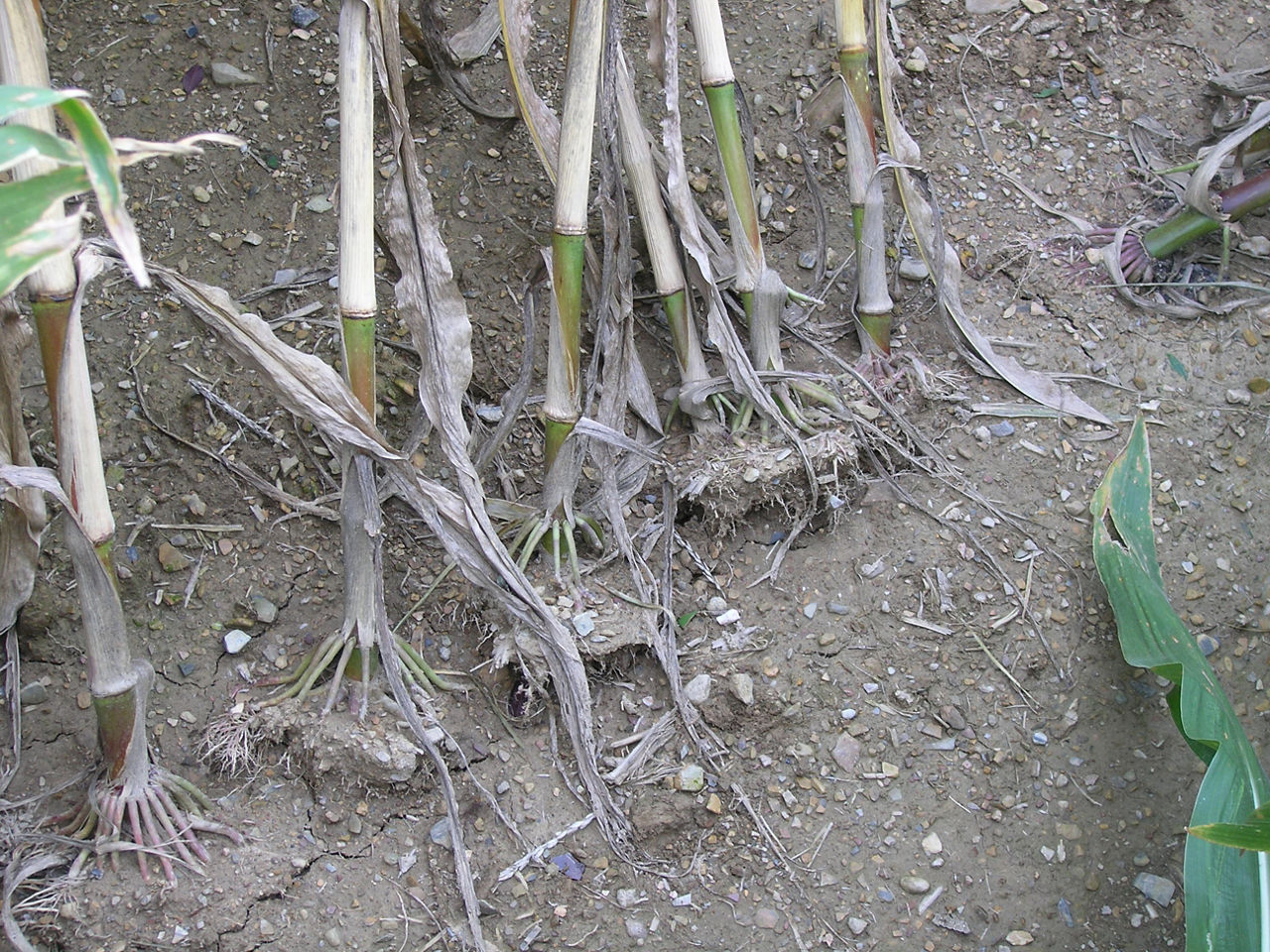
Strong winds can pull shallow roots partially out of the soil (Figure 1). Water-saturated soil at the time of a windstorm can make it easier for roots to be pulled by the force of the wind. Additionally, the stalks can buckle, causing the plant to lodge. Strong winds from one direction may pull the roots on one side of the plant and push roots further into the soil on the other, thus disrupting the “anchoring” system which may result in buckling. A rotation of the root system by as few as 10 degrees is enough to cause buckling of the corn stalk.1 Thunderstorms may also provide powerful downdrafts causing lodging in any direction and flatten corn in the field.2,3
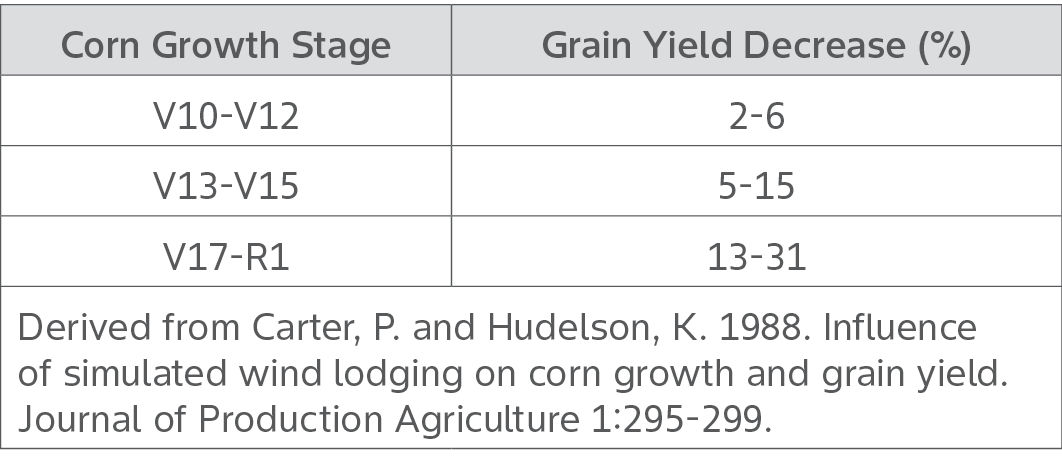
The effects of root lodging may depend on when the damage occurs.4 In general, the smaller the corn is when damage occurs, the less likely it will affect yield potential (Table 1).3 Corn can usually compensate for root lodging if damage occurs before silking (R1 growth stage). Corn stalks elongate until the R1 growth stage, so root-lodged plants may bend or “goose-neck” upward with the lower stalk leaning (Figure 2). The younger and shorter the corn, the more it can straighten-up following root lodging without noticeable goose-necking, especially in knee-high or shorter corn. Goose-necking is more pronounced in root lodged corn that is rapidly growing during later vegetative growth stages. The lifting or straightening-up of the plant generally occurs within a few days after root lodging without affecting the timing of plant development.
Table 1. Influence of simulated wind and root lodging on corn grain yield.
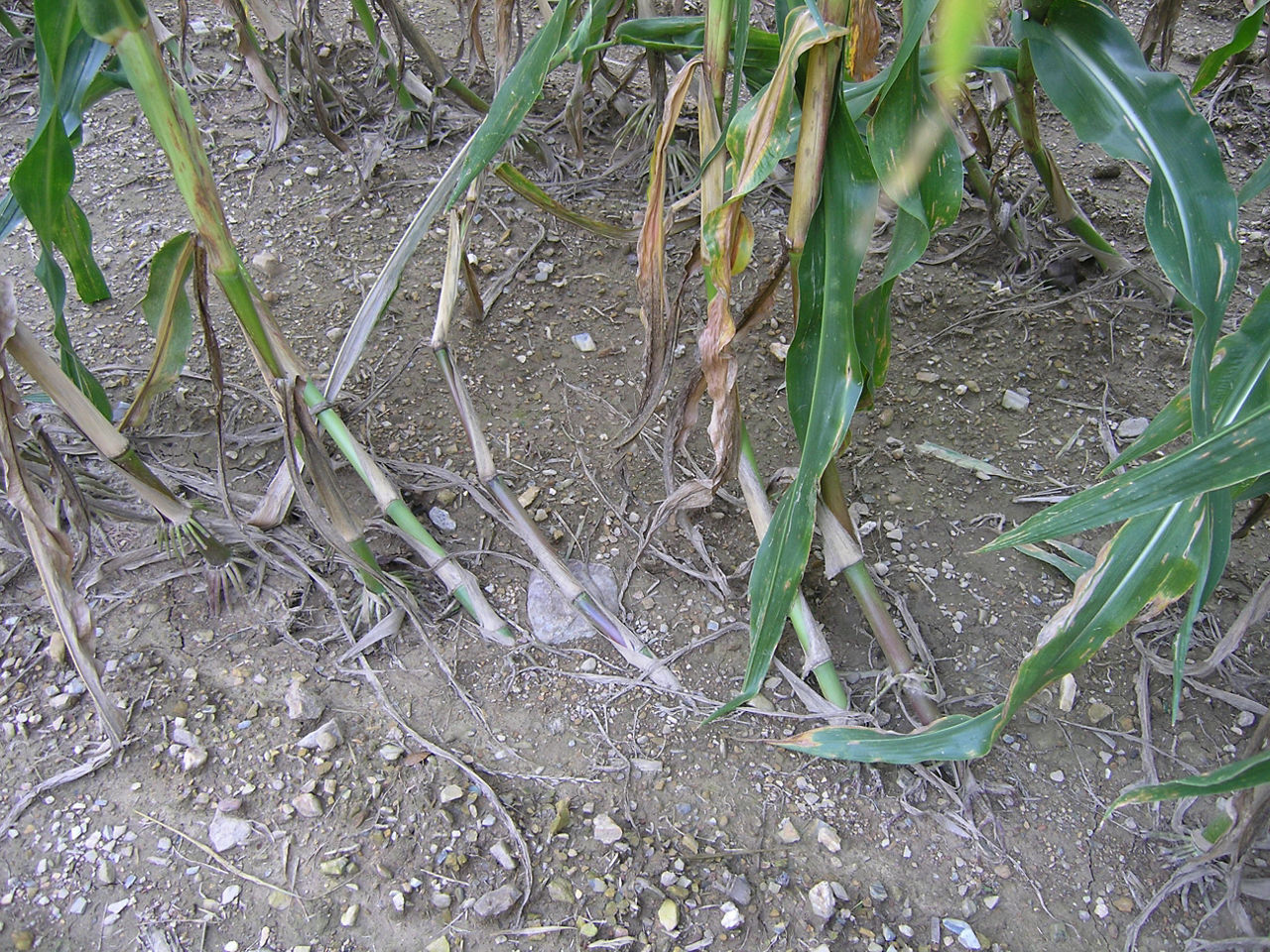
Pollination can still be successful with this type of recovery if tassels and ears with silk are lifted-up by the “goose-necking” of the elongating stalks. If damage occurs at tasseling or within days of pollination, severe yield loss can occur because stalk elongation is essentially completed, and the tassels and silks of damaged plants may be close to the ground and possibly covered. If damage occurs during grain fill, corn plants are likely to remain close to the ground and have reduced photosynthesis and nutrient uptake that could lead to kernel abortion and poor grain fill.
Managing Corn Root Lodging
Depending on the growth stage and wind severity at the time of the damaging event, corn may or may not continue to grow upright. It is important to be patient and allow time for the crop to recover before estimating damage or potential yield loss.5 Producers should note the growth stage of the corn and if any brace roots had been formed. Special management should be considered for plants that are damaged but survive. Lodged corn plants that are laying on each other or close to the ground may have a higher exposure to disease. Fungicide applications cannot recover the loss of yield potential due to lodging but may help protect against further yield reductions.
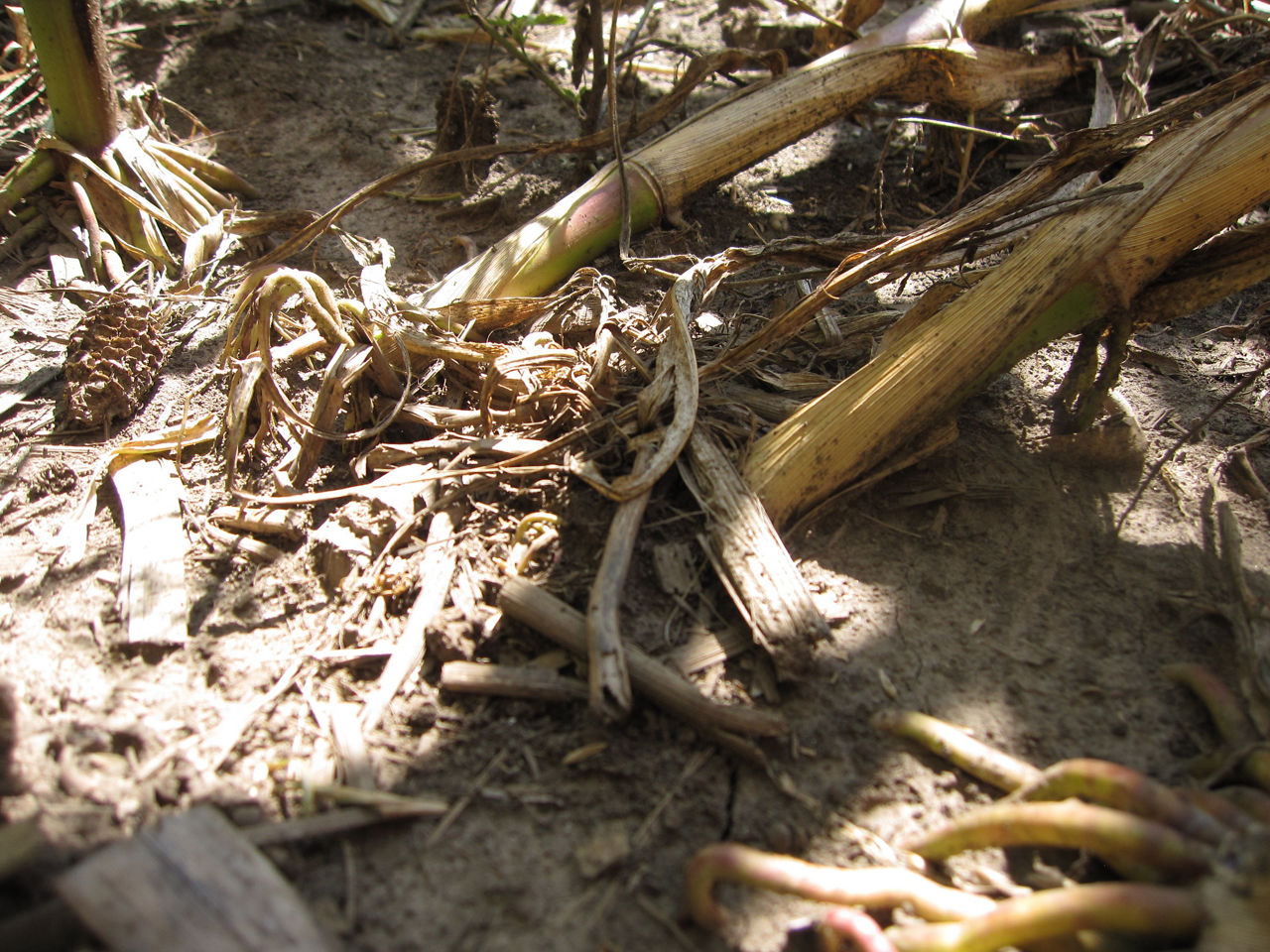
Watch lodged fields closely, especially near harvest. Goose-necked stalks can be difficult to harvest, resulting in mechanical harvest losses.6 Although yield losses may be minimal, harvesting can be slower with increased potential for ear loss. The use of after-market corn head reels may be of benefit to help direct stalks into the header. Corn stalks and ears lying on the ground can be especially difficult to pick up with harvesting equipment (Figure 3). Be patient and plan for a slow harvest with root-lodged corn.
Sources
1Ennos, A., Crook, M., and Grimshaw, C. 1993. The anchorage mechanics of maize, Zea mays. Journal of Experimental Botany 44(1): 147-153.
2Nielsen, R. 2002. Root lodging concerns in corn. Purdue University Department of Agronomy. Corny News Network. https://www.agry.purdue.edu/ext/corn/news/articles.02/RootLodge-0711.html
3Lauer, J. 2011. Yield response of flattened (lodged) corn. University of Wisconsin Agronomy Department. Field Crops 28.49 – 86. https://corn.agronomy.wisc.edu/AA/A086.aspx/.
4Nielsen, R. 2011. Prospects of recovery for root-lodged corn. Purdue University Department of Agronomy. Corny News Network. https://www.agry.purdue.edu/ext/corn/news/articles.11/FlatCorn-0726.pdf
5Quinn, D. 2021. “Flattened” or “root lodged” corn caused by heavy rain and wind – now what? Purdue University. Extension Entomology. Pest and Crop Newsletter. https://extension.entm.purdue.edu/newsletters/pestandcrop/article/flattened-or-root-lodged-corn-caused-by-heavy-rain-and-wind-now-what-2/.
6Elmore, R. 2005. Lodging: mid- to late-season. Iowa State University. Integrated Crop Management. https://crops.extension.iastate.edu/encyclopedia/lodging-mid-late-season/.
1215_141776
Disclaimer
ALWAYS READ AND FOLLOW GRAIN MARKETING AND ALL OTHER STEWARDSHIP PRACTICES AND PESTICIDE LABEL DIRECTIONS.