5 MIN READ
Uneven Corn Stands—Causes and Recommendations
January 29, 2026
- At planting it is important to have adequate soil moisture, optimum soil temperatures, good seed-to-soil contact, and consistent depth for even corn growth and emergence.
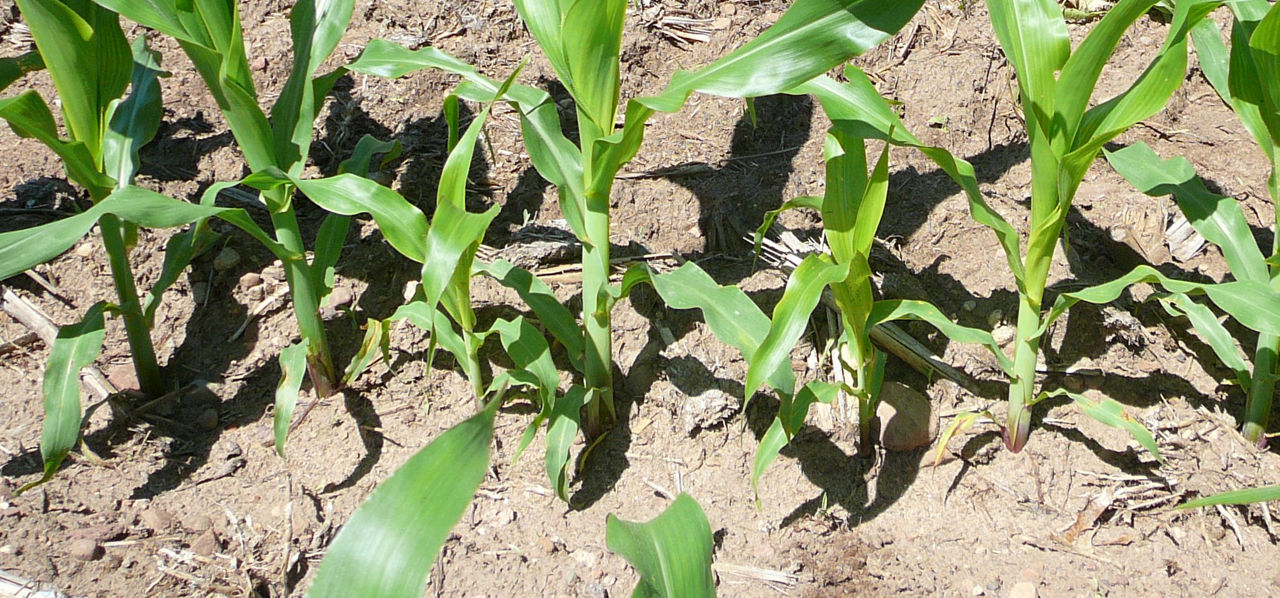
- Uneven corn stands have plants with differing heights and growth stages.
- If emergence of more than half of a corn stand is delayed by three weeks or more, yield potential can be reduced, and replanting may be justified.
What causes uneven corn stands?
Soil moisture. Uneven soil moisture throughout the seed zone is a main factor for uneven corn emergence. Soil moisture can vary within a field due to differences in soil characteristics or topography. A 1.5- to 2-inch depth is a good choice for many soil conditions but increasing to 2.5 to 3 inches may be necessary in dry soil conditions. Planting shallower than 1.5 inches may increase the risk of uneven germination and emergence due to drying of surface soils.1
Soil temperature. Typically, soil takes a longer time than air to warm up. The recommended temperature necessary for even corn seed germination is 50 °F. Below this threshold corn seeds can germinate but are more likely to emerge slowly and unevenly. When soil is wet or excessively cold, seeds and young seedlings are subjected to longer exposure to damaging factors such as soil-borne seed diseases, insect feeding, imbibitional chilling injury, and injury from pre-plant or pre-emergence herbicides or carryover herbicides from a previous crop.2,3 Under ideal soil temperature and moisture conditions, corn emergence can occur in about seven days.1 Variation in seed zone soil temperature can be caused by surface residue, differences in soil texture and color, soil drainage, and uneven seedling depth (Figure 1).
Seed-to-soil contact. Corn seeds need to imbibe about 30% of their weight in water before germination begins, less than that can slow or stop the germination process. Soil firmed around the seed allows moisture to absorb quickly and uniformly.1 Poor seed-to-soil contact can result from seed being in contact with residue, improper closure of the seed furrow, sidewall compaction, and cloddy soils; all of which may occur when soil is too wet.4 Soil crusting, herbicide injury, and damage from insects or diseases may also cause uneven corn emergence and growth.
What impact do uneven corn stands have on yield potential?
Uneven emergence can lead to a crop with plants at different growth stages. The later emerging plants are unable to capture enough sunlight and can have smaller stalks, smaller and fewer ears, and barren cobs leading to yield potential loss. In a study at the University of Minnesota, grain yield was reduced by roughly 20% for plants that are one-leaf stage behind earlier-emerged plants, and 50% for plants that are two leaf stages behind.5 A worksheet, Plant uniformity – corn, developed at Iowa State University can be used to estimate the potential yield loss because of uneven stands.
How can fields with uneven corn emergence be managed?
Wisconsin and Illinois researchers documented that replanting corn after an uneven stand is not warranted unless more than half of the plants are delayed by three weeks or more. Replanting fields with variable emergence and corn plant heights rarely leads to an increase in yield potential.6 To minimize the risk of uneven emergence, avoid working soil and/or planting when fields are too wet. Check periodically for uniform moisture and proper seed-to-soil contact during planting and adjust planter settings as necessary. When dealing with uneven stands throughout the growing season, it is important to use recommended herbicide application rates to avoid injuring corn. Be sure to apply herbicides based on the most advanced leaf stage in the field.5
Sources:
1Nielsen, R.L. 2020. Requirements for uniform germination and emergence of corn. Corny News Network. Purdue University. https://www.agry.purdue.edu/ext/corn/news/timeless/GermEmergReq.html.
2Nielsen, R.L. 2019. Visual indicators of germination in corn. ENTM Extension Newsletters. Pest & Crop Newsletter. Purdue University. https://extension.entm.purdue.edu/newsletters/pestandcrop/article/visual-indicators-of-germination-in-corn/.
3Licht, M. 2019. Imbibitional chilling or cold injury. Extension and Outreach. Integrated Crop Management. Iowa State University. https://crops.extension.iastate.edu/blog/mark-licht/imbibitional-chilling-or-cold-injury#:~:text=Imbibitional%20chilling%20occurs%20when%20there,the%20seed%20has%20imbibed%20water.
4Carter, P.R., Nafziger, E.D., and Lauer, J.G. 2014. Corn replanting. Corn Agronomy. University of Wisconsin-Madison. https://corn.agronomy.wisc.edu/Management/L004.aspx.
5Coulter, J. 2024. Key factors for evaluating corn stand establishment. Minnesota Crop News. University of Minnesota Extension. https://blog-crop-news.extension.umn.edu/2019/05/key-factors-for-evaluating-corn-stand.html
6Elmore, R. and Abendroth, L. 2006. What’s the yield effect of uneven corn heights? Integrated Crop Management. Iowa State University Extension and Outreach. https://crops.extension.iastate.edu/encyclopedia/whats-yield-effect-uneven-corn-heights.
1214_110752
Disclaimer
ALWAYS READ AND FOLLOW GRAIN MARKETING AND ALL OTHER STEWARDSHIP PRACTICES AND PESTICIDE LABEL DIRECTIONS.