Vyconic™ Soybean and Tolerance to Mesotrione
October 6, 2025
What are Vyconic™ Soybeans?
Vyconic™ Soybeans will represent the industry’s first trait package with tolerance to five herbicides (glyphosate, glufosinate, dicamba, 2,4-D, and mesotrione). This will represent Bayer’s next-generation herbicide tolerance platform. Features and benefits of Vyconic™ Soybeans will include:
- Tolerance to mesotrione for contact and residual weed control.*
- Two additional herbicide tolerance options (2,4-D and mesotrione) compared to Bayer’s third generation herbicide tolerance offering, XtendFlex® Soybeans.
- Outstanding yield potential.
- Unparalleled flexibility.*
- Excellent weed control programs*, with four unique sites of action (SOA) compared to three in Enlist E3® soybeans.**
- Five herbicides with foliar weed control activity* and two herbicides with residual weed control activity, compared to three and zero, respectively, for Enlist E3® soybeans.***
- Product testing across maturity groups (MG) MG000 to MG7 throughout North America.
What is mesotrione?
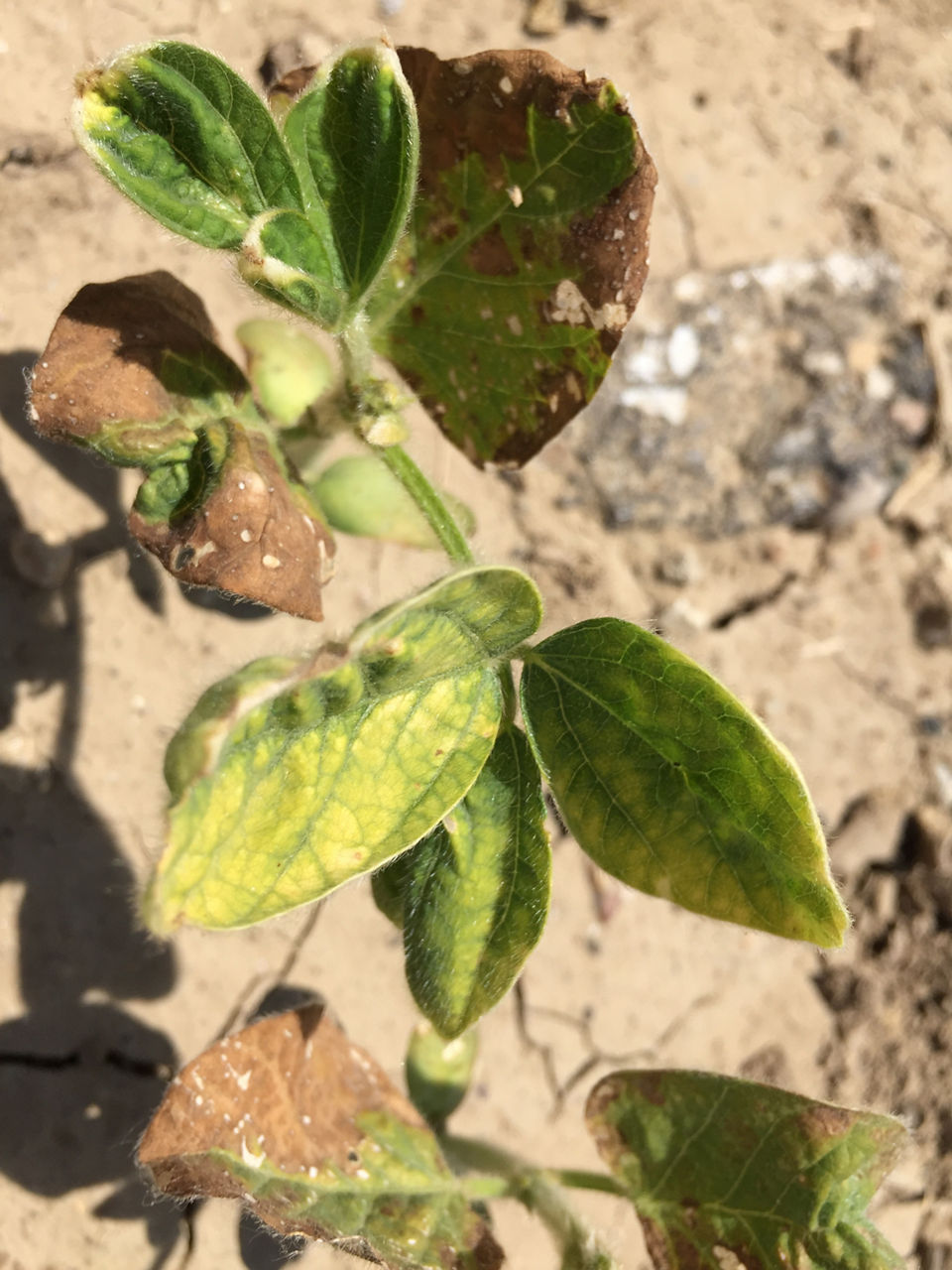
Mesotrione is a Group 27 herbicide (HPPD-inhibitor). HPPD inhibitors prevents pigment synthesis which leads to chlorosis, bleaching, and plant death for susceptible plants (Figure 1). Symptoms can range from bleached leaf margins to entire leaves, including the veins. Mesotrione moves through the phloem and injury symptoms appear on new growth. Microbial activity in the soil is the primary means of degradation. If microbial activity is reduced by dry soil conditions, the rate of breakdown may become slower. Longer persistence has been mainly observed in low organic matter soils, or in cases of overlap during the application to corn.
Mesotrione is an active ingredient in several corn herbicide products including Callisto® Herbicide and Halex® GT Herbicide. It can be applied preemergence or postemergence to corn and is currently labeled for the control of a broad spectrum of weed species including black nightshade, lambsquarters, pigweed, Pennsylvania smartweed, velvetleaf, waterhemp and Palmer amaranth. However, Take Action Herbicide-Resistance Management from the United Soybean Board lists waterhemp and Palmer amaranth as having resistant biotypes.
*Pending EPA label approval. NOT ALL formulations of glyphosate, dicamba, glufosinate, mesotrione, or 2,4-D are being pursued for regulatory approval for in-crop use with Vyconic™ Soybeans. ONLY USE FORMULATIONS THAT ARE SPECIFICALLY LABELED FOR SUCH USES AND APPROVED FOR SUCH USE IN THE STATE OF APPLICATION. It is a violation of federal and state law to use any pesticide product other than in accordance with its labeling
**Sites of Action defined by Site of Action group number follow the revised 2020 Herbicide Resistance Action Committee (HRAC) classification. Pending EPA approval. NOT ALL formulations of glyphosate, dicamba, glufosinate, mesotrione, or 2,4-D are being pursued for regulatory approval for in-crop use with Vyconic™ Soybeans. ONLY USE FORMULATIONS THAT ARE SPECIFICALLY LABELED FOR SUCH USES AND APPROVED FOR SUCH USE IN THE STATE OF APPLICATION. It is a violation of federal and state law to use any pesticide product other than in accordance with its labeling.
***Count includes Dicamba and Mesotrione; Areas with rainfall and/or irrigation after application with Dicamba will have reduced or limited efficacy on emerging weeds. Pending EPA label approval. NOT ALL formulations of glyphosate, dicamba, glufosinate, mesotrione, or 2,4-D are being pursued for regulatory approval for in-crop use with Vyconic™ Soybeans. ONLY USE FORMULATIONS THAT ARE SPECIFICALLY LABELED FOR SUCH USES AND APPROVED FOR SUCH USE IN THE STATE OF APPLICATION. It is a violation of federal and state law to use any pesticide product other than in accordance with its labeling.
Sources:
1 Anderson, M. and Hartzler, B. 2020. Identifying common herbicide symptoms in soybean. Integrated Crop Management. Iowa State University Extension and Outreach. https://crops.extension.iastate.edu/post/identifying-common-herbicide-symptoms-soybean
2 Bradley, K. 2024. Herbicide carryover concerns for soybean in 2024. Integrated Pest Management. University of Missouri. https://ipm.missouri.edu/croppest/2024/3/herbicide_carryover_concerns_soybean-kb/
3 Nice, G. and Johnson, B. 2011. Mesotrione carryover into soybean. Pest & Crop. Purdue Cooperative Extension Service. https://extension.entm.purdue.edu/pestcrop/2011/issue16/index.html
Kumar, V.; Stahlman, P. W.; and Boyer, G. (2018) "Palmer Amaranth Populations from Kansas with Multiple Resistance to Glyphosate, Chlorsulfuron, Mesotrione, and Atrazine," Kansas Agricultural Experiment Station Research Reports: Vol. 4: Iss. 7. https://doi.org/10.4148/2378-5977.7611
Web sources verified 07/11/2025. 1323_600601
Disclaimer
ALWAYS READ AND FOLLOW GRAIN MARKETING AND ALL OTHER STEWARDSHIP PRACTICES AND PESTICIDE LABEL DIRECTIONS.