How to Manage Herbicide Resistant Waterhemp, Palmer Amaranth, and Marestail in Soybean
September 15, 2025
- Growers face frustrations and challenges with managing herbicide resistant weeds in soybean that have demonstrated resistance to the site of action of several herbicides.
- Difficult weeds to manage include common or tall waterhemp (Amaranthus tuberculatus), Palmer amaranth (Amaranthus palmeri), and marestail (Conyza canadensis).
- Bayer Crop Science understands these challenges and recommends Integrated Pest Management approaches to help address herbicide resistant weeds.
The Site of Action Conundrum
An herbicide’s site of action (SOA) indicates how the chemical acts on and damages or kills target plants. SOAs include pigment inhibitors, cell membrane disrupters, nitrogen metabolism inhibitors, photosynthesis inhibitors, EPSP synthase inhibitors, growth regulators, amino acid synthesis inhibitors, lipid synthesis inhibitors, and seedling root and shoot inhibitors.1 If the same SOA is continually used on a population of weeds, natural selection may cause a weed species to adapt and become resistant to it. Waterhemp in the US has mutated into biotypes that may be individually resistant to one, two, three, four, or five different SOA chemistries, and the SOA combinations within the resistance can be different between populations.2 Palmer amaranth has resistant biotype combinations of one, two, three, four, five, and six SOA chemistries with different combinations.2 Marestail in the US has not become as resistantly diverse as waterhemp and Palmer; however, of its resistant biotypes, one is resistant to paraquat—a resistance which has not yet been found in waterhemp or Palmer amaranth.2 This cross-resistance creates the challenge for farmers to determine which herbicide SOA(s) is required to help control the multiple SOA–resistant plants. The challenge is increased if multiple resistant weed species, each with different SOA resistances, are present in the same field. As a further complication, these resistant biotypes may be widespread or localized. Additionally, in a soybean crop, volunteer transgenic corn plants resistant to glyphosate, glufosinate, or both may be present.
How to Manage Herbicide Resistant Weeds in Soybean through Integrated Pest Management
Integrated Pest Management (IPM) is an agronomic pest managerial approach that supports the utilization of various cultural, chemical, and environmentally friendly strategies to help manage pests, including herbicide resistant weeds. In many cases, economic thresholds have been established to help determine if and when pest control measures should be implemented. Approaches for managing herbicide resistant weeds in soybean may include:
- Selecting transgenic herbicide-resistant soybean products
- Crop scouting
- Crop rotation
- Use of labeled herbicides with different SOAs at different timings
- Fall
- Spring as a burndown
- PRE plant, or at planting and each timing with or without a residual herbicide(s)
- In crop (POST) applied herbicide applications
- Planting cover crops
Transgenic Herbicide Resistant Soybean Products
- Vyconic™ Soybeans are a Future Consideration
Planting transgenic soybean seed with herbicide tolerance to multiple sites of action helps in the management of resistant weeds. Bayer Crop Science anticipates a market introduction of Vyconic™ soybeans with tolerance to five SOA herbicide groups in the US by the 2027 planting season. Vyconic™ soybeans offer tolerance to glyphosate, glufosinate, mesotrione, dicamba* (pending EPA label approval), and 2,4-D. Mesotrione and 2,4-D are effective against a wide range of broadleaf weeds, including Palmer amaranth and tall waterhemp.
*No dicamba may be used in-crop with Vyconic™ Soybeans, unless and until approved or specifically permitted, and no dicamba formulations are currently registered for such use. Please follow www.roundupreadyxtend.com/pages/xtendimax-updates.aspx for status updates. Dicamba may harm crops that are not tolerant to dicamba.
- XtendFlex® Soybeans, offered by Bayer Crop Science, have tolerance to glyphosate, glufosinate, and dicamba*. Glufosinate can be applied over the top from emergence up to bloom (R1 growth stage) to help manage glyphosate resistant tall waterhemp, marestail, and Palmer amaranth.
*No dicamba may be used in-crop with seed with Roundup Ready® Xtend Technology, unless and until approved or specifically permitted, and no dicamba formulations are currently registered for such use.
Crop Scouting
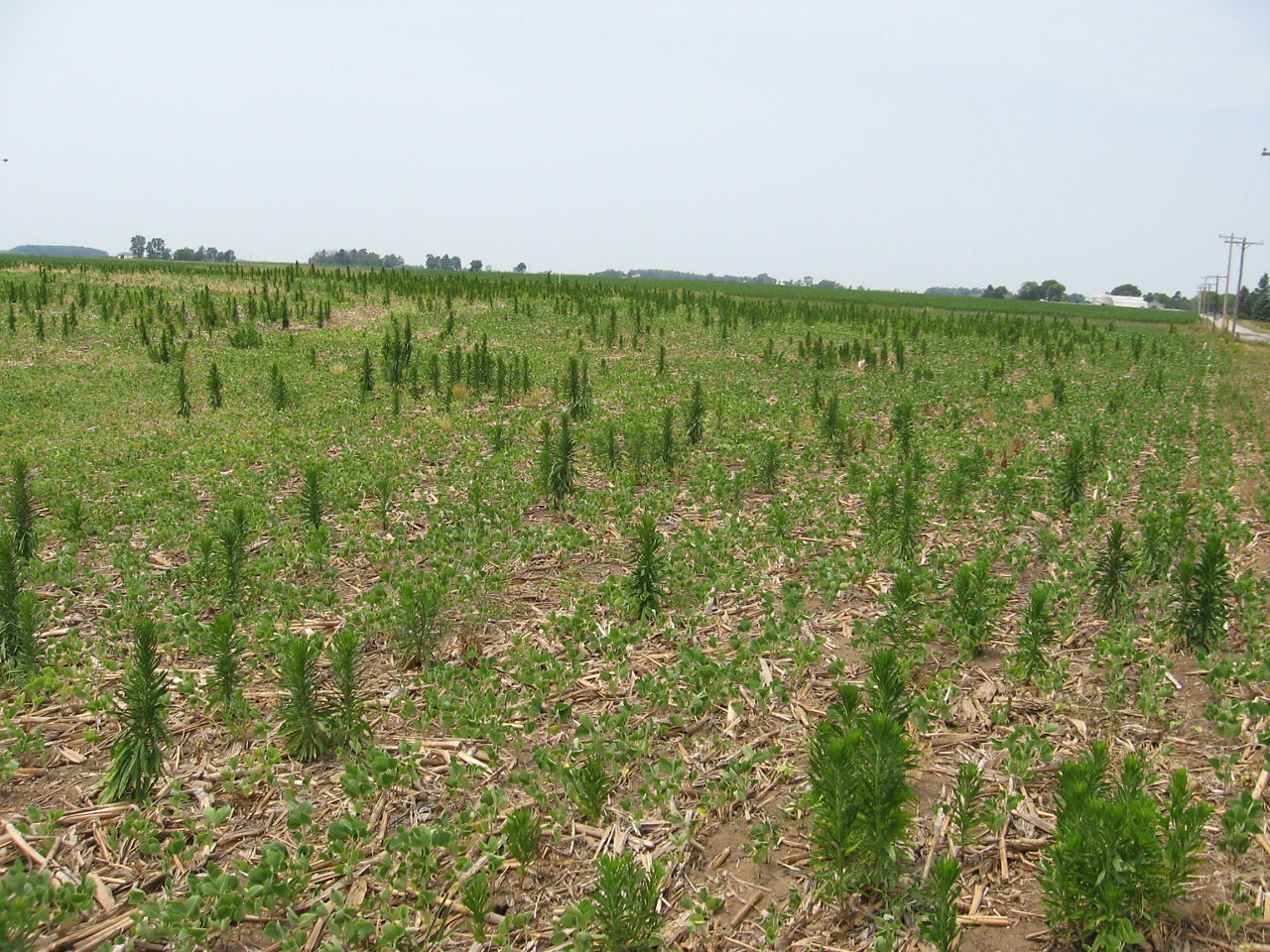
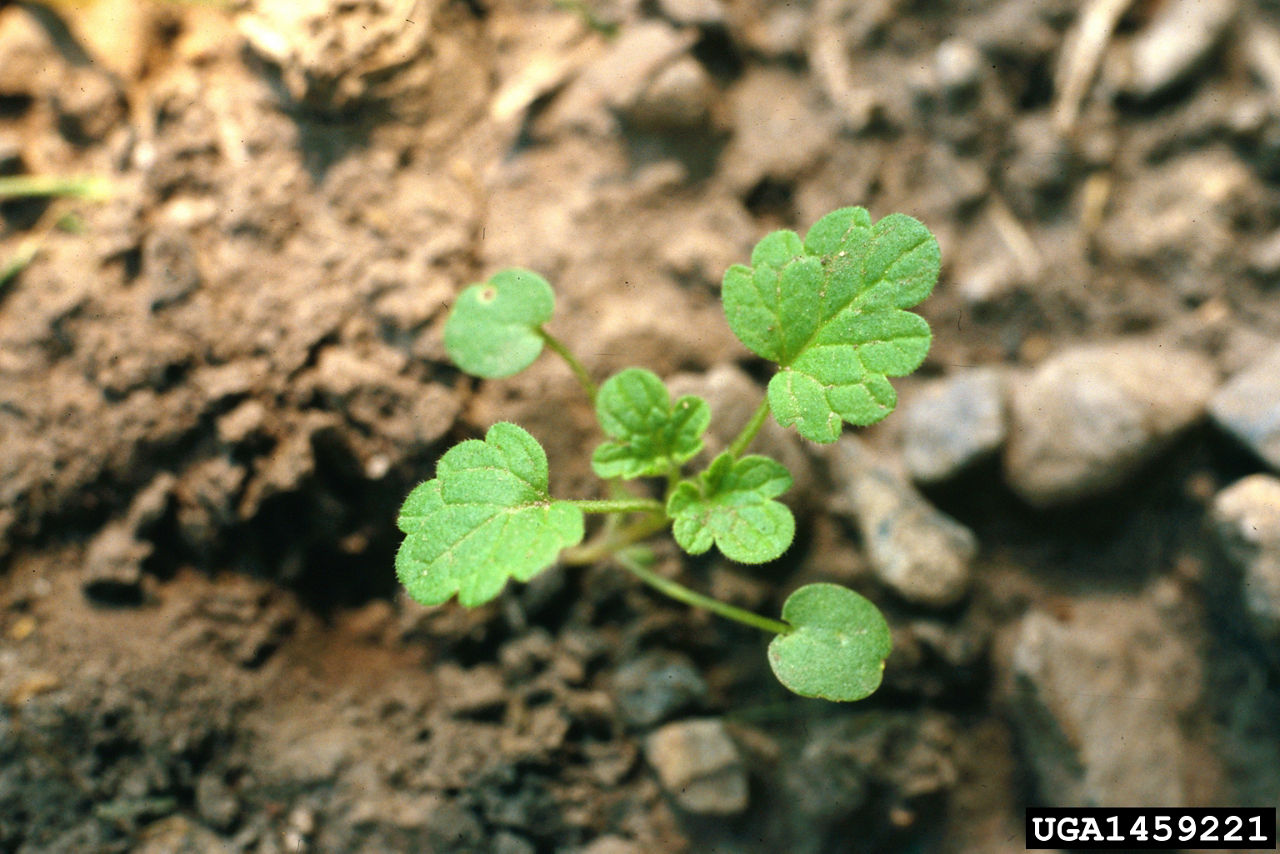
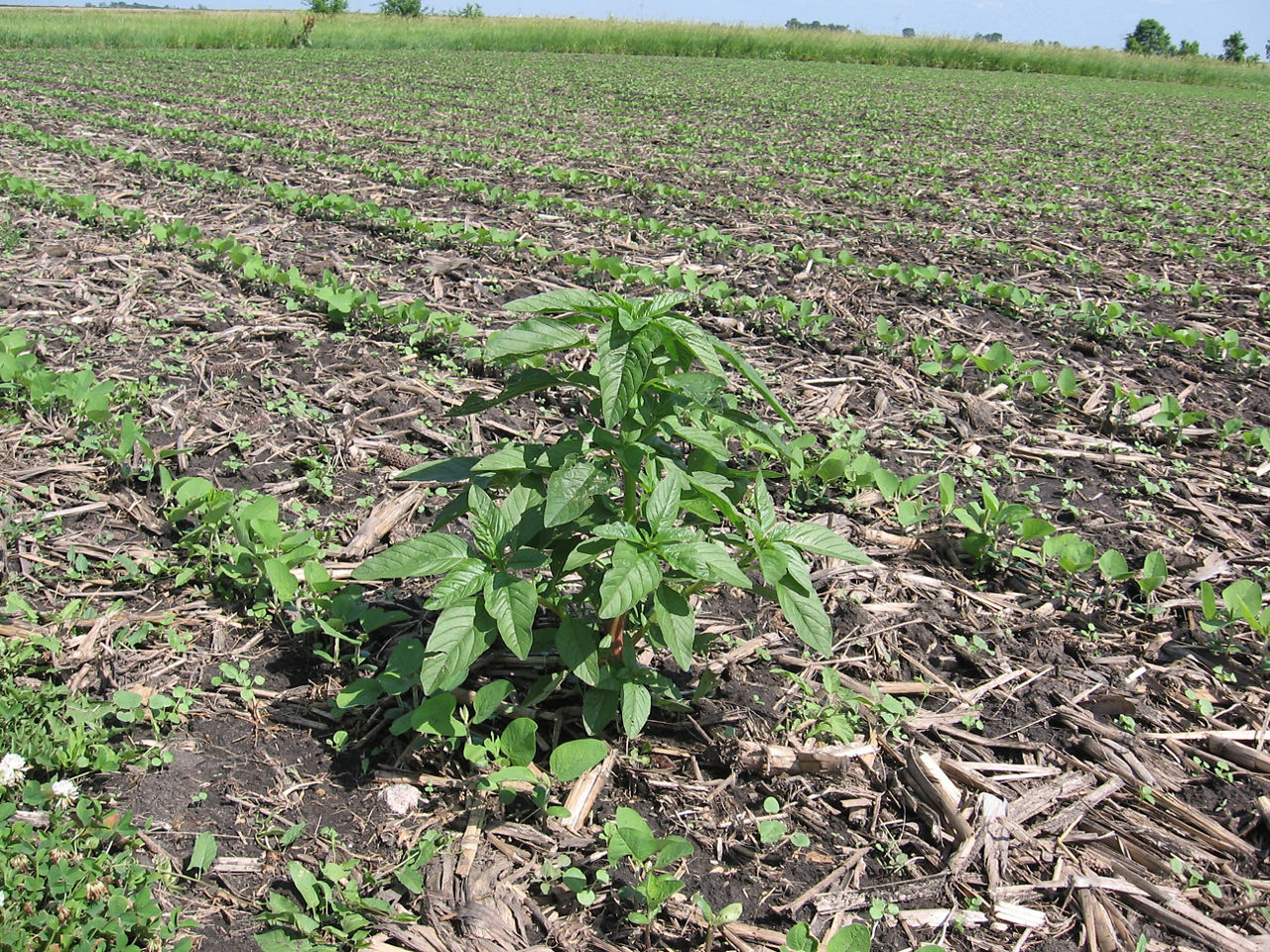
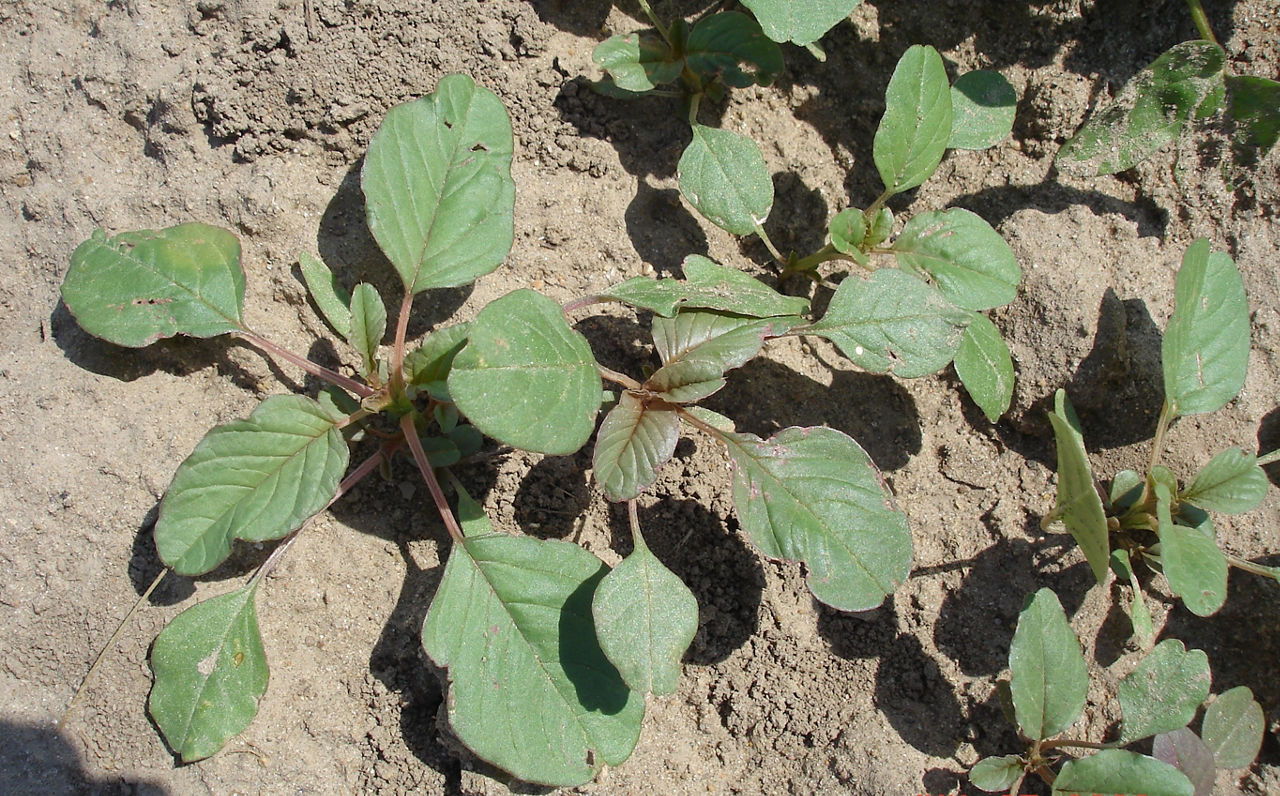
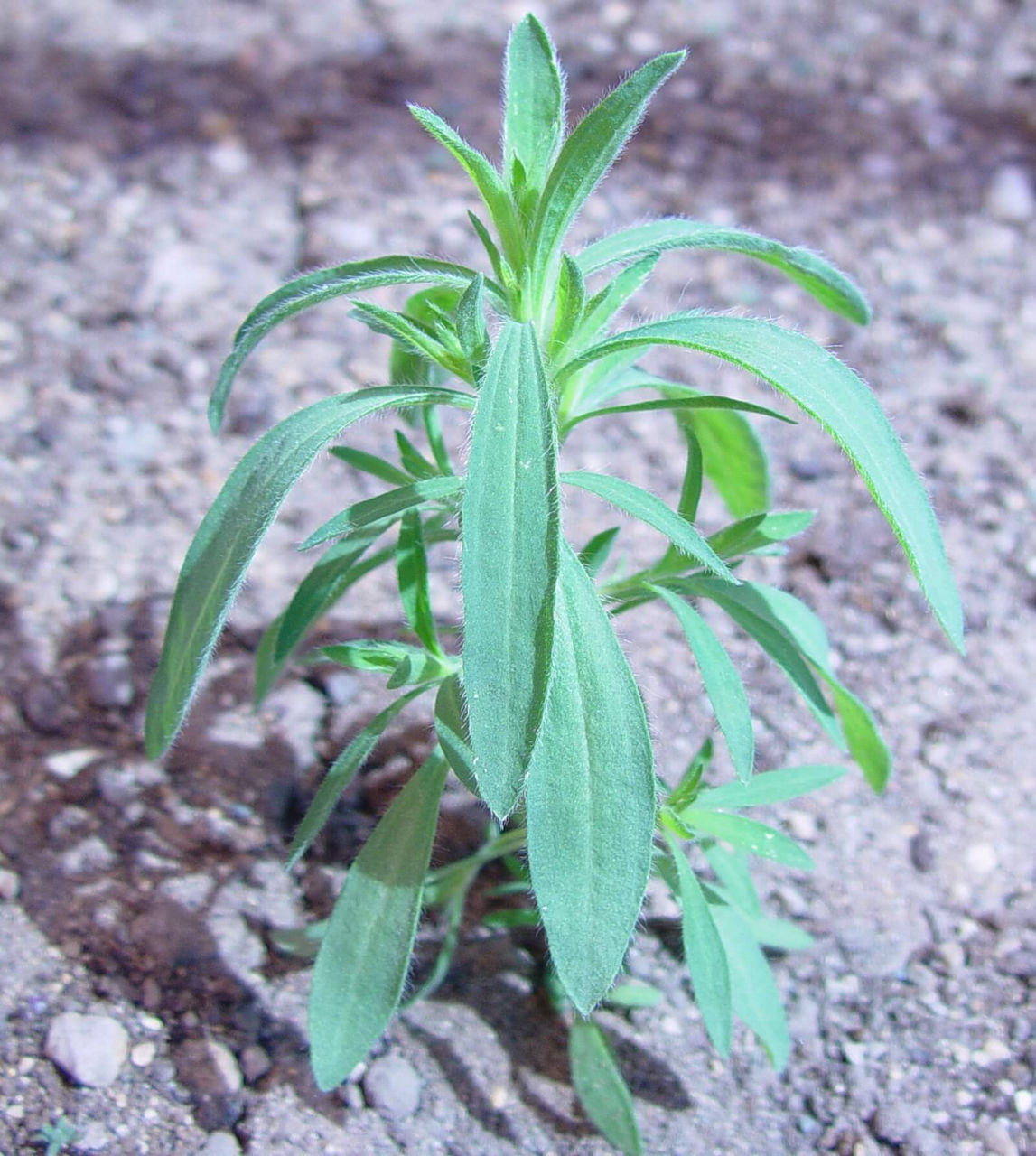
Observing fields for weeds should be a continuous effort throughout the year because winter annuals such as marestail (Figure 1) and henbit (Lamium amplexicaule; Figure 2) germinate in the fall and mature the next growing season; annual weeds such as waterhemp (Figure 3), Palmer amaranth (Figure 4), and kochia (Kochia scoparia) (Figure 5) germinate in the spring and mature by fall; biennial weeds have vegetative growth the first year and reproduce the second; and perennial weeds persist from year to year. Maintaining a watchful eye during harvest for emerging winter annuals can help determine if tillage or a fall-applied tank mix of a non-selective herbicide(s) for emerged weeds and a residual herbicide would be beneficial. Regardless of crop, scouting during the growing season can reveal the presence of different weed species and help determine a management approach.
Crop Rotation
Rotating soybean fields annually to a different crop such as corn can help manage difficult weeds in soybean fields because there are other SOA chemistries available for corn. For many growers, crop rotation results in a tillage operation for corn which can help disrupt weed growth where soybean may be no-tilled.
Use of Soybean Herbicides with Different Sites of Action
Alternating herbicide chemistries and using tank mixes of different SOA herbicide products can help reduce the potential for resistance development. The United Soybean Board Take Action Herbicide Classification Chart provides information on the SOA of different chemistries.1
Post Harvest Weed Management
Weed management for a next-season soybean crop can begin after harvesting the current rotational crop. Tillage, mowing, and herbicide SOA combinations are potential management tools. Depending on geographical area, Palmer amaranth seeds may germinate and produce seeds after harvest.3 Mowing can cut plants off before seed heads develop, tillage can uproot plants, and appropriate herbicides can kill susceptible weeds.
Applying foliar non-selective herbicides tank-mixed with a soil residual herbicide can help reduce the potential for marestail, henbit, and other winter annuals from continued growth or emergence in the fall. If glyphosate resistant weeds are present, paraquat may be an option. Herbicide labels must be read and followed for restrictions to the planting of soybean in the spring.
Start Clean in the Spring
Prior to planting a soybean crop, the field should be clean of weed growth. This can be accomplished with tillage or an herbicide burndown in conventional fields or a burndown in no-till fields. Weather permitting, tillage should occur while weeds are small, as larger weeds may not be fully uprooted. Full-rate herbicide applications are recommended before weeds grow to four inches in height. Reduced rates may not kill the plant, which can increase the potential for resistance development. Depending on known resistant weeds, glyphosate, glufosinate, and paraquat are potential non-selective chemistries to consider for the burndown. The addition of an appropriately labeled 2,4-D or dicamba can be beneficial for burndown applications; however, there are plant back restrictions for soybean. Herbicide labels must be read and followed. Consideration should be given to the use of soil residual herbicides when the burndown is applied to help keep weeds from emerging. Burndown and residual labels must be read and followed for any required delays before planting soybean.
PRE-Applied Herbicides With or Without a Soybean Residual Herbicide(s)
Prior to or at planting, an application of a labeled soybean residual herbicide such as Warrant® Herbicide (Group 15) plus a Group 14 herbicide should be considered to help reduce the germination of waterhemp species, pigweed species (including Palmer amaranth), and other broadleaf and grassy weed seeds. In no-till and reduced tillage fields, an application of a labeled non-selective herbicide such as a Roundup® agricultural herbicide or a paraquat-containing herbicide should be tank mixed with Warrant® Ultra Herbicide to help control emerged weeds such as marestail and henbit.
POST Applied Soybean Herbicide(s) With or Without a Soybean Residual Herbicide(s)
Knowledge of any weed resistance in soybean fields can help determine the use of labeled POST emergent herbicides. A glufosinate application on glufosinate-tolerant soybean plants can help manage glyphosate resistant marestail, waterhemp species, and Palmer amaranth. A POST applied residual herbicide tank mix such as Warrant® Herbicide plus a Group 14 herbicide can help deter the emergence of labeled weed seeds.
Cover Crops for Weed Suppression
The planting of cover crops in the fall can help suppress the emergence and establishment of difficult to manage winter annuals. Research in Alabama demonstrated that cereal rye and a cover crop mixture were effective in suppressing early season weeds.4 Consideration should be given to when and how the cover crop should be terminated if winter freezing does not kill a cover crop.5
Cover crops have the additional benefits of adding organic matter to the soil, absorbing unused nutrients to help deter nutrient loss from leaching and runoff, and helping to reduce soil erosion from wind and water.
Summary
Herbicide resistant weeds are considered “difficult to control” because of their ability to mutate. However, there are cultural and chemical solutions for their management in soybean. For additional information on managing herbicide resistant weeds and many other agronomic topics, please visit the Bayer Crop Science Agronomic Article website. Your Bayer Crop Science representative can also provide management recommendations for managing herbicide resistant weeds for your operation.
Sources
1Sprague, C. 2024. Herbicide classification chart. Take Action Herbicide-Resistance Management. Funded by soy checkoff. United Soybean Board. https://growiwm.org/take-action-classification-chart/
2Heap, I. The International Herbicide-Resistant Weed Database. Online, July 16, 2025. Herbicide Resistance Action Committee. Funded by the Global Herbicide Resistance Action Committee and CropLife International. WeedScience.org. https://weedscience.org/Pages/aboutus.aspx
3Thompson, C. 2019. After corn harvests, farmers should continue managing weeds. University of Georgia Cooperative Extension, CAES Newswire. https://newswire.caes.uga.edu/story/8050/weed-control.html
4Kumari, A., Price, A.J., Gamble, A., Li, S., and Jacobson, A. 2024. Integrating cover crops and herbicides for weed control in soybean. Weed Technology. 38: e38. https://doi.org/10.1017/wet.2024.24
5Watson, S. and Comstock, D. 2016. Using cover crops for weed control: Consider all aspects. Kansas State University, K-State Research and Extension News. https://www.ksre.k-state.edu/news/stories/2016/11/cover-crop-weed-control.html
Web sources verified 8/20/25. 1323_612451
Disclaimer
ALWAYS READ AND FOLLOW GRAIN MARKETING AND ALL OTHER STEWARDSHIP PRACTICES AND PESTICIDE LABEL DIRECTIONS.