Identification, Economic Impacts, and Management of Greenbugs in Sorghum
December 15, 2025
The greenbug (Schizaphis graminum) can be one of the most important and damaging insects of grain and forage sorghum crops across the United States. To effectively manage greenbugs, identification is important because of the similarity to corn leaf aphids.
Identification
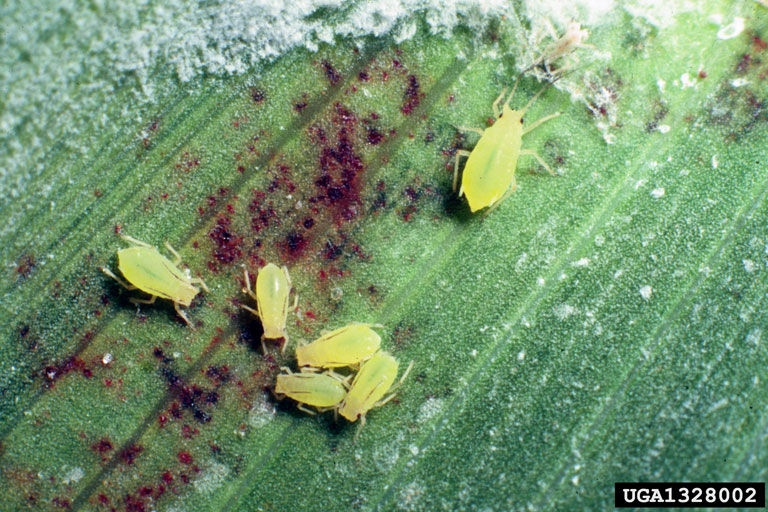
Greenbugs are light green or greenish-yellow aphids, have green legs with black feet, and have a narrow darker green stripe down the center of their backs (Figure 1). The cornicles (small “tail pipes” near the rear end) are green with black tips. Nymphs, immature greenbugs, exhibit a brownish-gray dorsal coloration with a green abdomen. Both winged and wingless greenbugs may be found in sorghum.1
In contrast, corn leaf aphids are blue-green to gray, lack the dark green stripe, spherical, soft-bodied, pinhead sized, and the two cornicles are black, short, and have a dark area around their base. The head, feet, and legs are also black. Both insects secrete honeydew.4 For additional information on corn leaf aphids, please visit Corn Leaf Aphids.
Economic Impact
Plant injury can occur quickly because greenbugs can multiply rapidly by parthenogenesis whereby females produce live young without mating. They injure plants by sucking sap from the leaves and injecting toxins that cause leaf yellowing and plant death. Heavy infestations can reduce yield dramatically or even cause total crop loss if not controlled in time.3 Economic losses also occur indirectly through increased costs for insecticides and reduced grain quality. Early detection and integrated pest management (IPM) are essential to prevent widespread outbreaks that threaten local and regional markets. Greenbugs, through their feeding, may vector Maize Dwarf Mosaic Virus (MDMV) if johnsongrass is present in the field, and several other viruses including barley yellow dwarf virus, sugarcane mosaic virus and millet red leaf virus.3,4 For additional information on MDMV, please visit Grain Sorghum Diseases: Identification and Management.
Management Strategies1,2,3
Greenbug management can be challenging because greenbugs have shown the ability to develop tolerance to plant resistance and organophosphate insecticides.1 Therefore, it is important to use Integrated Pest Management tactics for management and to help reduce the potential for resistance.
- Resistant Products: Planting sorghum products resistant to greenbugs remains one of the most cost-effective and sustainable strategies.
- Monitoring and Thresholds: Regularly inspect fields. Table 1 provides recommendations for treatments based on average number of greenbugs per plant at different growth stages.
- Biological Control: Beneficial insects such as lady beetles, lacewings, and parasitic wasps naturally reduce greenbug populations.
- Chemical Control: In areas with a history of greenbug infestations, apply insecticides at the first sign of pest presence. Recommended insecticides should be used according to label instructions, with a focus on rotating products to prevent resistance development. From a control standpoint, registered granular and liquid planting time insecticides, and seed treatments can provide effective control. Also, foliar applied insecticides can be effective if detected early enough. A minimum of 15 gal/acre of finished foliar insecticide material should be applied using a ground rig with drop nozzles so the spray may be directed up and under the bottom leaves because greenbugs are mostly found on the leaf underside.1 Recommended dosage and application intervals should be followed to maximize effectiveness.
- Cultural Practices: Early planting may help crops escape peak greenbug periods.
Table 1. Treatment Guideline for Greenbugs*
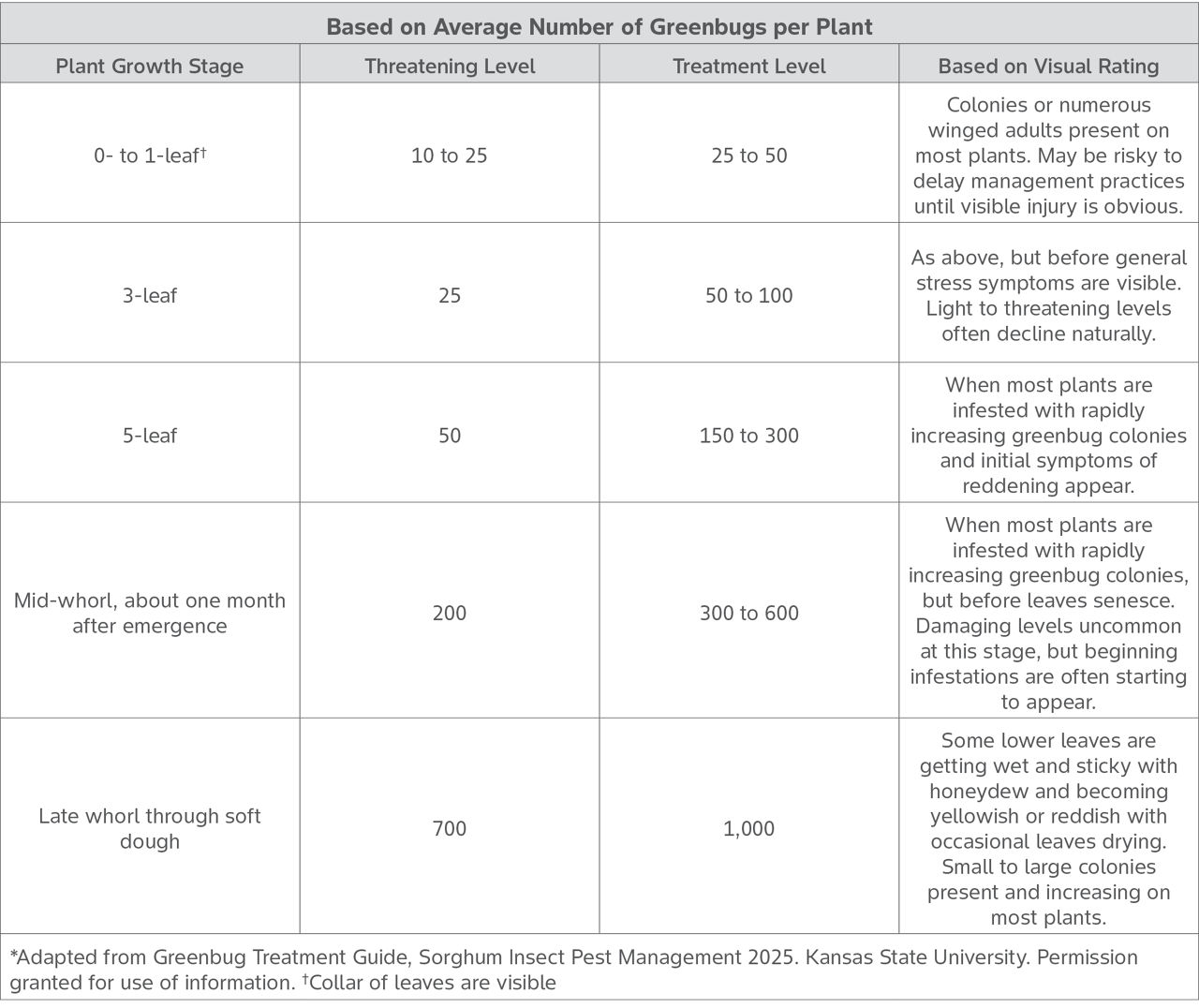
The guidelines in Table 1 are based on sorghum growth stages. For additional sorghum growth stage information, please visit Sorghum Growth Stages.
Conclusion
The greenbug poses serious economic threats to sorghum growers, but with vigilant scouting, resistant sorghum products, and integrated pest management strategies, producers can effectively reduce potential losses and maintain healthy, profitable crops.
Travis Edeal
Channel Agronomist
Sources
1Wright, R., Danielson, S., and Mayo, ZB. 2006. Management of greenbugs in sorghum. G838. NebGuide. University of Nebraska-Lincoln. https://extensionpubs.unl.edu/publication/g838/2006/pdf/view/g838-2006.pdf
2Zukoff, A., McCornack, B.P., and Whitworth, R.J. 2025. Sorghum insect pest management 2025. K-State Research and Extension. Kansas State University Agricultural Experiment Station and Cooperative Extension Service. https://bookstore.ksre.ksu.edu/download/sorghum-insect-pest-management-2025_MF742
3Patrick, C.R. and Thompson, A. 2008. Greenbug in grain sorghum. Insects. SP290-N. University of Tennessee Extension. The University of Tennessee Institute of Agriculture. https://shelbycountytn.gov/DocumentCenter/View/1265/The-Greenbug-in-Grain-Sorghum
4van Emden, H.F. and Harrington, R. 2017. Aphids as crop pests. CABI Digital Library.
Websites verified 10/29/25. 1110_708742
Disclaimer
ALWAYS READ AND FOLLOW GRAIN MARKETING AND ALL OTHER STEWARDSHIP PRACTICES AND PESTICIDE LABEL DIRECTIONS.