Soybean Red Crown Rot Management for Following Seasons
October 15, 2025
Soybean Red Crown Rot, caused by the soilborne fungus Calonectria ilicicola, has become a disease of concern for Midwestern soybean growers.1 Prior to being found in Illinois in 2018, soybean red corn rot was common in the southeastern U.S. where soybean and peanut crops were rotated. Along with Illinois, incidences have now been verified in Kentucky, Indiana, Missouri, and Ohio. Once in a field, the pathogen can survive in the soil for several years because of the microsclerotia that overwinter with or without a host such as soybean.1 With this opportunity to survive for long periods, there is a high potential for reoccurrence in future soybean crops.1
Soybean Red Crown Rot Management Strategies
- Crop Rotation – Though the pathogen can survive for several years without a susceptible host, crop rotation to non-host crops such as corn or small grains for at least two years can help reduce the potential for increased production of microsclerotia.1 Other hosts include red, white, and crimson clover, vetch, lupine, alfalfa, and peanuts.2
- Soil Management – Soybean red crown rot infection occurs under warm (77 to 86 °F), wet conditions.1,2,3,4 Therefore, consideration should be given to improving drainage to help reduce the potential for fields retaining water.1,2 Compacted soils should be addressed as they can hinder drainage and cause ponding.
- Seed Treatments – Seed treatments cannot eliminate the pathogen; however, they may help reduce symptoms and infection.4
- Soybean Products – Currently, no soybean products are resistant to soybean red crown rot; however, there may be differences in tolerance among soybean products.2,4 Nematode resistant soybean products should be considered as wounds created by nematode feeding provide an entry point for disease pathogens.1,3
- Equipment Sanitation – Equipment should be cleaned before moving from soybean red crown rot infected fields to non-infected fields. The microsclerotia can be transported to other fields with soil and crop residue adhering to the equipment.2,3
- Planting Date – Delay soybean planting if soils are wet and temperatures are warm. These conditions favor early infection.2
- Scouting – Fields should be scouted regularly to observe for soybean red crown rot symptoms as well as other diseases, insects, and agronomic issues.
Soybean Red Crown Rot Identification
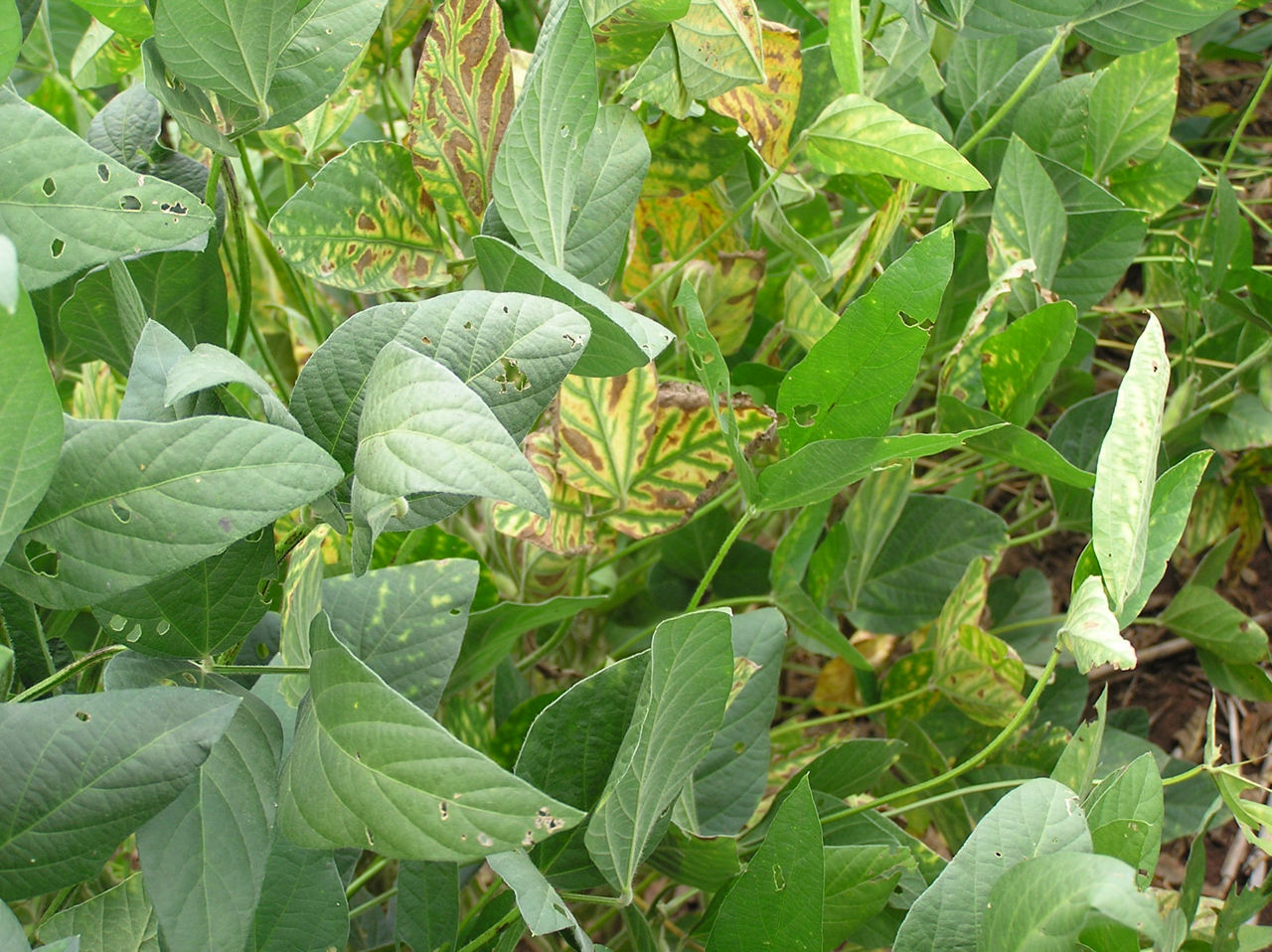
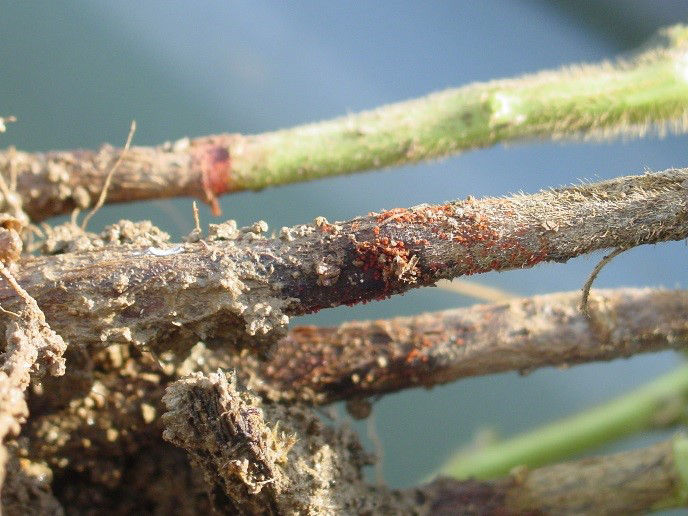
Though soybean plant infection may occur early in the season, foliar symptoms start appearing between R3 and R7 growth stages.3 Interveinal chlorosis on leaves may appear on scattered or patches of plants. The chlorosis can mimic that of sudden death syndrome (SDS) and brown stem rot (BSR) (Figure 1).5 Plant stems should be examined and split to help distinguish between the diseases. Sudden death syndrome pith is white, brown stem rot pith is brown, and red crown rot pith is grayish.5 The lower stem of red crown rot has a red discoloration near the soil line and red, spherical perithecia may be visible on the outer lower stem tissue (Figure 2). The roots of red crown rot infected plants are rotted, and the plants can be easily pulled out of the soil.1,5
For additional information on Soybean Red Crown Rot, please visit Red Crown Rot in Soybean.
Zak Swanson
Channel Agronomist
1110_642262
Sources
12019. Red crown rot of soybean. Crop Protection Network. A Product of Land Grant Universities. https://cropprotectionnetwork.org/encyclopedia/red-crown-rot-of-soybean
2Lopez-Nicora, H. 2025. Red crown rot confirmed in Ohio soybean field for the first time. Ohio’s Country Journal. https://ocj.com/2025/08/red-crown-rot-confirmed-in-ohio-soybean-field-for-the-first-time/
3Joyce, A. and Thiessen, L. 2020. Red crown rot of soybean. Soybean Disease Information. NC State University Field Crops and Tobacco Lab. NC State Extension Publications. North Carolina State University. https://content.ces.ncsu.edu/red-crown-rot-of-soybean
4Geist, L. 2024. Red crown rot: No cure for this soybean disease. University of Missouri Extension. https://extension.missouri.edu/news/red-crown-rot-no-cure-for-this-soybean-disease
5Telenko, D. and Bonkowski, J. 2024. Red crown rot of soybean: What to do if you suspect it is in your field. ENTM Extension Newsletters. Pest&Crop newsletter. Purdue University. https://extension.entm.purdue.edu/newsletters/pestandcrop/article/red-crown-rot-of-soybean-what-to-do-if-you-suspect-it-is-in-your-field-2/
Disclaimer
ALWAYS READ AND FOLLOW GRAIN MARKETING AND ALL OTHER STEWARDSHIP PRACTICES AND PESTICIDE LABEL DIRECTIONS.