Corn Planting Before Rainfall Events – DEKALB® Brand Corn Yield Response by Day, Depth, and Date
February 2, 2026
TRIAL OBJECTIVE
- The desire to plant very early exposes crops to stress from cool, wet soil.
- Planting depth affects moisture imbibition and time to emergence. In some cases, bird predation is a concern for losing shallow planted seed.
- Growers often question when planting should be stopped before a forecasted rainfall event to avoid chilling injury and slow early growth.
- The Bayer Crop Science Learning Center at Scott, MS conducted a trial to further assess potential interactions of planting dates, soil conditions, and seeding depth.
RESEARCH SITE DETAILS
![DEKALB Seed Evaluation Field Characteristics and Background for corn planting research] report](https://cs-assets.bayer.com/is/image/bayer/dekalb-brand-corn seed-evaluation-field-characteristics-background-1210_709500)
Table 1. DEKALB® brand corn products planted and their traits and relative maturities. Results were averaged across the two corn products.

- All field work, tillage, and herbicides were done per local standards.
- The trial used non-replicated strip plots.
- Plot Size – 6-row plots, 145 ft length, approximately 0.07 acre/plot
- Plots were set up as follows
- Planting Dates – Planting was timed to coincide with a rainfall event less than 24 hours after the last date on which each series was planted. Approximate rainfall amounts are listed below.
- 2/28/2025 to 3/3/2025 – Early Date
- ≈ 1 inch rainfall, 3/4/2025
- 47 °F, morning soil temperature at 3.0-inch depth
- 3/19/2025 to 3/22/2025 – Mid Date/Normal Date, Depending on Conditions
- ≈ 1 inch rainfall, 3/23/2025
- 58 °F, morning soil temperature at 3.0-inch depth
- 4/16/2025 to 4/19/2025 – Late/Normal Date
- ≈ 0.5 inch rainfall, 4/20/2025
- 68 °F, morning soil temperature at 3.0-inch depth
- 2/28/2025 to 3/3/2025 – Early Date
- Planting Depths
- 1.25 inches
- 2.50 inches
- Planting Dates – Planting was timed to coincide with a rainfall event less than 24 hours after the last date on which each series was planted. Approximate rainfall amounts are listed below.
- Data were collected with commercial combine machinery.
- Yields corrected to 15.5% moisture for reporting.
- Plots were set up as follows
UNDERSTANDING THE RESULTS
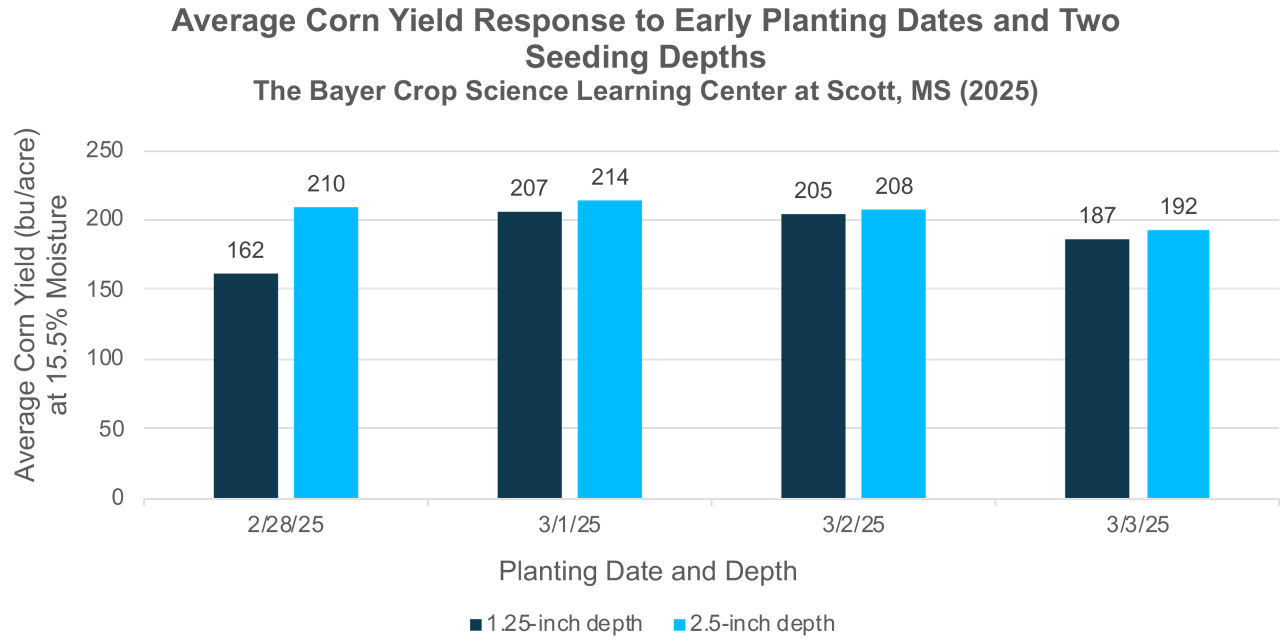
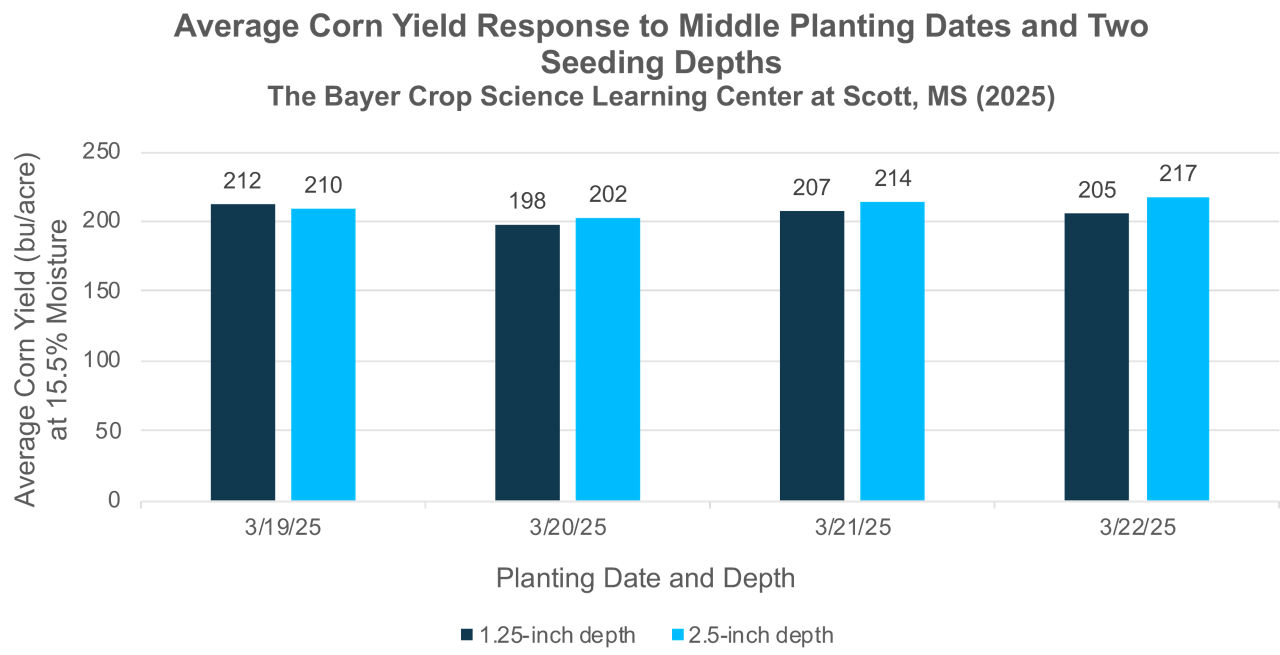
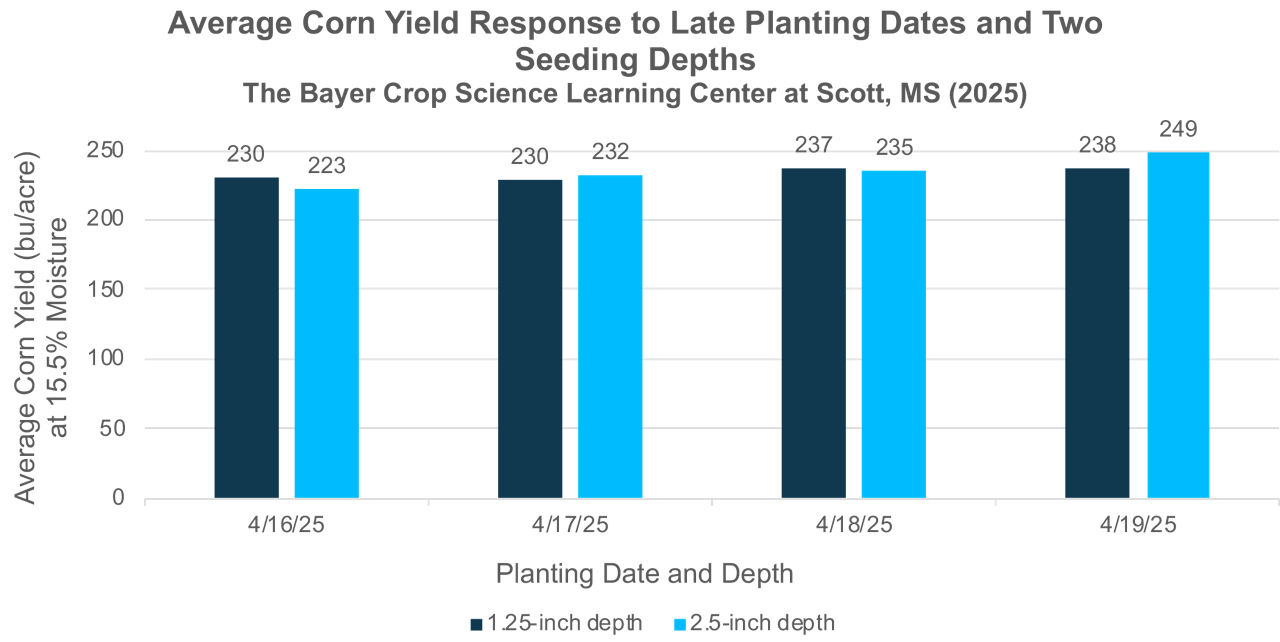
- In this study, 9 out of 12 times, the 2.5-inch planting depth had yields greater than the 1.25-inch planting depth (Figures 1, 2, and 3). This difference was greatest for the earliest planting date (Figure 1).
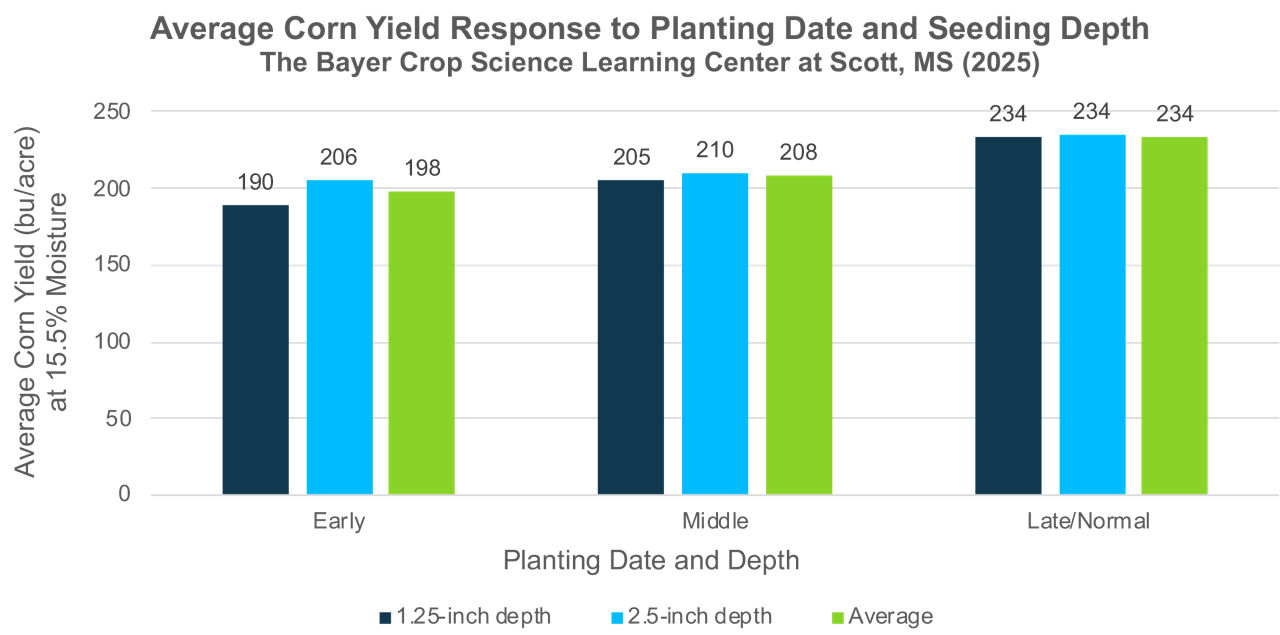
- Yield responses to planting parameters seemed to be mostly related to the overall planting window (early, middle, late). The later planting window had greater yields across all tested parameters when compared to the early and middle planting windows (Figure 4).
KEY LEARNINGS
- Many factors, including planting date and seeding depth, shape corn yield during the planting process.
- Shallower planting typically exposes seeds to larger temperature changes than deeper planting. The more moderate temperatures at deeper seeding depths may allow plants to have more consistent emergence patterns.
- Weather forecasts for the post-planting period should remain a factor in the decision to plant or not plant on a given day.
- In this experiment, rainfall and soil temperature simulated the cool, wet conditions which can lead to a chilling event. However, results from this study did not indicate that corn yields were reduced as seeds were planted closer to a rainfall event.
- While effects of bird predation were not measured in this study, seeding depth can be a factor in how much seed is exposed and lost to this risk.
- Please contact your local DEKALB® brand representative for more information.
1210_293700
Disclaimer
ALWAYS READ AND FOLLOW GRAIN MARKETING AND ALL OTHER STEWARDSHIP PRACTICES AND PESTICIDE LABEL DIRECTIONS.