Use of Stance® Plant Growth Regulator and Mepiquat Chloride on New Deltapine® Brand Cotton Varieties
March 3, 2026
Get Year-Round Updates From Our Agronomic Experts
TRIAL OBJECTIVE
- Plant growth regulators (PGRs) help balance vegetative and reproductive cotton growth throughout the season.
- Questions about how and when to use plant growth regulators on cotton persist as new cotton varieties are introduced.
- Stance® Plant Growth Regulator affects two key plant hormones to provide effective and consistent vegetative management in cotton.
- The objective of this study was to evaluate different PGR treatments of varying intensity to help identify optimal management for a set of Deltapine® brand cotton varieties representing a range of growth potential and PGR responsiveness.
RESEARCH SITE DETAILS

- All field work, tillage and herbicides were per local standards.
- This trial was planted as a single-entry strip plot with no replications. Plots were 12 rows wide and approximately 1 acre per plot.
- A total of eight Deltapine® brand cotton products were planted with one of the following trait packages: B3TXF (Bollgard® 3 ThryvOn® cotton with XtendFlex® Technology), NR B3TXF (Nematode Resistant Bollgard® 3 ThryvOn® cotton with XtendFlex® Technology), B3XF (Bollgard® 3 XtendFlex® cotton):
- DP 2211 B3TXF
- DP 2414 B3TXF
- DP 2317 B3TXF
- DP 2522NR B3TXF
- DP 2127 B3XF
- DP 2537 B3TXF
- DP 2328 B3TXF
- DP 2333 B3XF
- Plant growth regulator products used:
- Generic 4.2% Mepiquat chloride containing 0.35 lb ai/gallon with 48 fluid ounces/acre/year maximum.
- Stance® Plant Growth Regulator with a 22 fluid ounces/acre/year maximum.
- Both chemical treatments deliver 0.132 lb Mepiquat chloride/acre when applied at the yearly total maximum. They can be alternated through the year to total the yearly maximum.
- A calculator was created in a spreadsheet to allow calculation of seasonal use of PGR products.
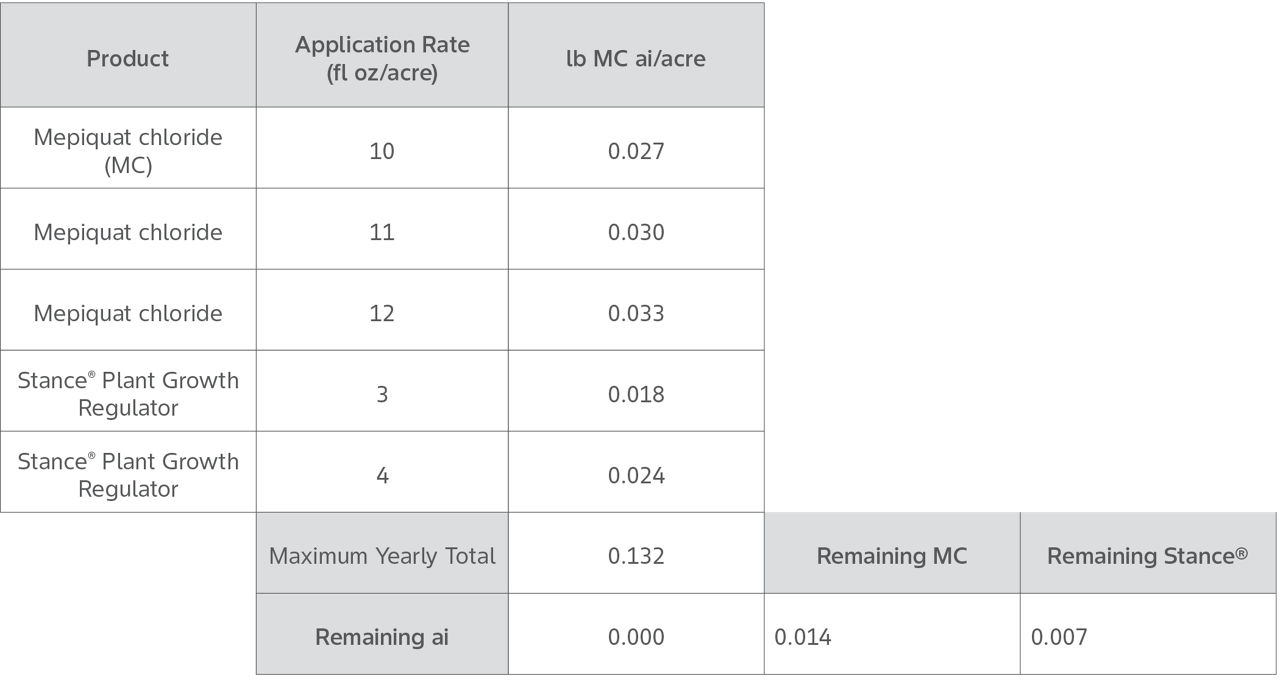
- Mepiquat chloride can be applied to cotton fields for a yearly total of 0.132 lb/ai/acre. This allows varying amounts and timings of both Mepiquat chloride and Stance® Plant Growth Regulator (which also includes Mepiquat chloride) to be applied throughout the growing season.
- The calculator represented in Table 1 shows the most aggressive treatment in the trial. Other treatments were calculated accordingly.
Table 1. An example of the calculator created to help design plant growth regulator treatments.
- PGR Treatments
- Treatment 1: This is the most timely treatment in trial, but not necessarily the most aggressive even though it used the yearly maximum Mepiquat chloride ai rate. The objective for this treatment was to control growth later in the season, which is directed for more determinate cotton varieties. Applications include plant growth regulator used, application rate, and date of application.
- Mepiquat chloride 10 fl oz/acre 6/18/2025
- Mepiquat chloride 11 fl oz/acre 7/01/2025
- Mepiquat chloride 12 fl oz/acre 7/16/2025
- Stance® Plant Growth Regulator 3 fl oz/acre 7/30/2025
- Stance® Plant Growth Regulator 4 fl oz/acre 8/18/2025
- Treatment 2: Started with lower rates of Mepiquat chloride than standard 16 fl oz/acre treatment and finished with Stance® Plant Growth Regulator.
- Mepiquat chloride 12 fl oz/acre 6/18/2025
- Mepiquat chloride 12 fl oz/acre 7/01/2025
- Mepiquat chloride 16 fl oz/acre 7/16/2025
- Stance® Plant Growth Regulator 3 fl oz/acre 7/30/2025
- Treatment 3: No PGR applied.
- Untreated control (UTC)
- Treatment 4: The historical standard treatment for the Midsouth. Probably the most aggressive treatment with the highest rates early and the most aggressive height control.
- Mepiquat chloride 16 fl oz/acre 6/18/2025
- Mepiquat chloride 16 fl oz/acre 7/01/2025
- Mepiquat chloride 16 fl oz/acre 7/16/2025
- Treatment 5: Started with Stance® Plant Growth Regulator and finished with more aggressive Mepiquat chloride treatments.
- Stance® Plant Growth Regulator 2 fl oz/acre 6/18/2025
- Mepiquat chloride 12 fl oz/acre 7/01/2025
- Mepiquat chloride 16 fl oz/acre 7/16/2025
- Mepiquat chloride 16 fl oz/acre 7/30/2025
- Treatment 1: This is the most timely treatment in trial, but not necessarily the most aggressive even though it used the yearly maximum Mepiquat chloride ai rate. The objective for this treatment was to control growth later in the season, which is directed for more determinate cotton varieties. Applications include plant growth regulator used, application rate, and date of application.
- The 2025 growing season would be characterized as a moderate growth environment. UTC plots averaged final plant heights of 60 inches compared to historical 70+ inches. A very good picking season also eliminated some of the typical penalty for having plants that are excessively tall in the trial – i.e. boll rot, fruit shed, and harvest difficulties.
Yield data were collected as follows:
- Machine harvested yield.
- Hand samples collected for fiber quality estimations.
- Turnout calculated from ginning results.
UNDERSTANDING THE RESULTS
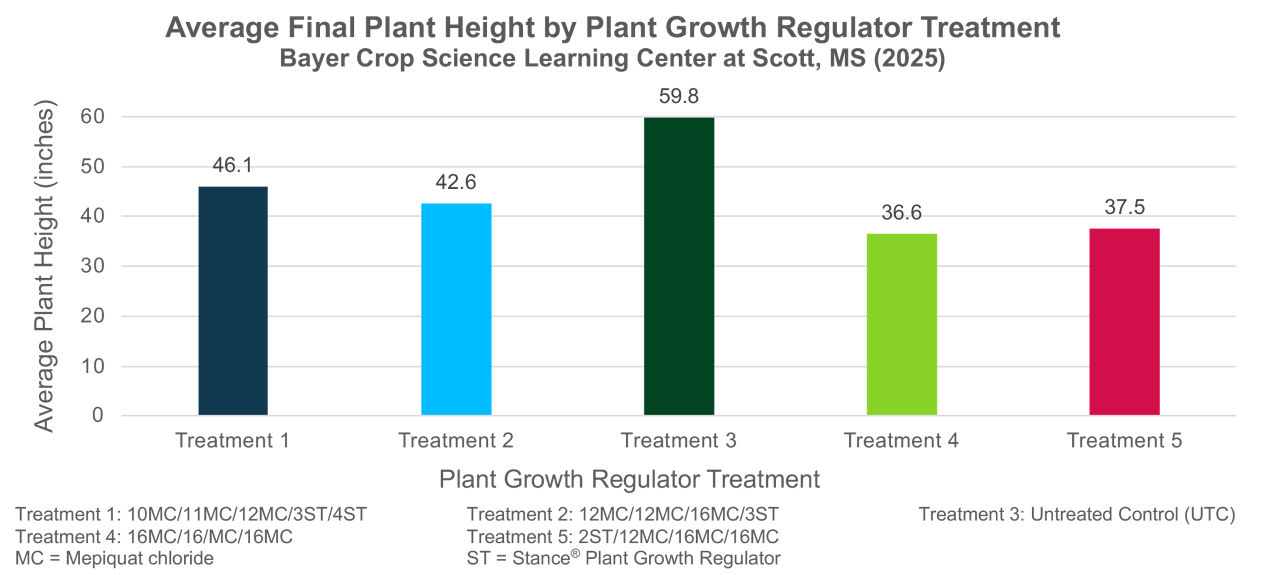
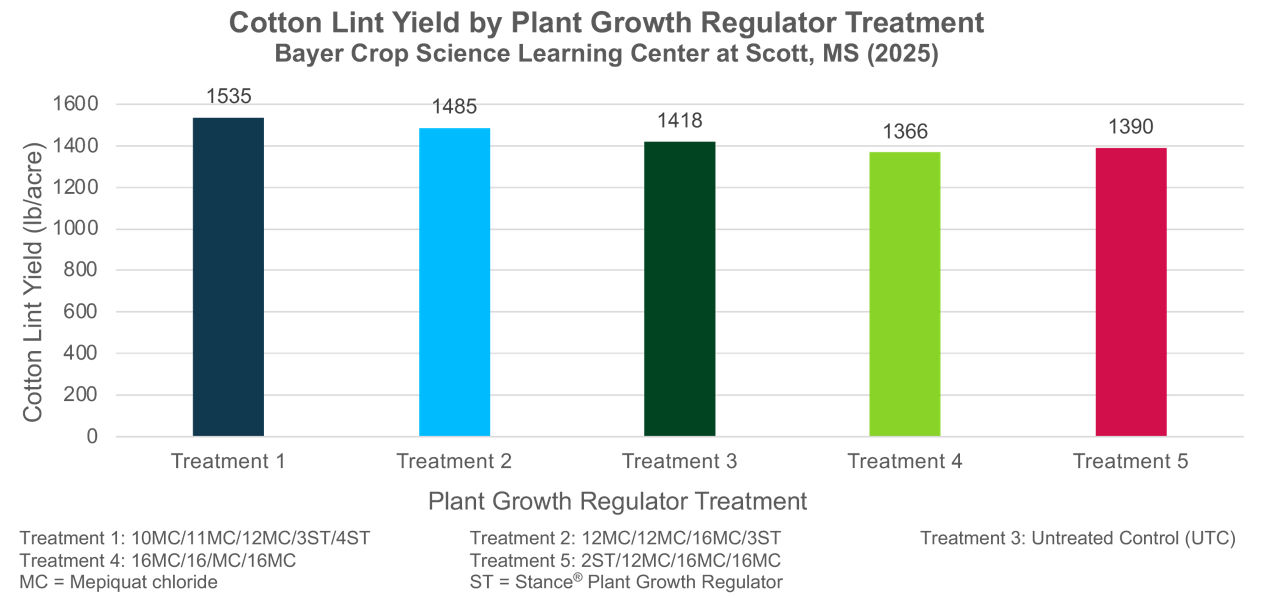
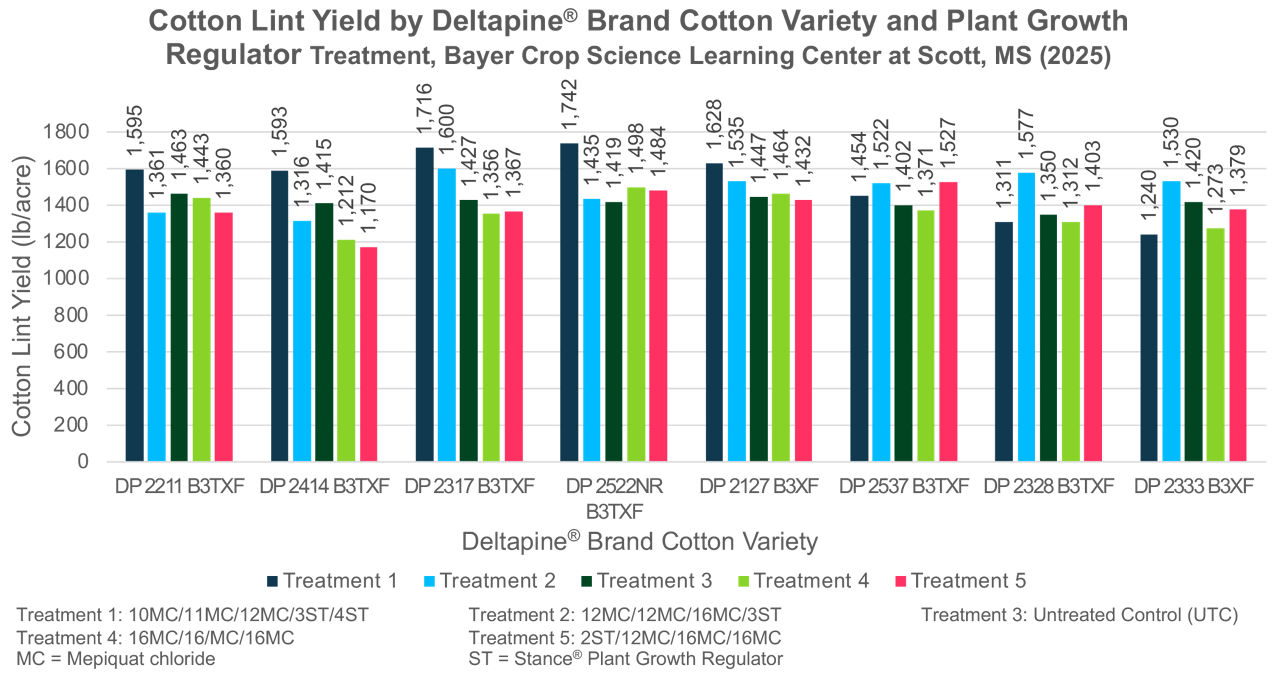
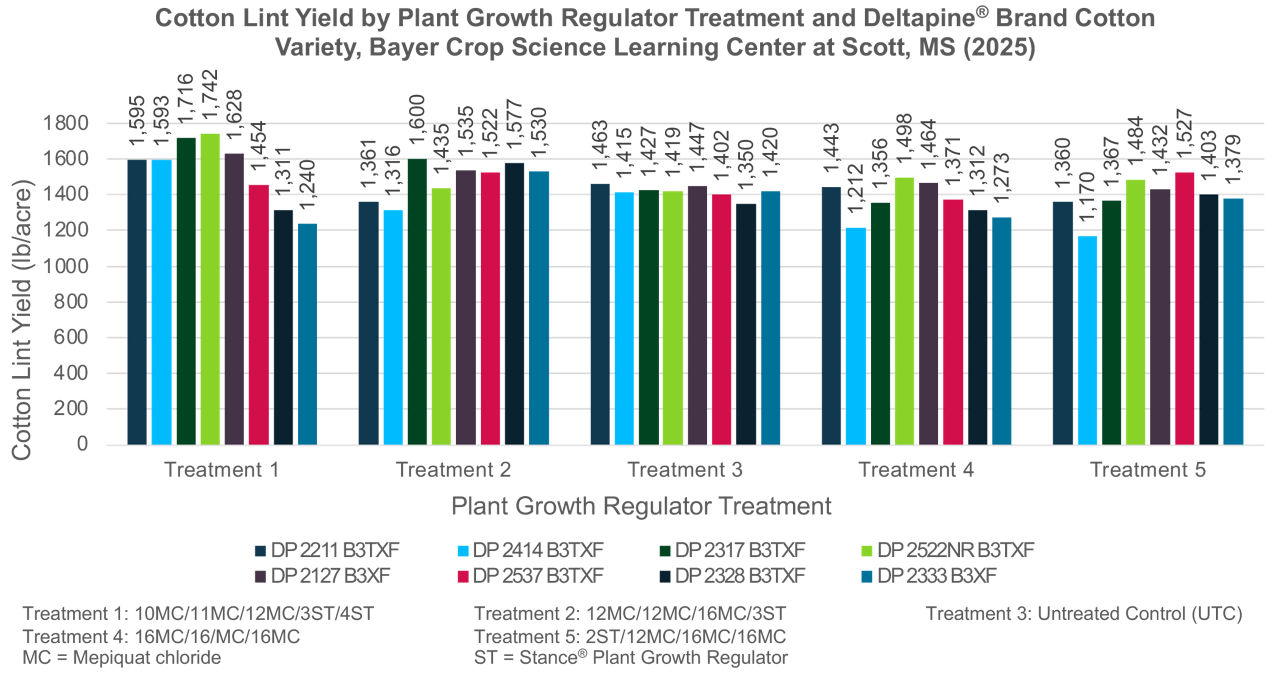
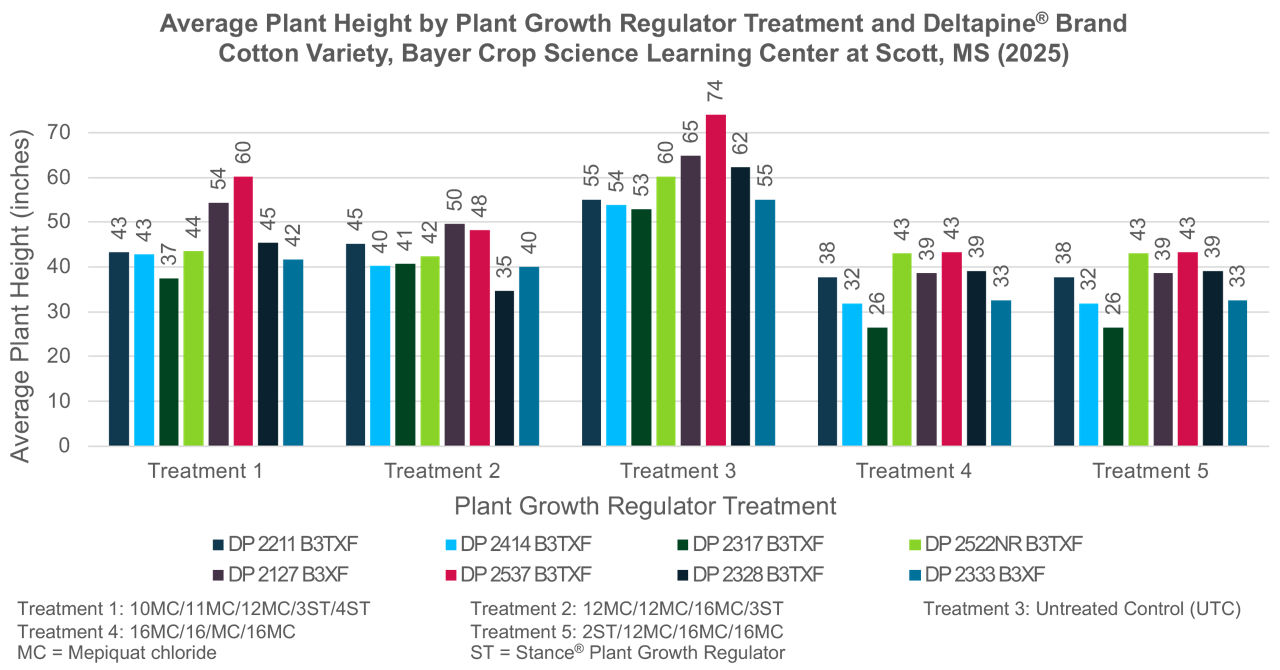
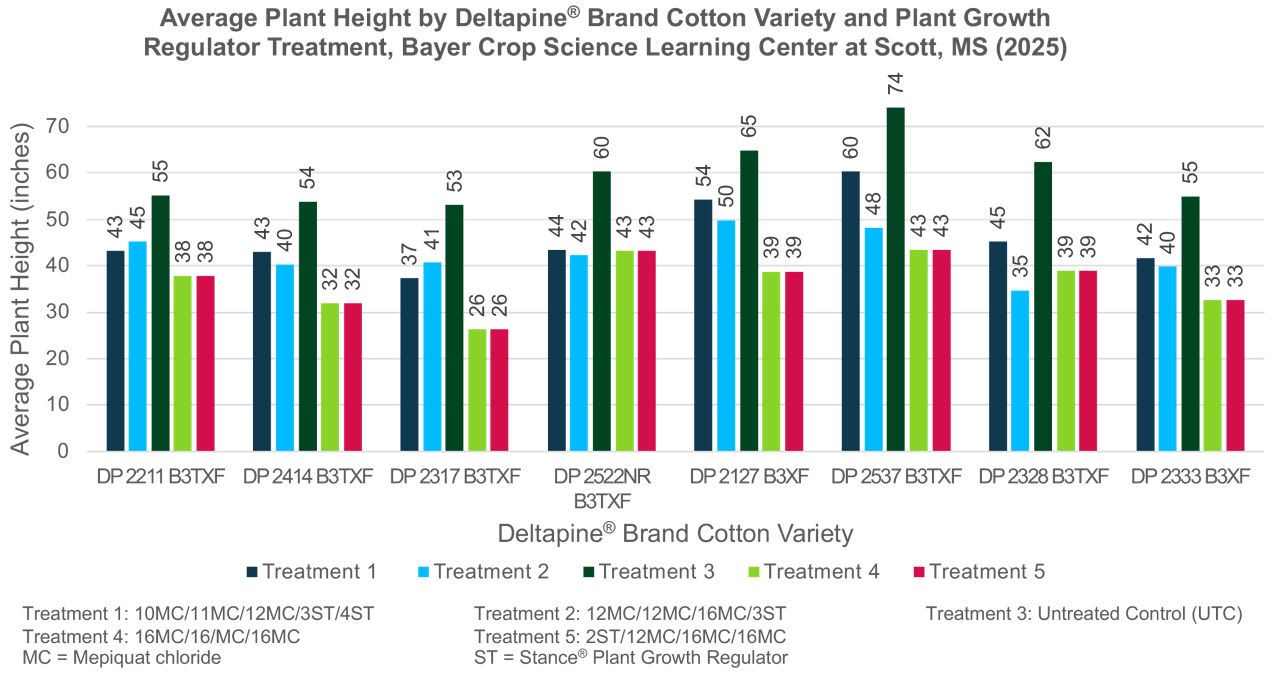
- A general statement about these results. The goal of this trial was to optimize the use of PGRs within the rate ranges listed on the label. The “softer starting” treatments, like Treatment 1, apply an earlier and lower rate of PGR to lightly reduce plant height and potentially prevent a yield reduction. This is demonstrated in comparing Treatment 1 and Treatment 4 for both yield and height (Figures 1 and 2). The “soft start” used in Treatment 1 can help optimize more determinate products. The contrast would be higher PGR rates earlier for later, less determinate cotton varieties to establish an acceptable growth control system in the field. In other words – we often need to hit the brakes harder on less determinate varieties, and a lighter brake tap earlier for more determinate varieties in the early season followed by more aggressive controls later.
- The main objective is to attempt to characterize varieties by which type of system they require for optimal management. Some require more (or less) aggressive treatment on the front end. Keep in mind that almost all cotton needs some early PGR intervention. The question is more one of rate and product choice than one of timing.
- Treatment 4, the standard treatment with three applications of Mepiquat chloride at 16 fl oz/acre, reduced plant height by the greatest amount across the trial. Treatment 3 (UTC) plots had an average height of 60.0 inches compared to 36.6 inches in the plots with Treatment 4. Other treatments were intermediate to the plots managed with Treatment 4.
- The above result is to be expected compared to other softer, lower-rate alternatives and can be useful in evaluating the appropriateness of a treatment for a given field and/or variety.
- The early maturity (i.e. more determinate) products are particularly well adapted at the Scott, MS location. They responded well in both yield and height control to the softer start (10 to 12 fl oz/acre Mepiquat chloride) and the more aggressive finishing treatments (3 to 4 fl oz/acre Stance® Plant Growth Regulator) found in Treatment 1.
- The less determinate products appeared to be optimized in this trial with an early application of a moderate PGR rate followed by somewhat more aggressive treatments later, like Treatment 2 and Treatment 5. This is to be expected in these conditions in Scott, MS.
KEY LEARNINGS
- Cotton variety growth habit is an important consideration when making PGR application decisions.
- Stance® Plant Growth Regulator offers a complimentary addition to growth control systems in two primary ways: when softer, lower rates are needed for either more determinate products or less growthy production systems, and if more growth control is needed later in the season after other Mepiquat chloride applications have accumulated through the early and mid-season.
- A couple of important considerations:
- Varieties containing ThryvOn® Technology and/or nematode tolerance may demonstrate very aggressive growth habits. This is an important decision factor in varieties such as DP 2522NR B3TXF, which is reniform nematode tolerant.
- At this location, DP 2537 B3TXF has been the most aggressive growth case across the lineup. For this reason, all agronomic decisions (seeding rate, fertility, crop rotation) and particularly early PGR decisions become especially important when growing this variety.
- Plant growth regulators are active at dry weight concentrations and at least the effect (and likely the ai) can be long lasting. For these reasons, applying appropriate PGR rates early can help load the ai into the plant, which has shown to require less follow-up ai to get back to the threshold of activity for control. This makes early PGR applications even more important in aggressive growth cases.
- Additionally, PGRs are “regulators”, not “shrinkers”. If hesitations in rate or timing lead to excessive mid/late season growth, that excess growth is irreversible during the growing season.
- Each field, farm, and variety should be considered a specific case, scouted independently, and managed appropriately.
- Please contact your local Deltapine® brand representative for more details.
1414_737650
Disclaimer
ALWAYS READ AND FOLLOW GRAIN MARKETING AND ALL OTHER STEWARDSHIP PRACTICES AND PESTICIDE LABEL DIRECTIONS.