20 MIN READ
Cotton Yield Performance of Deltapine® Brand Cotton Varieties on Two Midsouth Soil Types
March 17, 2026
To compare yearly data, click on a tab.
TRIAL OBJECTIVE
- Cotton varieties and transgenic packages change regularly. Each growing season, the Bayer Crop Science Learning Center at Scott, Mississippi evaluates a new set of cotton varieties from the New Product Evaluator (NPE) program along with commercial standards. This work is especially relevant as new cotton products with ThryvOn® Technology enter the marketplace.
- The primary goal of this trial was to evaluate a selection of existing and new Deltapine® cotton varieties for their productivity and adaptation characteristics on two soil types in the Midsouth.
- A secondary goal was to estimate the impact of Bollgard® 3 Technology on Heliothine insects present at the testing sites.
- Selecting an adapted cotton variety is foundational to a cotton production program. Every tested parameter is important to cotton growers as they are offered new commercial products in the coming seasons.
RESEARCH SITE DETAILS
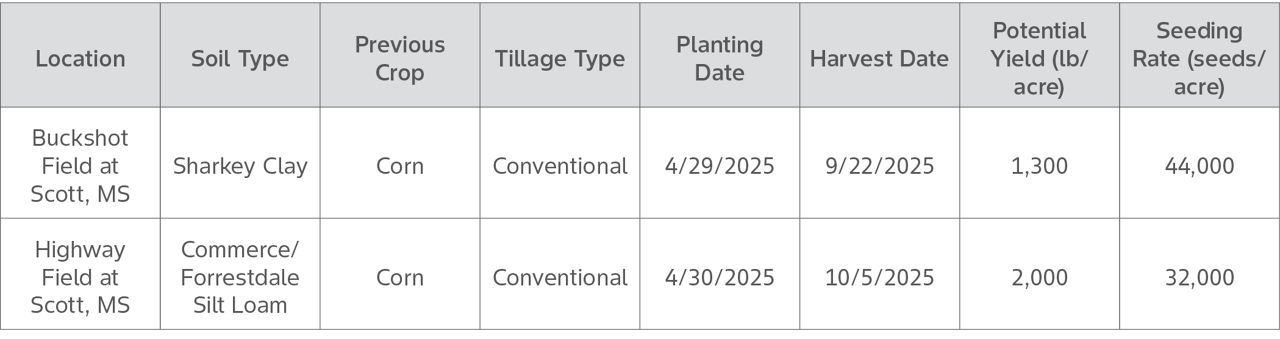
- All field work, tillage, and herbicides were per local standards. Insects were managed as follows:
- Thrips
- The entire plot area (products with and without ThryvOn® Technology) was managed for thrips control.
- Two insecticide applications labeled for thrips control were applied due to the heavy thrips pressure. Thrips control in the cotton products without ThryvOn® Technology was observed to be subpar. The cotton products with ThryvOn® Technology sustained little to no thrips damage throughout the testing.*
- Lygus
- The entire plot area (products with and without ThryvOn® Technology) was managed for lygus control.
- Three insecticide applications labeled for the control of lygus species were applied based on recommended state thresholds.
- Heliothine Pests
- Considerable Heliothine pressure was present during these studies.
- Population thresholds were not exceeded in entries with Bollgard® 3 Technology; therefore, no insecticides were applied for heliothine pest control.
- Thrips
- A total of 14 Deltapine® brand cotton products were planted with one of the following trait packages: B3TXF (Bollgard® 3 ThryvOn® cotton with XtendFlex® Technology), NR B3XF (Nematode Resistant Bollgard® 3 XtendFlex® cotton), B3XF (Bollgard® 3 XtendFlex® cotton), and XF (XtendFlex® cotton):
- DP 2211 B3TXF
- DP 2414 B3TXF
- DP 2115 B3XF
- DP 2317 B3TXF
- DP 2624NR B3TXF
- DP 2522NR B3TXF
- DP 1822 XF (not planted in the Buckshot field)
- DP 2127 B3XF
- DP 2328 B3TXF
- DP 2131 B3TXF
- DP 2333 B3XF
- DP 2537 B3TXF
- DP 2038 B3XF (not planted in the Buckshot field)
- DP 2141NR B3XF (not planted in the Buckshot field)
- Acceleron® Solutions Offering ELITE seed treatment was applied to all cotton varieties tested except the first planted DP 1822 XF, which received no seed treatment. This was replanted with Acceleron® Solutions Offering ELITE seed treatment after it was seriously damaged by seedling disease.
*Scouting is critical to determine which and how many insecticide applications are recommended to avoid economic loss greater than pest management costs (i.e., when economic thresholds are met). Check with your local university extension for the latest spraying recommendations.
This trial was planted as a single-entry strip plot with no replications. Plot size for each location was as follows:
- Highway Field
- 6-row plot
- 0.22 acre/plot
- Buckshot Field
- 12-row plot
- 0.60 acre/plot
All PGR (plant growth regulator) applications were applied according to growth management required. Details were as follows:
- Highway Field, five applications:
- 6/21/2025: Mepiquat chloride 4.2%, 10 fl oz/acre
- 7/3/2025: Mepiquat chloride 4.2%, 11 fl oz/acre
- 7/21/2025: Mepiquat chloride 4.2%, 12 fl oz/acre
- 8/1/2025: Stance® Plant Growth Regulator, 3 fl. oz/acre
- 8/10/2025: Stance® Plant Growth Regulator, 4 fl. oz/acre
- Buckshot Field, two applications:
- 7/3/2025: Mepiquat chloride 4.2%, 8 fl oz/acre
- 7/21/2025: Mepiquat chloride 4.2%, 12 fl oz/acre
Data were collected as follows:
- Machine harvested yield.
- Hand samples collected for fiber quality estimations.
- Turnout calculated from ginning results.
UNDERSTANDING THE RESULTS
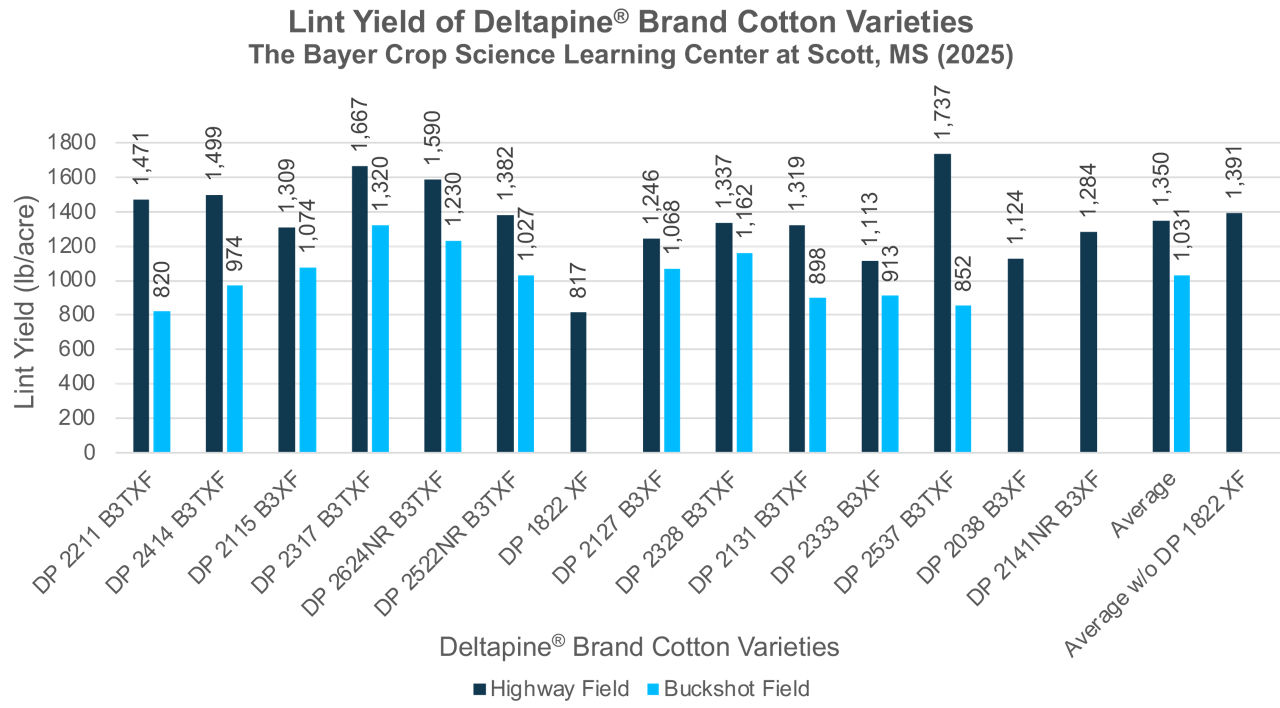
- Highway Field
- Overall, cotton varieties tested at the Highway Field location were high yielding.
- The average lint yield for this location was 1,350 lb/acre. The average yield at this location excluding DP 1822 XF was 1,391 lb/acre (Figure 1).
- The lint yield range for this location (excluding DP 1822 XF) was 1,737 lb/acre in DP 2537 B3TXF to 1,113 lb/acre in DP 2333 B3TXF.
- Without insect traits, DP 1822 XF yielded 817 lb/acre or approximately 80% of the trial average.
- NOTE – This plot was originally planted with black (untreated) DP 1822 XF seed. Due to conditions during emergence, a substantial part of the plot area was killed by seedling disease (primarily Rhizoctonia solani) and required replanting on 5/12/2025. The surviving plot area was severely infested by thrips (primarily tobacco thrips) at the magnitude of approximately 14 thrips per plant.
- Replanting DP1822 XF may have led to loss of earliness and yield potential for this variety. It was also observed to be seriously damaged by Heliothine pests during mid-season.
- The plots treated with Acceleron® Solutions Offering ELITE Seed Treatment did not succumb to the severe seedling disease present in this trial.
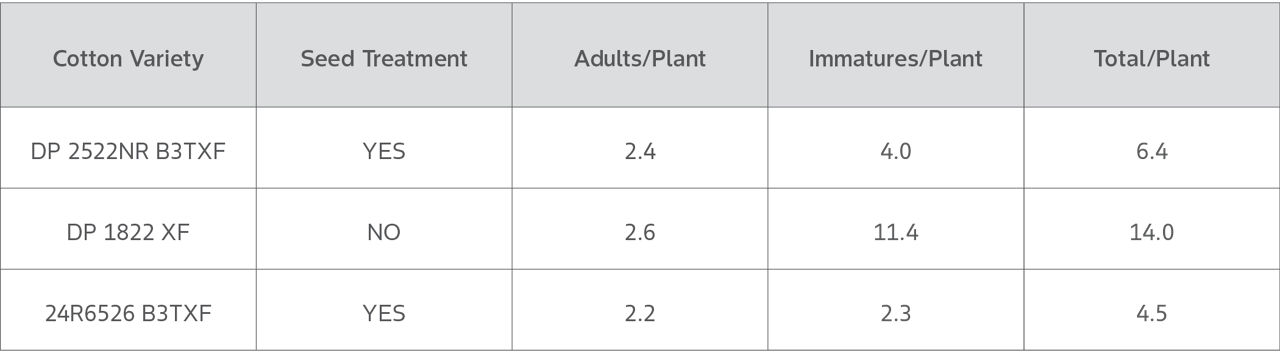
- Plots with Bollgard® 3 Technology had an average of 4 thrips per plant.
- Plots with Bollgard® 3 ThryvOn® Technology had roughly the same number of adults, but half the number of immatures as plants without ThryvOn® Technology (Table 1).
- Varieties with Bollgard® 3 Technology, but without ThryvOn® Technology required two treatments for thrips. The entire plot was sprayed, even though the varieties with ThryvOn® Technology did not require treatment.
- Little to no thrips damage was observed in the plots with ThryvOn® Technology.
- Thrips samples were taken pre-treatment.
- Thrips feeding may have delayed maturity in the varieties without ThryvOn® Technology and negatively impacted yield potential, even with treatments applied.
Table 1. Number of thrips, immatures and adults, per plant by cotton variety and seed treatment.
- Buckshot Field
- The average lint yield for this location was 1,031 lb/acre.
- The lint yield range for this location was 1,320 lb/acre in DP 2317 B3TXF to 820 lb/acre in DP 2111 B3TXF.
KEY LEARNINGS
- Several of the products demonstrated excellent yield potential in this trial.
- Acceleron® Solutions Offering ELITE Seed Treatment provided protection from seedling disease in this environment.
- Several of the leading products in the trial contained ThryvOn® Technology.
- It appears from this testing that the Deltapine® brand continues to make breeding progress in developing high yielding, high fiber-quality products which contain the newest biotech traits.
- Please contact your Deltapine® brand representative for more information.
1416_172950
Disclaimer
ALWAYS READ AND FOLLOW GRAIN MARKETING AND ALL OTHER STEWARDSHIP PRACTICES AND PESTICIDE LABEL DIRECTIONS.