5 MIN READ
Cotton Irrigation Scheduling Management
April 28, 2026
Get Year-Round Updates From Our Agronomic Experts
- The water requirements for a cotton crop vary throughout the growing season, with the period from first square to peak bloom being the most critical time to prevent drought stress.
- Irrigation scheduling is not universal across cotton growing regions—it differs according to climate and yield goal.
- The objective for irrigation scheduling is to help maximize yield potential and lint quality by meeting crop water demands and improving water use efficiency.
A cotton crop’s water requirements vary throughout the growing season. Irrigation scheduling helps growers match water use with water availability. To help optimize yield potential, a cotton crop requires around 20 to 30 inches of water in rainfed and irrigated systems or 40 inches in dry, arid regions. The estimated cost to irrigate an acre of land is $9 per acre per inch of water applied for electric pumps or $12 per acre per inch of water for diesel pumps (at $3 per gallon of diesel). Averaging the cost to $10.50 per acre per inch of water with 10 inches of irrigated water applied over the season, the total irrigation cost for a 500-acre cotton crop would be $52,500.1 Carefully managing inputs—including irrigation—can lead to higher returns at the end of the season.
Tools to Help Determine if Cotton Irrigation is Needed
Relying on irrigation convenience or visibly stressed plants triggering an irrigation can result in limiting yield potential or increasing input costs. There are several tools available that can help provide more accuracy when determining a crop’s water needs for irrigation scheduling.
- The Checkbook Method is based on how much water is available in the soil. It works like balancing a checkbook—precipitation and irrigation are inputs credited to the total water available and evapotranspiration is the withdrawal:
Soil Water (today) = Soil Water (yesterday) – Withdrawals + Inputs
Note that the current soil water level is strongly affected by soil type. For example, sandy soils have large pore spaces, which allows water to flow through quickly and makes it less available to plants. Clay soils can hold water well, but they also bind tightly to water particles, making the water difficult for roots to uptake. Loamy soils hold water well while also allowing plant roots to absorb water. Many Land Grant Universities offer tools to help estimate crop water use based on historical data. These tools can help calculate if and when an irrigation is required.2
- Computer models are based on the checkbook method with real time field data incorporated. A couple of options include Smart Irrigation Apps developed by the University of Florida and University of Georgia or IrrigatorPro developed by the USDA Agricultural Research Service National Peanut Research Lab.
- Soil moisture sensors improve accuracy when the data generated is interpreted well. This can be expensive to implement but can be worth the expense if it helps ensure water availability at critical growth stages or avoids surplus irrigations.
- Hybrid systems use all of these tools to provide the most accurate irrigation scheduling recommendations.1 The accuracy of the recommendation depends on the accuracy of the data entered into the model.
Water Demand by Cotton Growth Stage
The sensitivity of cotton to water stress varies by growth stage. Having adequate soil moisture is important for stand establishment, nutrient uptake, square and boll retention, fiber quality, and maximizing yield potential. Cotton has some tolerance to drought conditions and can respond favorably to periods of water stress outside of critical water requirement stages (first square to first bloom), a physiological feature that can benefit from timely irrigation management.
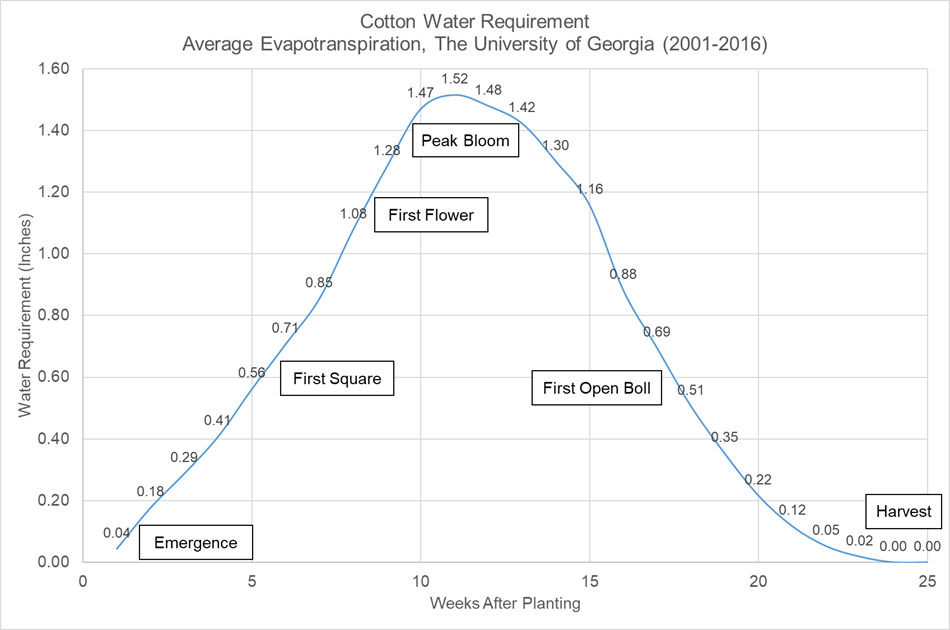
Figure 1. Cotton water requirement related to development. Long term data from the University of Georgia over 15 years (2001–2016) across multiple locations. Source: Porter, W. 2023. Irrigation. 2023 Georgia Cotton Production Guide. The University of Georgia. 124-3. https://extension.uga.edu/publications/detail.html?number=AP124-3
Planting to First Square
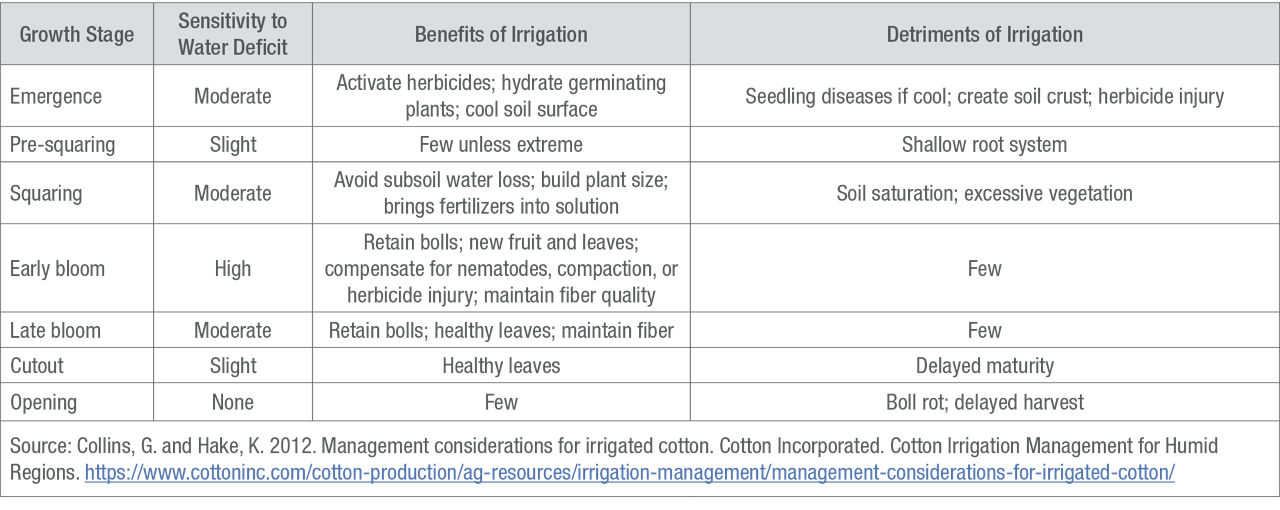
Cotton water use is low at planting and through emergence. If the seedbed is too dry to support germination, pre-planting irrigation is preferable to irrigating after planting. Irrigating shortly after planting can cool the soil and may encourage development of seedling diseases. Once seeds germinate, young cotton plants put much of their energy into developing roots. Unless soil moisture is extremely low at this time, irrigation contributes little to yield. Some water deficits early in the season can stimulate root production and development of a deeper root system, especially in sandy soils.3
First Square to First Flower
Once cotton plants have emerged and are growing, irrigation should be used to supplement rainfall and prevent depleting the soil moisture profile prior to bloom.4 For approximately 21 days from first square to first bloom, cotton vegetative growth is very rapid, the number of fruiting sites is determined (especially in short-season environments), and plants should be rapidly taking up phosphorus (P) and potassium (K) at this growth stage.
First Flower to Peak Bloom
Crop water demand increases from 0.2 to 0.28 inches per day during this period.4 Water stress at this growth stage can reduce plant growth, reduce the number of fruiting sites, cause shedding of young bolls, reduce boll size, and result in loss of yield potential. Severe water deficit at this stage can also lead to shorter staple, higher micronaire, and lower cotton lint fiber quality. Lack of water does not typically result in square shed between first flower and peak bloom. If square shedding is observed during this time, other causes should be investigated.3
Peak Bloom to Open Bolls
Water demand begins to decrease as bolls mature and open. While severe water deficit can lead to square and young boll shedding, loss of late fruit has less effect on yield potential than loss of early-season bolls. Growers should reduce or stop irrigation and allow plants to have some water stress after bolls start opening. This stress helps limit regrowth, improves defoliation, and promotes boll opening.3
Table 1. Benefits and detriments of irrigation at various cotton growth stages.
Regional Differences in Cotton Irrigation Strategies
Providing supplemental water through irrigation requires managing production costs while preventing a potentially devastating loss of yield due to water stress. Cotton irrigation strategies in humid cotton-growing regions can have large differences from irrigation strategies in arid and semi-arid regions of the West. In more humid regions, irrigation supplements rainfall. In arid and semi-arid regions, access to irrigation is necessary for supplying water to cotton, though only about 35% of the total US cotton acreage is irrigated.5 Regardless of the region, the goal of water management is to meet crop demand and optimize yield with the resources available.4
Cotton Irrigation in Humid Regions
Growers with adequate water and irrigation capacity to meet peak water use demand may elect to deplete the subsoil moisture before initiating irrigation. The goal is to irrigate before severe plant water stress occurs with an amount of water that would not waterlog the soil or impact plant growth even with subsequent rainfall. This strategy requires close crop monitoring and timely applications of controlled amounts of water.4
Water use efficiency (WUE) is a useful relationship describing the yield produced per unit of crop water used, or per unit of evapotranspiration (ET). Modern, high WUE cotton products tend to provide at least 50 pounds of lint and 75 pounds of seed for every acre-inch of water used.5 Irrigators should strive to increase yield per total water applied by employing water management practices that reduce losses due to deep leaching and runoff, and by improving irrigation system efficiency and application uniformity through system upgrades.
The Southeast typically experiences enough rainfall for total cotton crop use, but the rain is uncontrolled and can be untimely. Risks associated with yield instability can be partially removed by irrigation. For example, sandy soils can benefit from irrigation by nearly doubling the yield potential from 750 pounds of lint per acre in water limited conditions to roughly 1,200 to 1,500 pounds of lint per acre under irrigation.6
Cotton Irrigation in Arid Regions
Irrigation is the leading influence on cotton yield in arid climates. Growers planning on producing top yields must have irrigation capacity to cover their acreage over 7 to 10 days. Pre-irrigation is often necessary in arid regions. This helps provide a soil profile that is full of moisture to the rooting depth, drained of excess surface water, and warmed by the sun prior to planting. Filling the soil profile delays the need for the first post-planting irrigation and helps prevent potential problems such as: evaporation loss of valuable water, plant cooling, nitrate leaching, and potential soilborne pathogen infection.4
Timing of the first post-planting irrigation is critical in arid regions. Growers must consider well capacity and the ability of the irrigation system to supply enough water to meet crop needs at critical growing stages. Starting too early may lead to chilling injury (when temperatures remain below 80 °F), potential development of seedling diseases, a shallow root system, weed germination, and rank vegetative growth.4 Starting too late may lead to stunted plants, early cutout, and reduced yield potential. Optimum irrigation timing in arid regions occurs when plants are slowing mainstem growth, but before obvious leaf color changes.4 Once irrigation is started, most growers in arid regions will need to continue supplying water throughout the growing season to prevent loss of yield potential from water stress.
For additional agronomic information, please contact your local Deltapine® representative.
Sources
1Porter, W.M. 2025. Irrigation scheduling and planter considerations for cotton production. University of Georgia Extension, 2025 Cotton Agent Trainings. Porter-Irrigation-and-Planters-for-Cotton-2025-Agent-Training.pdf
2Sassenrath, G. and Schmidt, A. 2012. Section 7: Irrigation scheduling tools. In C. Perry and E. Barnes, Eds. Cotton Irrigation Management for Humid Regions. Cotton Incorporated. https://www.cottoninc.com/cotton-production/ag-resources/irrigation-management/irrigation-scheduling-tools/
3Bauer, P., Faircloth, W., Rowland, D., and Ritchie, G. 2012. Section 5: Water-sensitivity of cotton growth stages. In C. Perry and E. Barnes, Eds. Cotton Irrigation Management for Humid Regions. Cotton Incorporated. https://www.cottoninc.com/cotton-production/ag-resources/irrigation-management/water-sensitivity-of-cotton-growth-stages/
4Hake, K., Ayers, V., Hutchinson, B., Lyle, B., Pringle, L., and Thomas, J. 1992. Cotton irrigation scheduling. Cotton Physiology Today. 3(8). https://www.cotton.org/tech/physiology/cpt/plantphysiology/upload/CPT-Aug92-REPOP.pdf
5Cotton and responsible water use. Cotton Incorporated. https://cottontoday.cottoninc.com/our-sustainability-story/water/
6Farahani, H. and Munk, D. 2010. Section 1: Why irrigate cotton? In C. Perry and E. Barnes, Eds. Cotton Irrigation Management for Humid Regions. Cotton Incorporated. https://www.cottoninc.com/wp-content/uploads/2017/03/cotton-irrigation-schedule.pdf
Collins, G. and Hake, K. 2012. Section 8: Management considerations for irrigated cotton. In C. Perry and E. Barnes, Eds. Cotton Irrigation Management for Humid Regions. Cotton Incorporated. https://www.cottoninc.com/cotton-production/ag-resources/irrigation-management/management-considerations-for-irrigated-cotton/
Web sources verified 03/20/26. 1421_157749
Disclaimer
ALWAYS READ AND FOLLOW GRAIN MARKETING AND ALL OTHER STEWARDSHIP PRACTICES AND PESTICIDE LABEL DIRECTIONS.