Managing Southern Rust: Corn Fungicides & Seed Tolerance
April 10, 2026
Get Year-Round Updates From Our Agronomic Experts
TRIAL OBJECTIVE
- New and current Bayer corn seed products are evaluated for yield response to fungicide applications in regional fungicide trials each year.
- Yield response to a fungicide application can vary year-over-year due to many agronomic factors including germplasm selection, growing environment, weather patterns, crop management, and disease pressure.
- In 2025, at the five evaluation sites, southern rust (Puccinia polysora) (SR) was the most prevalent corn disease observed, arriving in mid- to late July. Due to the intensity of SR observed, Bayer corn seed products were evaluated through the broader lens of SR tolerance rating group to determine the significance of native tolerance (or lack thereof) on product performance.
- This research report summarizes the interaction between SR tolerance (as rated in product information, on a scale of 1 to 9, 1 = best tolerance) within Bayer corn seed products and the yield response to applications of Delaro® Complete Fungicide at the R1 growth stage.
RESEARCH SITE DETAILS
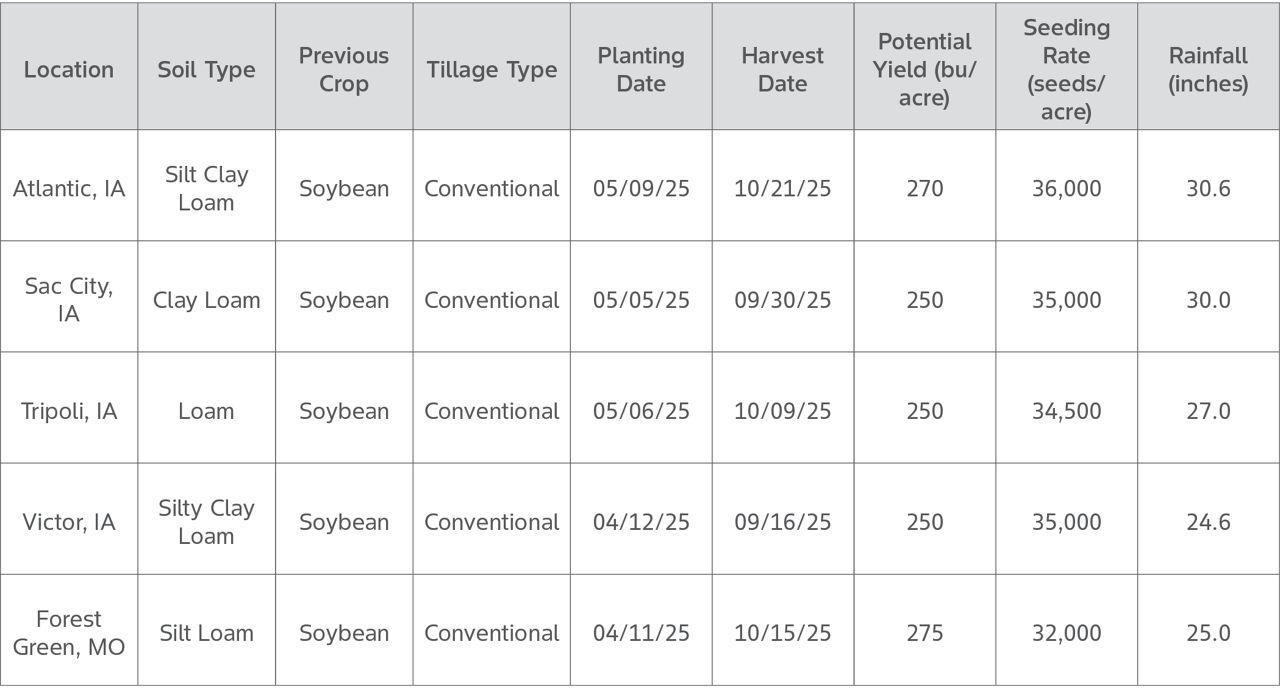
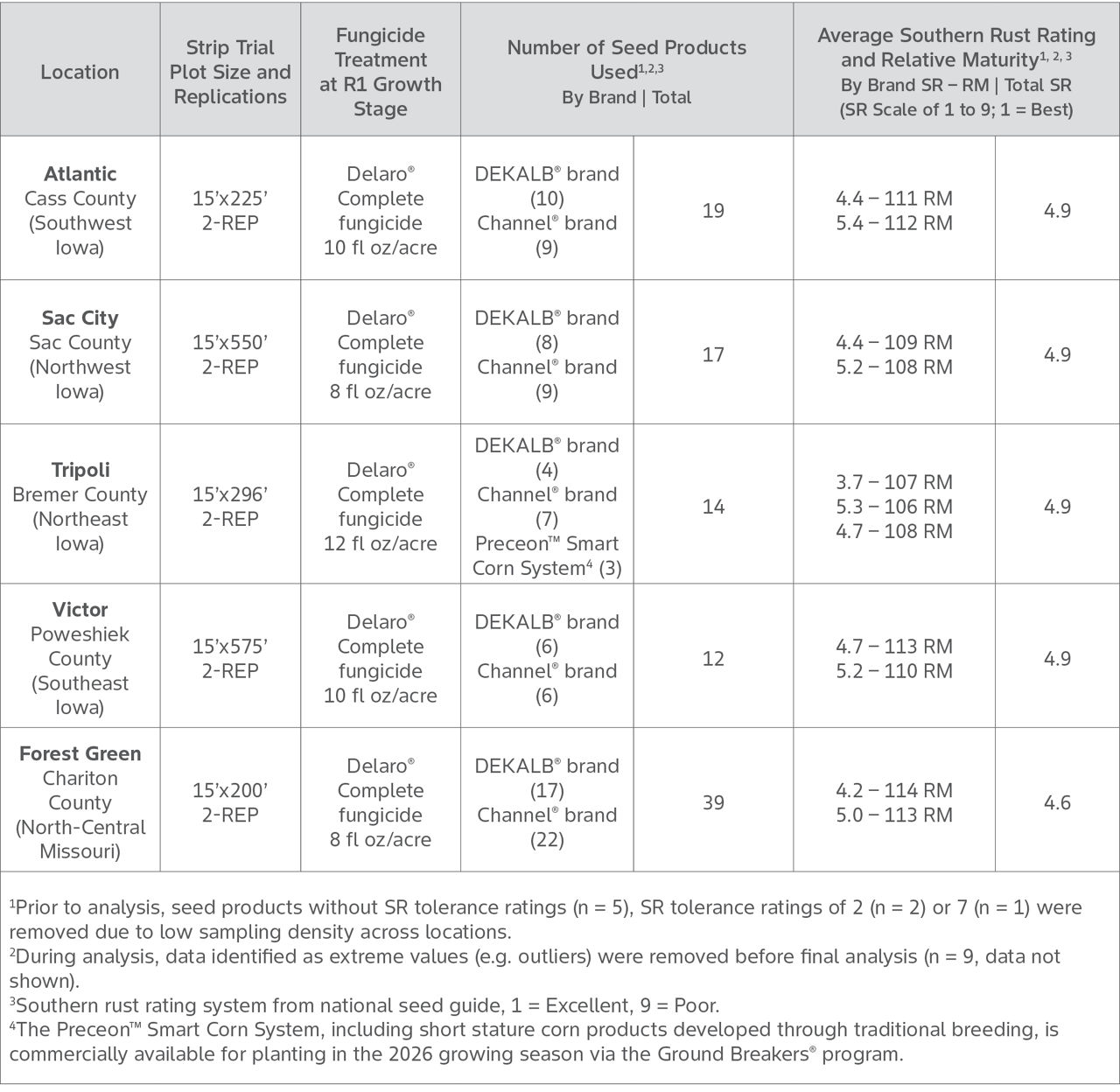
Table 1. Location, trial dimensions, fungicide treatment, number of products tested by seed brand, and southern rust (SR) ratings with relative maturities (RM).
UNDERSTANDING THE RESULTS
Statistical Analysis:
- Data from plots treated with Delaro® Complete fungicide at either 8, 10, or 12 fl oz/acre were combined prior to analysis.
- Trial location was not significant for yield or yield difference (Yield Δ = Yield Treated – Yield Untreated). Therefore, data were analyzed across locations.
- ANOVA was performed (α-value of 0.05), with least significant means separated using the 95% confidence levels.
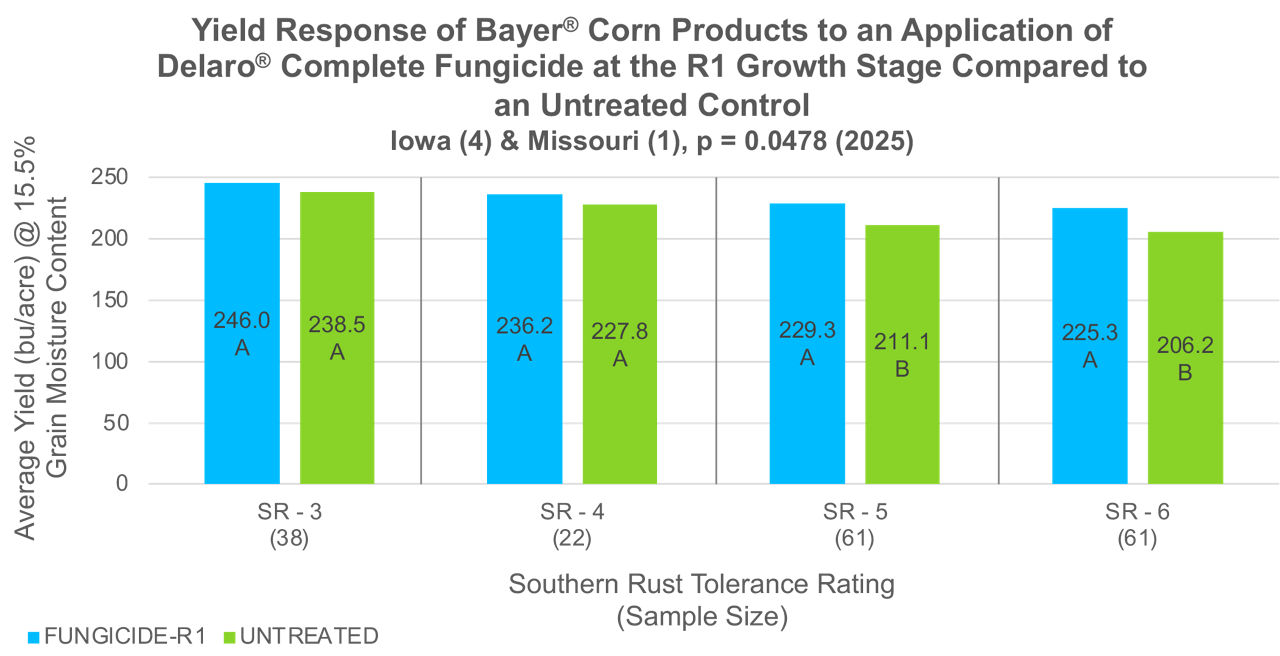
- For grain yield, fungicide treatment nested within southern rust (SR) tolerance group was significant (P-value = 0.0478).
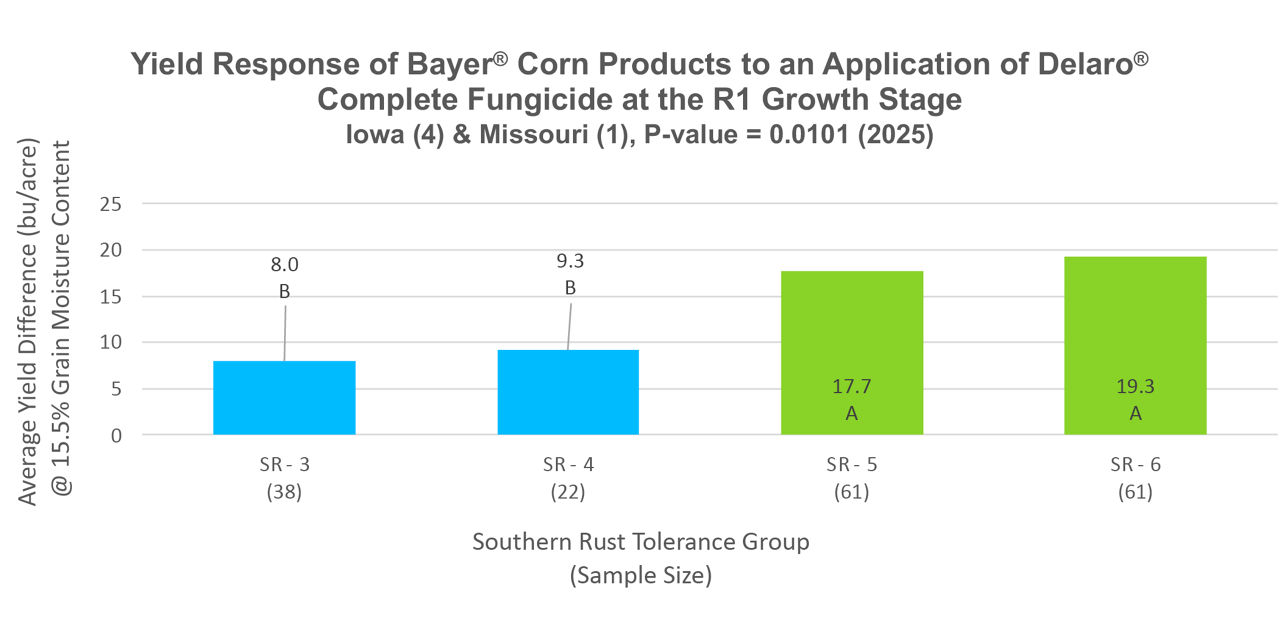
- For yield difference, SR tolerance group was significant (P-value = 0.0101).
- Means which are followed by identical letters (e.g. A or B) are statistically similar to one another. Means followed by different letters are significantly different from one another (Figures 1 and 2).
KEY LEARNINGS
Comments or Observations:
- Individual results may vary on your farm. These results are from five locations within a single year.
- Southern rust (SR) was the most severe and prevalent disease for all five locations, with low to moderate tar spot (Phyllachora maydis) pressure arriving late in the grain-fill period for most locations.
- The highest yield was observed in seed products rated 3 to 4 for SR tolerance (Figure 1), while the largest yield response to an application of Delaro® Complete fungicide was observed in seed products with reduced natural tolerance (5 or 6 rating) to SR (Figure 2).
- This research report was published to help guide management decisions as they pertain to SR disease tolerance ratings if SR is the predominant pathogen present within your fields.
- There are many agronomic factors to consider when selecting corn seed products for your farm in addition to SR tolerance ratings. Please contact your local Bayer seed representatives, agronomic advisors, or technical agronomists for additional information about your local seed offerings.
- Delaro® Complete fungicide provides consistent, broad spectrum disease control with three modes of action, helps strengthen corn stalks to withstand environmental pressures for robust growth and improved ease of harvest, and will help boost photosynthesis and increase grain fill, leading to higher yield potential and resistance management.
1210_748700
Disclaimer
ALWAYS READ AND FOLLOW GRAIN MARKETING AND ALL OTHER STEWARDSHIP PRACTICES AND PESTICIDE LABEL DIRECTIONS.