5 MIN READ
Maximizing Fiber Quality for the Cotton Market
October 24, 2025
Many factors determine cotton fiber quality, including the variety selected, how the crop is managed, environmental conditions, and the ginning process. When selecting a cotton product, it is crucial to consider its fiber quality characteristics from the start. Over the last 50 years, cotton breeding has significantly improved both fiber quality and yield potential. Ongoing breeding efforts continue to balance the trade-off between higher yield potential and fiber quality.1 Ultimately, fiber quality indicates the crop’s potential use as a finished product. For example, excellent fiber length produces stronger yarn, which leads to improved spinning efficiency and more product opportunities for mills and textile industries. Cotton with higher yarn counts can be spun into finer yarn, producing a higher-quality product. Cotton with high fiber quality can provide a market advantage and a greater opportunity to increase profit potential.
How Management and Environment Impact Cotton Fiber Quality Parameters
Micronaire is an indication of fiber fineness and maturity. Micronaire is typically determined by environmental conditions during the growing season. Fiber with micronaire values outside of the preferred range (typically 3.7 to 4.2) is limited in how it can be used within the textile industry. Cotton with high micronaire has coarser fibers because of excessive carbohydrate production during development. High micronaire lint has a value of 5.0 or above and will incur deductions. This cotton is used for products like denim, blends, and unwoven materials. Fibers with low micronaire are often immature (low carbohydrate production) and can easily form neps that lead to yarn breakage during the ginning process.2
Management decisions can help growers in certain situations avoid high or low micronaire fiber. In conditions where severe boll loss occurs, high amounts of carbohydrates become available to the remaining bolls, leading to high micronaire. If this is anticipated, applying harvest aids earlier than usual may be considered.
Low micronaire can be caused by a shortened growing season or limited carbohydrate availability. Disease, frost, and early harvest aid application can prevent a cotton crop from reaching maturity. Potassium (K) deficiency can also impact micronaire. Potassium-deficient plants can have low micronaire, because they shift available K from leaves to boll production, resulting in leaf senescence and reduced photosynthesis. Without enough photosynthesis, the crop cannot produce the carbohydrates required for boll maturation, leading to low micronaire. Excessive irrigation, fertilizer, and high plant populations can also contribute to a low micronaire value. Moderate weather conditions may cause increased boll production and retention, limiting the carbohydrates available for each boll and lowering micronaire.3
Managing for earliness and uniformity is important to help prevent high or low micronaire. This requires season-long crop management from planting date, fertility, pest management, plant growth regulator application, and harvest.4
For more information, read Causes of High Micronaire in Cotton and Low Micronaire in Cotton Production.
Fiber strength is primarily determined by the variety planted, though the environment and certain cultural practices can have an influence. Severe K deficiency and extreme weather conditions may cause physical or microbial damage to fiber, resulting in reduced lint strength.
To help maximize fiber length, or staple, proper management and ideal growing conditions must be available during the elongation phase of fiber development. Fiber elongation takes place in the first 16 to 25 days of boll development.2 During this time, high temperatures, water stress, and K deficiency can result in shorter fibers. Extended weathering of open bolls due to delayed harvest may also shorten fibers.4 Ginning can also affect fiber length and lead to breakage when the moisture is too low. The ideal ginning moisture range is 6 to 8%.5 When lint moisture is below 5%, each percentage lower is equivalent to 1/100 of an inch reduction in length.
Long staple cotton has fibers longer than 1.1 inches and commands a premium price, as yarns are stronger and more uniform. Long staple cotton is used to produce high quality dress shirts and bedding.
Length uniformity provides an indication of how much variability in fiber length a cotton bale has. Cotton with more uniform fibers produces stronger and more even yarns and increases spinning efficiency.6
Grade includes reflectance and yellowness of the fiber. It receives a three-digit number like 41-4, which is the current base grade value. Lower numbers indicate higher quality cotton.6 Weathering of bolls in the field, poor defoliation, and inefficient harvesting can lead to poor color and higher trash content. Very hairy leaves can attach to cotton lint, increasing trash content. Any contamination of the lint lowers yarn quality.1
Extraneous matter requires evaluation by the human eye and includes bark, seed coat fragments, stickiness from whitefly, oil, and plastic. Bark content tends to increase as the season progresses as stalk deterioration occurs or if the crop weathers a hard frost or freeze. Lint that is contaminated by plastic can receive heavy deductions and removal is problematic at gins and textile mills.6
For the 2025 production year, the loan rate for base quality upland cotton is $0.52 per pound and has the following characteristics: micronaire 3.5–3.6 and 4.3–4.9, strength 26.0–28.9 grams per tex, length uniformity of 80.0–81.9%. More information about how loan values are calculated can be found on the Commodity Loan Rates webpage provided by the U.S. Department of Agriculture Farm Service Agency. The complete Cotton Loan Schedule for 2025 can be found here. Values listed in the table are points, where 100 points represents $0.10 per pound.7
Maintaining Fiber Quality During and After Harvest
Harvest aid applications should be made according to recommended timing (see the article, Cotton Harvest Aid Application and Timing ). Delayed applications can increase the potential for poor late-season weather, which can affect cotton quality. Harvested cotton must be stored until ginning, and any vegetative material or green trash left in the cotton module can result in excess moisture content, high trash count, and stained cotton lint.
Spindles should be checked and replaced if needed prior to harvest. Lower spindles can have degraded harvesting efficiency because they are subject to more wear due to abrasion from soil particles. The lower third of the cotton plant typically matures before the rest of the plant, and these bolls can be exposed to poor environmental conditions for longer.
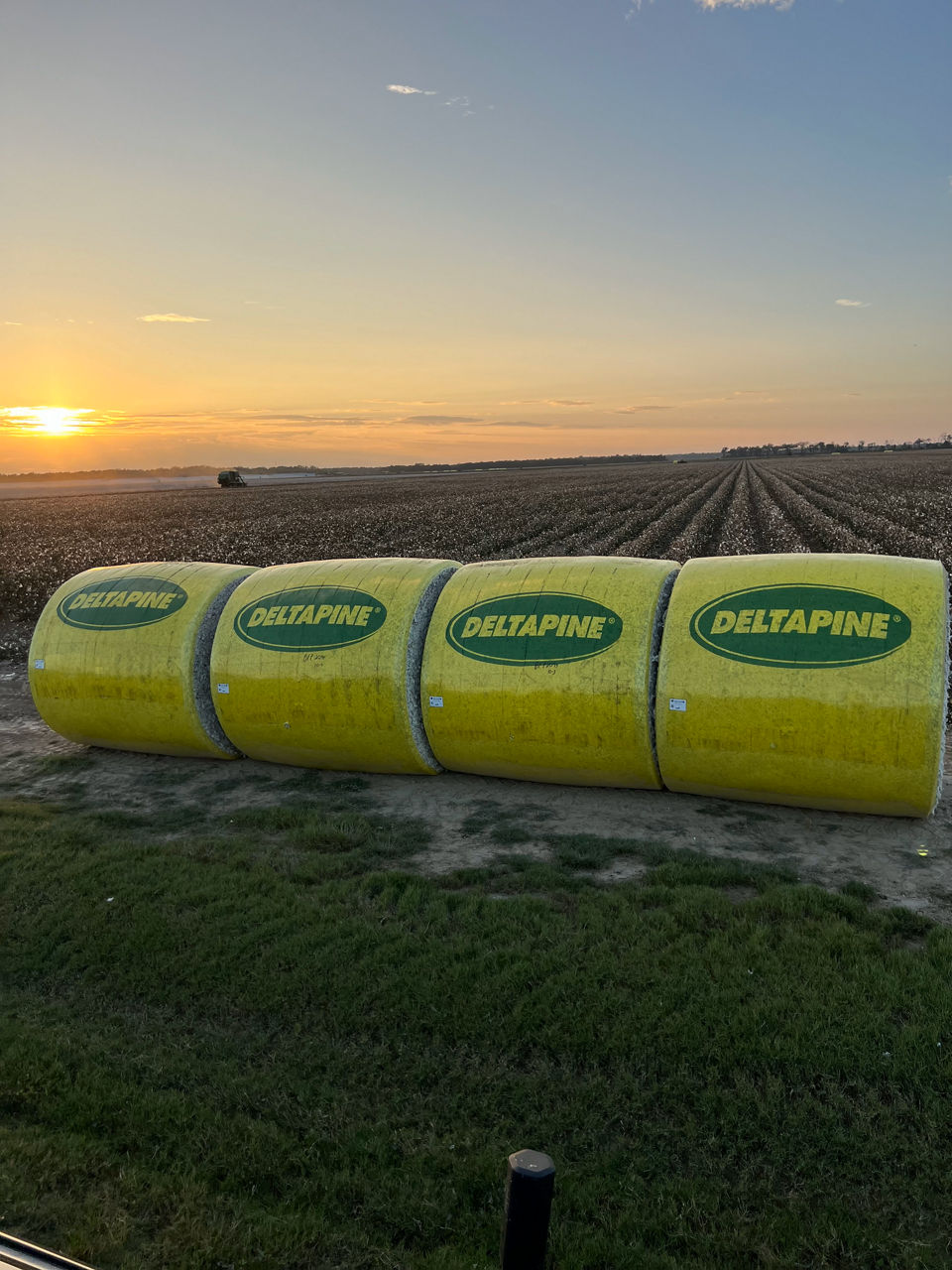
Once cotton is harvested, it is either stored in round modules or large rectangular modules placed on the edge of fields until it is transported to a ginning facility. To help protect cotton during storage, round modules are wrapped with plastic that covers the circumference of the bale and a few inches on the ends (Figure 1). Rectangular modules should be covered with a high-quality tarp. Tarps should be checked for any tears or pin holes before use. Any excess moisture in the cotton can cause condensation, so modules should be monitored. When elevated moisture levels occur, temperatures increase within the module, compromising lint grade and potentially causing seed germination. Extreme cases can result in spontaneous combustion. Cotton module or bale temperature should be monitored for the first five to seven days. Ideally, cotton harvested at correct moisture levels should only increase 10 to 15 °F in the first five to seven days of module storage, then level off or decrease in temperature. A 15 to 20 °F temperature increase during the first five to seven days indicates a high moisture problem and the module should be ginned as soon as possible.5 After the initial daily temperature check, modules should continue to be checked every three to four days. If a module reaches a temperature of 120 °F at any time during storage, the cotton should be ginned immediately.
Reducing stress is fundamental for maintaining the high fiber quality potential of a cotton variety. Fiber quality is built throughout the entire growing season, and certain production practices can help protect the potential of the product planted.
For more information, read Environmental Factors Impacting Cotton Fiber Quality.
Sources
1Constable, G., Llewellyn, D., Walford, S.A., and Clement, J.D. 2015. Cotton breeding for fiber quality improvement. Industrial Crops, Handbook of Plant Breeding 9. Ch. 10 pg 191-224.
2Producing for quality. 2001. Cotton Physiology Today. National Cotton Council. Vol. 12 No. 1.
3Hake, K. Bragg, K., Mauney, J., and Metzer, B. 1990. Causes of high and low micronaire. National Cotton Council. Physiology Today. Vol 1. No 12.
4Silvertooth, J.C. 2015. Crop management for optimum quality and yield. The University of Arizona Cooperative Extension. AZ 1219. https://extension.arizona.edu/sites/extension.arizona.edu/files/pubs/az1219-2015.pdf
5Hake, S.J., Kerby, T.A., and Hake, K.D. 1996. Cotton production manual. University of California Division of Agriculture and Natural Resources. Pub. 3352.
6Haire, B. 2022. Know the cotton quality factors and avoid deductions. Southeast Farm Press. https://www.farmprogress.com/cotton/know-the-cotton-quality-factors-and-avoid-deductions/
7Wright, A. 2024. Understanding the rlationship between cotton classing and cotton prices. Texas A&M AgriLife Extension. https://agrilife.org/agecon/understanding-the-relationship-between-cotton-classing-and-cotton-prices/
Web sources verified 9/18/25. 1414_75901
Disclaimer
ALWAYS READ AND FOLLOW GRAIN MARKETING AND ALL OTHER STEWARDSHIP PRACTICES AND PESTICIDE LABEL DIRECTIONS.