Are Vegetative Branch Cotton Bolls Contributing to Yield? – Mid-South
April 2, 2026
Get Year-Round Updates From Our Agronomic Experts
TRIAL OBJECTIVE
- A 2023 study (also known as “Antique Alley – A Walk Through Cotton of Yesterday and Today” from the Bayer Crop Science Learning Center at Scott, MS evaluated changes in cotton production systems from variety advancements, agronomic characteristics, and shifts in plant growth regulator (PGR) use patterns toward more aggressive regimens.
- Several notable changes were documented in the 2023 study regarding yield components and associated agronomic traits in new varieties and production systems.
- Cotton bolls have primarily two types of bolls – monopodial and sympodial. Monopodial bolls originate on vegetative branches. Sympodial bolls are generated on fruiting branches.
- Previous work from the early 1990s showed approximately 6% of total yield to be harvested from monopodial bolls on vegetative branches.1
- In the Antique Alley study, monopodial bolls were measured to contribute in excess of 30% of total yield in plots managed aggressively with PGRs. This was true for both OLD and NEW cohorts of varieties, indicating this shift in yield contribution was primarily a result of agronomics rather than a result of new varieties.
- This agronomic shift is likely a reduction in planting rates during more modern times and appears to be independent of varietal age cohort.
- Questions remain about both the relative age and contribution that monopodial bolls make to cotton crops in modern production systems.
- Answering these questions can help guide decision making about scouting, protection, and relative contributions of monopodial bolls in cotton crops.
RESEARCH SITE DETAILS

- All field work, tillage, and herbicides were per local standards.
- Various cotton varieties were planted from late April to early May. Boll position is expected to have little to no relationship to cotton variety grown.
- A plot would be considered an individual plant. Bolls were tagged on plants, in pairs around the site (Figure 1).
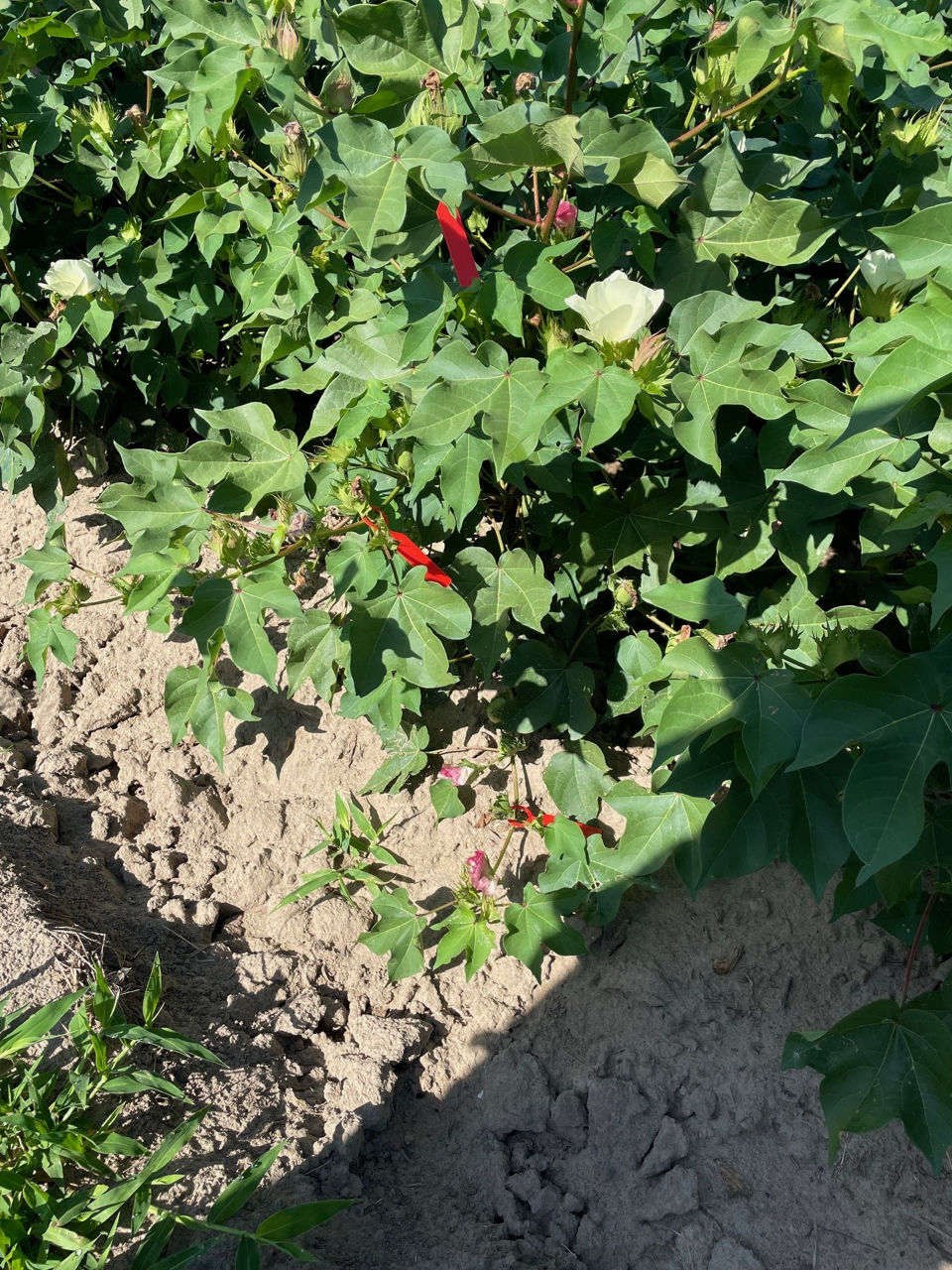
- On July 23, 2025 approximately 275 pairs of bolls were tagged using the following criteria:
- A white bloom was present on both a vegetative and reproductive branch on the same plant. This would be a bloom that opened that morning.
- After defoliation and prior to harvest, plants with tags were cut from the tagged locations and plant mapping was performed in the field (Figures 2 and 3).
- Vegetative fruit (monopodial) – recorded the following:
- Mainstem node of the vegetative branch
- Fruiting branch on the vegetative branch
- Mainstem fruit on fruiting branches (sympodial) – recorded the following:
- Mainstem node of the fruiting branch
- Position of the fruit present – 1st, 2nd, 3rd
- Vegetative fruit (monopodial) – recorded the following:
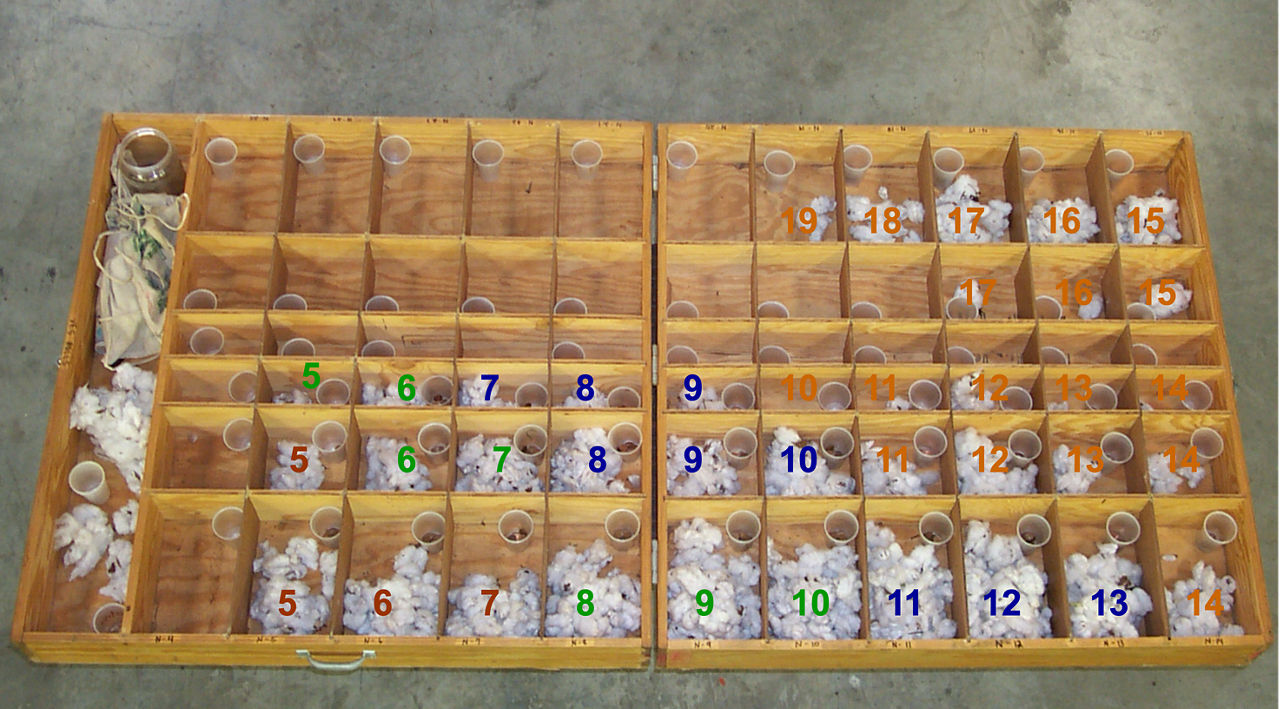
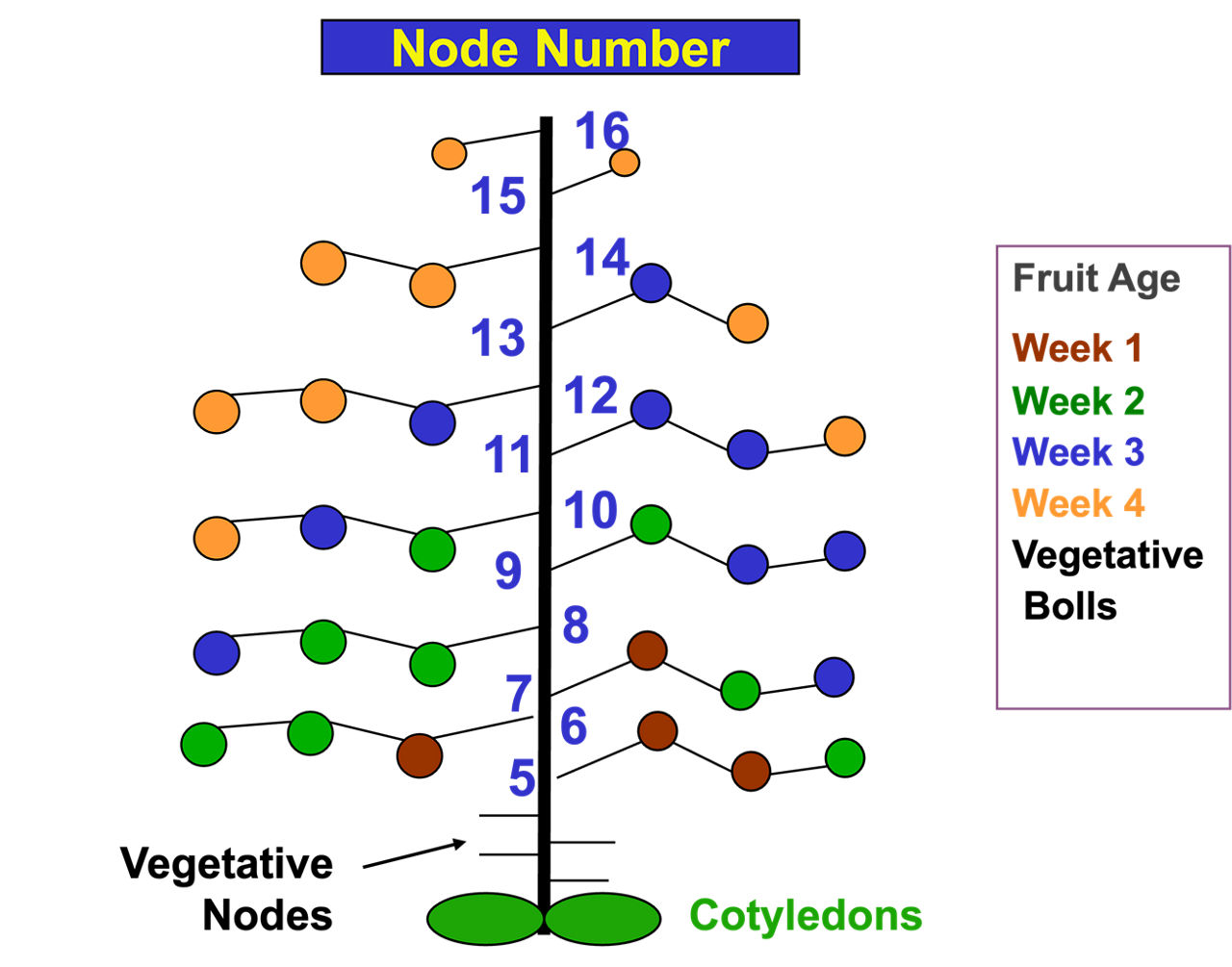
- At the end of the mapping process, bolls from each branch type were bulked together, bagged, and sent to ginning for fiber quality and turnout estimations.
- Data presentation – Data analysis is presented primarily by either fruiting branch or vegetative branch node (ignoring both fruiting branch number on vegetative branches and fruit position on fruiting branches). The individual position/branch data did not add significantly to the analysis and data from that portion is not shown.
- Data will be presented in several contexts, including:
- Across all boll positions
- Where pairs of vegetative and reproductive bolls existed on the same plant.
- By node age equivalent (NAEQ) – this parameter represents basically by day of bloom and standardizes the boll age within similar boll age cohorts, allowing comparison back to the vegetative branch bolls. This data represents a snapshot in time but can be used to roughly estimate the age cohorts and their respective boll sizes, ages, and contributions to yield potential.
- Notes about the Node Age Equivalent parameter:
- NAEQ uses the understanding of fruiting progression to place bolls in age cohorts. This allows bolls to be grouped by similar ages (i.e. bolls within a cohort bloomed on roughly the same day).
- Under normal heat, water, and sunshine conditions, it takes three days to make a new boll between nodes.
- As an example, a boll on Node 8/Position 1 is three days older than a boll on Node 9/Position 1. This is because fruiting starts at the bottom of the plant and progresses toward the top.
- Under normal heat, water, and sunshine conditions it takes a boll six days to develop from position to position on one fruiting branch.
- As an example, a boll on Node 8/Position 1 blooms six days before a boll on Node 8/Position 2.
- As a result of this relationship, after four to five fruiting branches go into bloom, at least three fruiting positions could bloom on the same day on each plant assuming they are retained as squares. On many plants, there will likely be one or more vegetative bolls blooming on a given day. Node age equivalent allows documentation of these bolls, which can then be compared to the vegetative fruiting positions. This allows a rough estimation of the age cohort of vegetative bolls.
- In short, we are working from the known – boll age relationship on fruiting (sympodial) branches – to the unknown, location and bloom date on vegetative (monopodial) branches as compared to fruiting branches.
- Data will be presented in several contexts, including:
UNDERSTANDING THE RESULTS
- Sample Numbers – The samples were divided into several groups primarily due to fruit shed occurring after plants were tagged.
- Approximately 275 pairs of fruit were tagged, which bloomed on the same day and on the same plant.
- 238 plants were recovered for mapping.
- 190 pairs of bolls from the same plant were recovered post defoliation.
- Positional Shed – It is also important to explain why some of these numbers may appear inconsistent with the total number of plants sampled. Some plants had multiple blooms on either a sympodial branch and/or a monopodial branch. They were all included in parts of the analysis to complement the data set.
- The results from actual sheds, from either of the two versions listed, are below.
- 112 fruiting positions shed their vegetative comparison, or 47% shed from the 238 plants recovered
- 39 vegetative positions shed their fruiting comparison, or 16% shed from the 238 plants recovered
- The results from actual sheds, from either of the two versions listed, are below.
- Data Learnings
- Across all bolls of the various fruiting forms:
- Fruit recovered at mapping
- Vegetative (monopodial) fruit recovered = 229 bolls
- Fruiting (sympodial) fruit recovered = 302 bolls
- Fruit recovered at mapping
- Average node number of the bolls bloomed on the same day on the same plant (the similar age cohort of bolls):
- Vegetative node number (monopodial) of recovered fruit = 4.68
- Fruiting node number (sympodial) of recovered fruit = 10.64
- Where pairs of bolls existed on the same plant, mapping was translated into Node Age Equivalents to allow maximum numbers of bolls for comparison. This also allowed estimations across several bloom dates when including positions of similar age in the analysis.
- Node 4 was considered Day Zero for the NAEQ analysis.
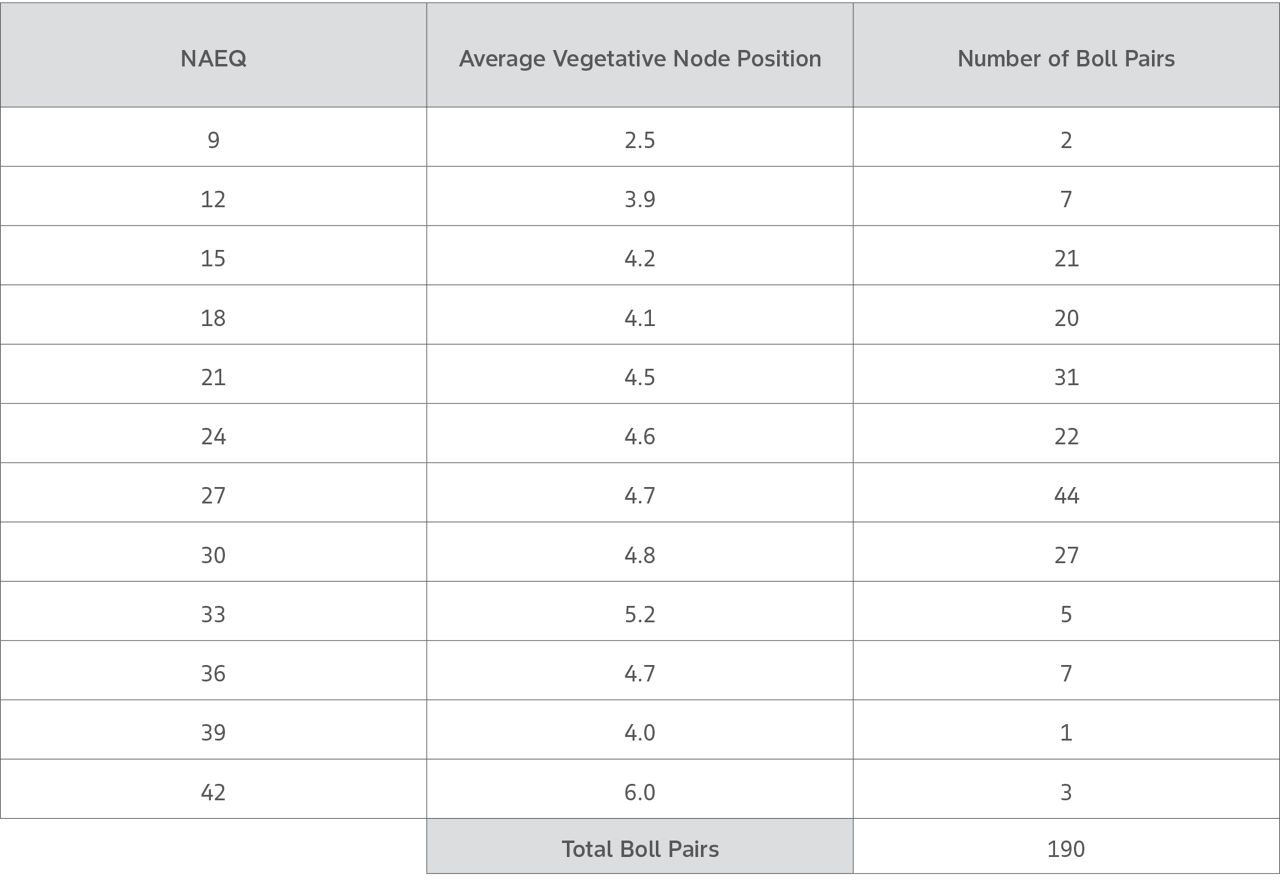
- Three to four nodes into fruiting, pairs and/or triples of similarly aged bolls began to appear in the data; therefore, the table starts on NAEQ 9 (Table 1).
- From this, we can generally see as bloom date progresses and NAEQ moves later, the node of the similar aged vegetative boll moves later into the season and therefore is further up the plant.
- Across all bolls of the various fruiting forms:
Table 1. Node Age Equivalent (NAEQ) and average vegetative (monopodial) node position and number of bolls.
- Boll size parameters – ginning performed to estimate boll size
- Seed Cotton per Boll
- Monopodial bolls – 3.42 grams/boll
- Sympodial bolls – 4.00 grams/boll
- Sympodial bolls were 16.9% heavier than monopodial bolls
- Lint Turnout
- Monopodial bolls – 42.79%
- Sympodial bolls – 43.02%
- Numerically similar
- Lint per Boll
- Monopodial bolls – 1.46 grams/boll
- Sympodial bolls – 1.72 grams/boll
- Sympodial 17.6% heavier than monopodial
- Seed Cotton per Boll
KEY LEARNINGS
- From these data, we conclude that vegetative fruiting proceeds in a similar and predictable manner as compared to reproductive fruiting.
- As day of fruiting branch bloom progresses, the location of same-day bloomed vegetative fruit also moves up (and likely out) on the vegetative branches but remains in a similar day-of-bloom cohort.
- Vegetative fruits appear to have similar turnout and somewhat reduced seed and lint weight as compared to bolls from fruiting branches which bloomed on similar days.
- Vegetative fruits do not appear to be more easily shed by cotton plants.
- Approximately three times the number of vegetative bolls shed compared to fruiting bolls: 48% vegetative shed versus 16% fruiting shed.
- Growers and consultants should consider vegetative fruit as a significant contributor to yield potential and protect it as needed throughout the season.
- Please contact your local Deltapine® brand representative for more information.
Sources:
1Jenkins, J.N. and J.C. McCarty Jr. 1995. Useful tools in managing cotton production: End of season plant maps. (K.H. Remy, Ed.). Office of Agricultural Communications, Division of Agriculture, Forestry, and Veterinary Medicine, Mississippi State University. Bulletin 1024. https://www.mafes.msstate.edu/publications/bulletins/b1024.pdf
1414_738100.
Disclaimer
ALWAYS READ AND FOLLOW GRAIN MARKETING AND ALL OTHER STEWARDSHIP PRACTICES AND PESTICIDE LABEL DIRECTIONS.