5 MIN READ
Evaluating DEKALB® Hybrid Corn Seed Performance in the South
January 20, 2026
Click on a tab below to see data collected each year for this study
TRIAL OBJECTIVE
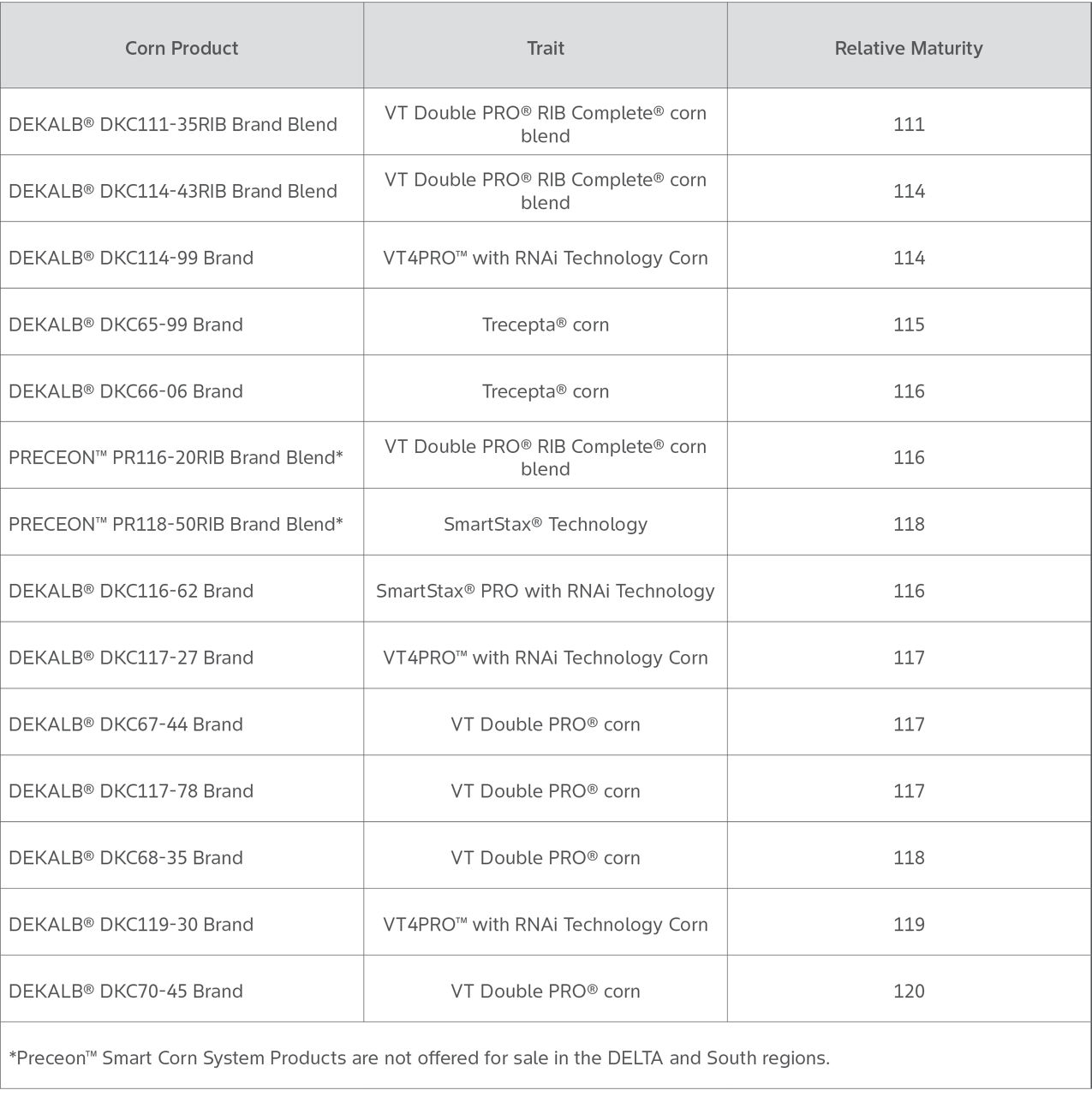
- Each season the Bayer Crop Science Learning Center at Scott, Mississippi evaluates market leading DEKALB® brand corn products and Preceon™ Smart Corn System Products for adaptability to the southern corn growing region. Though evaluated, Preceon™ Smart Corn System Products are not available for sale in the Delta and South regions.
- These experiments are conducted on different alluvial Delta soil types. The Buckshot site has heavy clay soil, and the Highway site has deep sandy soil.
- Yield potential and plant characteristics (height, ear size) are important factors to consider when selecting corn products for your operation.
RESEARCH SITE DETAILS
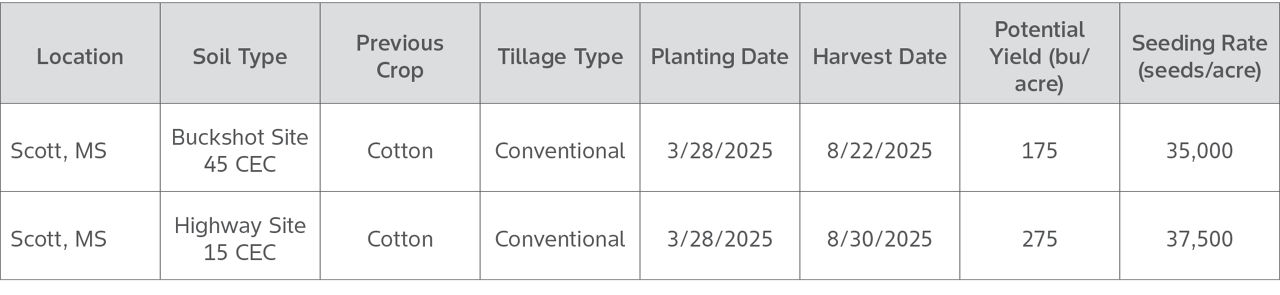
- All field work, tillage, and herbicides were conducted per local standards.
- 250 lb nitrogen was applied to both experiments as liquid 30-0-0-2.5.
Table 1. Corn products planted.
- The trial used non-replicated strip plots.
- Plot Sizes:
- Buckshot Field: 12-row plots, each 600 ft long, about 0.5 acre/plot
- Highway Field: 6-row plots, each 400 ft long, about 0.2 acre/plot
- Buckshot and Highway Field yield data was calculated using a commercial combine via whole plot harvest and corrected to 15.5% moisture content.
- Trials averaged 92% stand establishment post emergence.
UNDERSTANDING THE RESULTS
- Buckshot Site (Heavy Clay Soil)
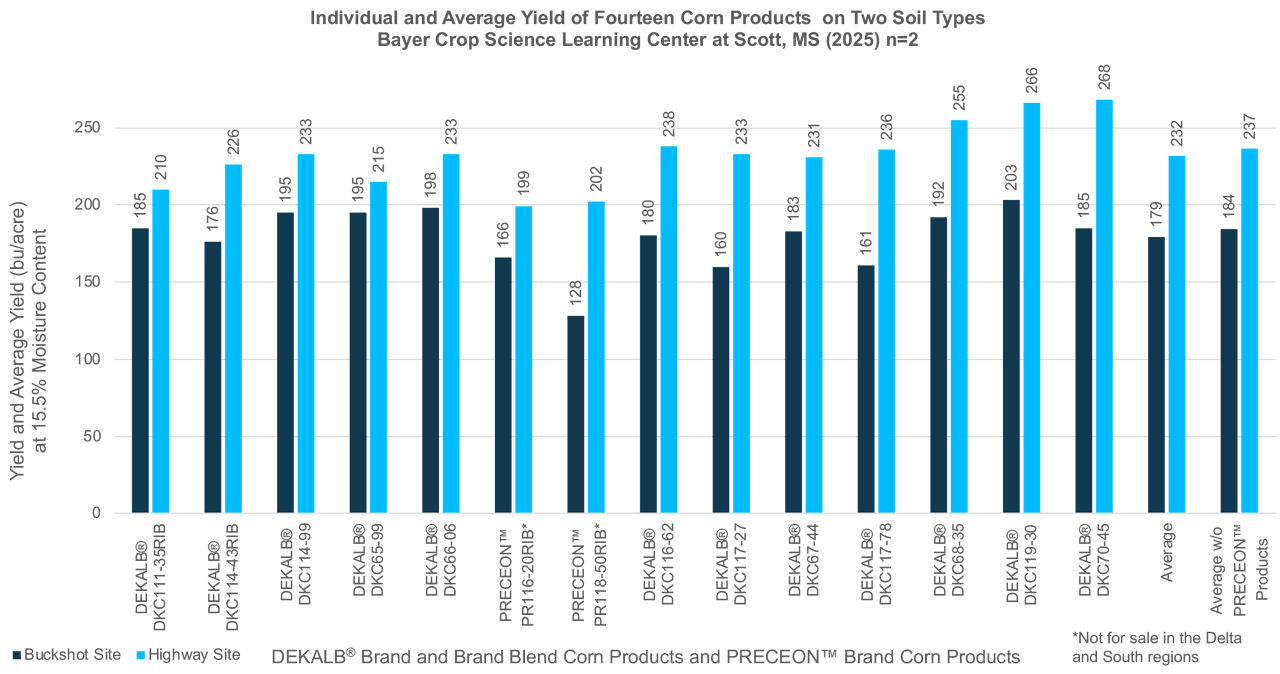
- Average yields at this site across the study were exceptional in this environment for 2025 with an average of 179 bu/acre and 184 bu/acre with and without the Preceon™ corn products, respectively. Several of the corn products yielded between 120 to 200+ bu/acre.
- Yield values during 2025 were higher than 2024 yields in many Learning Center fields or experiments at Scott, MS, especially those planted on heavier land. This was likely due to the lack of early, heavy rainfall events and the associated agronomic characteristics during the early season. Corn yields in lighter soil studies appeared to be somewhat lower than 2024 but remained relatively high for 2025.
- Highway Site (Deep Sand Soil)
- Average yields at the Highway Site were higher than the Buckshot Site with an average of 232 bu/acre and 237 bu/acre with and without the Preceon™ corn products, respectively.
- The top end yields in this environment for 2025 approached 270 bu/acre with several products (3 of 14) demonstrating yields above 240 bu/acre.
- Several of the newer products in this trial (particularly DEKALB® DKC119-30 Brand and DEKALB® DKC114-99 Brand) demonstrated outstanding yield potential while older products such as DEKALB® DKC66-06 Brand remained solid performers in both environments.
KEY LEARNINGS
- The results of this trial demonstrated that DEKALB® brand offers a robust lineup of corn products suiting the diverse soil types of the Mississippi Delta, including heavy clay.
- Growers should consider their personal preferences and the yield potential of corn products in combination with the plant characteristics measured here when choosing corn products for the 2026 growing season.
- Please contact your local DEKALB® brand representative for more information.
1220_58307
Disclaimer
ALWAYS READ AND FOLLOW GRAIN MARKETING AND ALL OTHER STEWARDSHIP PRACTICES AND PESTICIDE LABEL DIRECTIONS.