The Intersect
Combating Corn Rootworm with Innovation
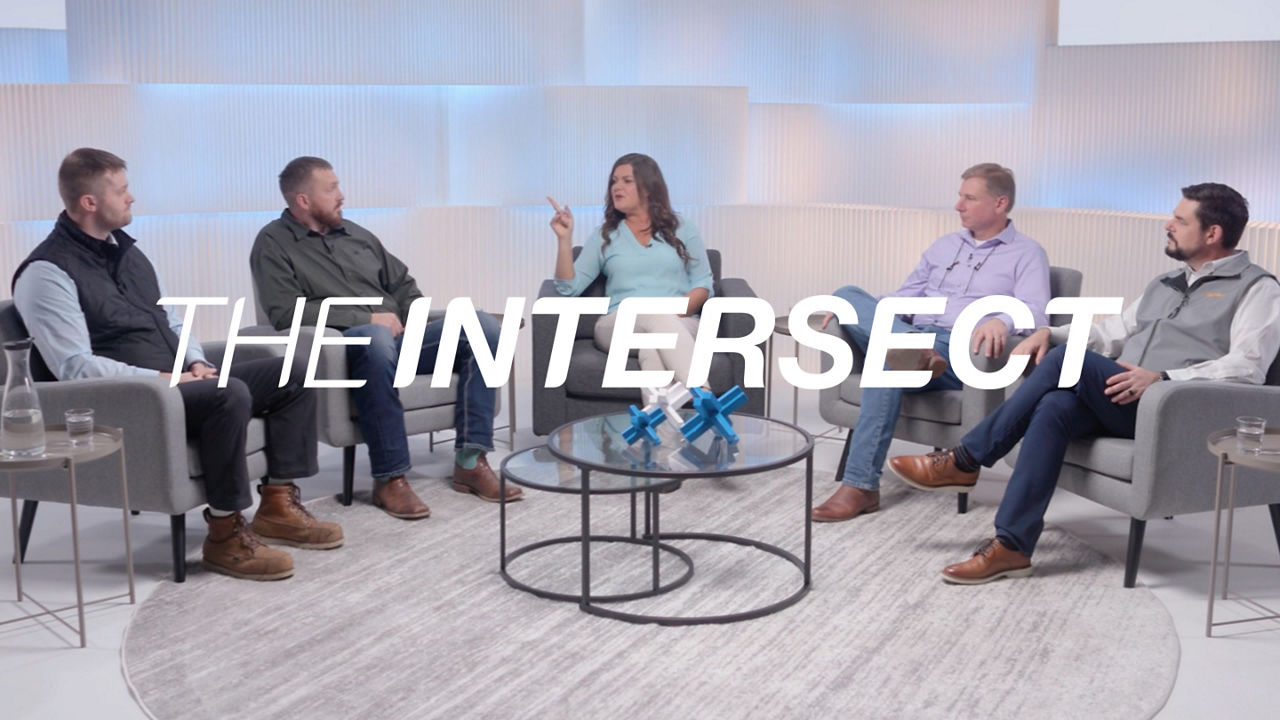
Often dubbed “the billion dollar bug,” corn rootworm is a notorious pest on farms across the country. Hear from industry experts about how the latest technologies — including SmartStax® PRO with RNAi Technology and VT4PRO™ with RNAi Technology — are helping farmers fight back and defend valuable cropland from corn rootworm.
More ways to listen:
Video Transcript
Read the full video transcript here.
- [Narrator] The Intersect.
- Welcome to The Intersect, where experts from across the industry get together to discuss unique ideas and opinions. And today, we're gonna talk about the billion-dollar bug: the corn rootworm. I'm your host, Michelle Miller, and I'm here to introduce some very special guests, starting with Ryan.
- Yep, good morning. My name is Ryan Tichich. I'm the corn agronomic systems lead for Bayer Crop Science. I help launch products for our company and bring new solutions to growers.
- I'm Ashley Dean. I am an extension specialist for field crop entomology at Iowa State University. And so my background is in agronomy and entomology, and I help with research and extension for field crop insects in Iowa.
- Good morning. My name's Josh Carlson. I'm a farmer panelist. I've been farming since 2016. I went to Iowa State and majored in agricultural studies with a minor in agronomy in AST. I've been farming alongside my dad and brother since May of 2020.
- My name is Ben Carlson. I'm a farmer panelist as well. I've been farming since 2020, about 400 acres row crop, and about 7,000 head of market hogs and farming alongside my dad and brother since 2020.
- Yeah, I'm Jim Carlson. My wife, Jennifer, and I farm in Central Iowa, just south of Fort Dodge. We farm about 3,000 acres and have some corn on corn and as well as some rotated ground.
- Yeah. My name's Andrew Penney. I'm a technical agronomist for Bayer Crop Science. My background is plant pathology and crop physiology.
- All right, so corn rootworm is a problem that has been plaguing corn growers for over a hundred years. Ryan, we'll start with you. What do you think is the reputation behind corn rootworm?
- Yeah, I mean, I think it's a very devastating pest for growers, right? It definitely is at the top of their list of high-impact insects that they have to battle. Causes a lot of damage, right? It can be up to 45% yield loss in extreme cases. So it's something growers have to stay on top of and be very thoughtful in their management of.
- Yeah, I'd like to ask you, Jim, you've been farming probably your whole life, right? What kind of personal experiences or personal stories have you had when it comes to corn rootworm?
- Sure. Started out there wasn't many because in the early years of my career, it was a lot of rotation and you just didn't hear a lot about the pest. And as we went to more corn on corn, the pest has evolved and gotten to where it's been more of a problem. And the last couple years, we've had, like Ryan said, we haven't had 45% reductions, but we've had 20 and 30% reductions in yield from other fields that didn't have rootworm pressure. And not only is a yield reduction devastating, just managing the crop and trying to harvest it when the crop is not standing properly and down from the root-feeding damage.
- Yeah, so Bayer, you know, you guys kind of came up with the original solution for this problem, right? With Bt. So what would you say, when it was introduced, what was its impact on farming?
- Yeah, I mean, I can start, and be curious to hear from Jim and others. But I think the impact is large, right? Cause suddenly, you know, you had a pest that you were putting out insecticide, you know, in-furrow and having to do a lot to manage, right? To kind of building in that plant-incorporated protection, right? You're taking a protein that naturally occurs, right? Bacillus thuringiensis is the bacterium that makes that protein, and we found a way to incorporate that right into the plant, right? And so it expresses in the roots and rootworm feeds on it, right? And they're not able to survive that. So, I think it changed the game from that standpoint in just bringing a whole new management tool, one that had a very high degree of effectiveness. And yeah, I think delivered a lot of value from that standpoint.
- Anybody else wanna add to that?
- Yeah, I'd like to. When it was first introduced, I think that the main benefit was from corn borer. I mean, we saw a lot more corn borer pressure back in those times than we did rootworm feeding, in our area anyway. So, it started out as a good corn borer product to manage corn borer, and now has evolved into more of the rootworm and the below-ground traits.
- Yeah, before Bt was introduced, what did you guys do then?
- Well, it was either spraying insecticides for the corn borer late season, and rootworms, it was insecticide in-furrow with the planter.
- Ashley, what are your thoughts on this from an entomology perspective as far as corn rootworm and some of the biggest challenges you've seen?
- Yeah, they've touched on it really well so far. I think that in general, it's a challenging and frustrating pest because it's feeding, the larvae are feeding below ground, and you can't see that unless you're out digging up roots and things like that. So from that perspective, it can be really frustrating. But then also the larvae have evolved resistance to Bt, which makes it that much more challenging because it used to be like an easy button, right? It was right there in the plant ready to go. But a lot of times, especially in Iowa, people are really having trouble with those Bt traits doing what they're supposed to do. So they typically do what you have described where they try to throw a lot of different things at it. So Bt and insecticides, things like that, and some people are having success with that, but it is a huge cost to farmers, eating into their profit margins. So that's something to consider moving forward is just how profitable are those management strategies?
- Yeah, why do you think it's so important to have multiple modes of action?
- Yeah, I think just in general with pest management, it's important to have multiple modes of action so that it's harder for a pest to become resistant to one specific mode of action. And especially if we can rotate these year after year, that is usually the most effective way to do it. So that could be multiple modes of action within the plant-incorporated protectants, or it could just be, you know, rotating Bt with an insecticide rather than layering those approaches.
- Yeah, for sure. I remember when I was growing corn too, we always used the SmartStax®, which has the seven different modes of action they always talked about, right? I'd like to hear your opinions, you know, Ryan and Andrew, as far as from the Bayer side of things, how does the technology actually work?
- Yeah, again, Bt proteins are a pretty cool story in and of themselves, right? So you have a naturally occurring protein. The larvae will feed on the roots, right? They ingest that protein, it gets into the gut of the insect essentially. And there's a reaction that happens there, Ashley may be able to describe that in more detail, but a reaction that occurs that essentially leads to the gut lysing or kind of breaking open, right? And the contents leak out and the larvae very quickly die. And so great technology from that standpoint, like you said, with SmartStax, we bring two different Bt proteins into play there. And I think that's a really important point on this story of Bts, right? We started with sort of single Bt products, right, in kind of the first generation. And then, you know, around 2010, really the whole industry started moving more towards what we call a pyramided approach, which is bringing multiple proteins together to help combat the pest. And I think that that has helped. I think we still need to keep focused on new strategies going forward as we've been talking about.
- Yeah, and this is kind of like the transgenic-type plant breeding, right?
- That's correct.
- Whereas now, we're transitioning more into RNAi, right?
- Yes.
- Can you guys explain a little bit of those differences and how that technology works now?
- Sure.
- You bet. Yeah, so I mean, RNA interference is a fascinating technology. You know, basically a good way to think of it, it's a naturally occurring defense that all eukaryotic organisms have, so plants, animal, fungi, and it's basically a naturally occurring defense mechanism against foreign DNA or viruses. And so, we've actually learned a lot about RNA interference through work with plant viruses, animal viruses. And so, we've utilized a way to use this technology and deliver a double-stranded RNA to the insect, which interferes with the protein production that that insect needs to survive. So it's pretty fascinating technology.
- And the great thing about it is, you know, it's a very targeted protein that we're going after, right? One that really is only found in Diabrotica species and the corn rootworm species essentially.
- Highly specific and highly targeted.
- Very specific, very targeted, right? So not gonna impact other species and things like that.
- Yeah, you think about that, which you could probably talk about this, Jim, like before that all the different things that you had to use, right? Like all the different insecticides. Tell us a little bit more about that.
- Yeah, basically the only option we had was in-furrow insecticides with the planter. And then to try to control the adult beetles during the summer prior to the next year. So really all we had was a planter.
- So you guys as Bayer are the ones that have come up with this technology, but will you be licensing it to other companies?
- Yes. You will find it in other companies, other platforms as well. So yeah, there'll be multiple brands incorporating RNAi.
- Yeah, and I would say, I mean, just discussing, to build on what some of these, you know, what Josh and Ryan and Ben and everybody has discussed, I think the important thing to discuss here is the fact that this used to be a pest that was somewhat easy to manage. It's always been an issue. And I think over the last few years, it's become more of an issue. And what's made it really hard and challenging is the populations that are feeding more on some of these roots that we have out there. But I think it's gone from being able to scout and manage easily to now where we have to actually get outta the truck, look at populations, understand the population number, so that we know the amount of egg laying that will go on, which impacts feeding for the next year. So it's a lot more work than it used to be, you know? We used to be able to assume that traits are working 100% or that we don't have high populations of rootworms in our field. And now it's getting to the point where we really don't know what's out there unless we go out there and scout. And so scouting, you know, digging roots, looking for feeding, going out there when the soaks are out during the tassel and soaking stages of corn is vital to understand the populations of these insects. And that really dictates the next year of potential feeding that can go on in that field.
- Yeah, for sure. What are your thoughts as the farmers? Which one of you guys gets to be the lucky recipient of the crop scouting duties?
- Everybody. I mean, it's all hands on deck. Everybody does it, is involved with scouting. So, a point Andrew made, and Ashley, you touched on it, we talked about it earlier off camera, is when's the ideal time to scout for the adult beetles? Because it seems like that hatch window has gotten wider, they've evolved and gotten to be a wider hatch window too.
- Yeah, I feel like that was kind of a loaded question because honestly, if I were to recommend a time to scout for corn rootworm as a pest, it would be to dig roots. And I know it's like super labor intensive to do that, but that would be the best method to know what was happening in your field this year, right? The beetles are highly mobile, and so beetles that are flying around in your field may not have come from your field. So my recommendation to people is try to dig up some roots if you can, especially in fields that you think you may have a problem with. If you can do every field that would be ideal. But if you dig up roots and you're finding that at least half a node of roots are pruned back to within an inch and a half, that would be a benchmark to try to do something different the next year. But adult beetle scouting is quite interesting. People, I think this is probably the easiest way, that people could scout for corn rootworm just because it's relatively passive. You just put out these yellow sticky traps and then capture beetles. And we have been seeing that people think that the emergence window is kind of getting bigger. And so unless you're scouting for the entire emergence period, you may not have a great representation of the activity in the field. So we're trying to kind of iron that out over the next few summers, trying to figure out the best time to scout for recommending that for farmers.
- Yeah, I know you're doing some pretty cool research there at Iowa State looking at sticky traps and trying to give us some new insight on how to scout and how to manage these. Can you go in depth on kind of what you're doing there?
- Yeah, so maybe some people are familiar with the recommended threshold right now is if you see two beetles per trap per day, which is kind of a complex threshold in itself, but if you see that, then we would recommend doing something different the following year. So that would be like if you, ideally it would be crop rotation, but not everybody can do that, right? Especially livestock growers in Iowa specifically. But it could also be, you know, if you used a soil-applied insecticide this year, perhaps you use a Bt next year if you're gonna plant corn or vice versa. So what we're trying to do, because we've gotten a lot of feedback that people feel like they're not really getting a good representation with the amount of trapping that they're doing. And typically it's only like, four weeks of trapping and the emergence period is 10 weeks, so it can be hard to iron that out. What we're trying to do is we're putting sticky traps out for 10 weeks in a bunch of fields in Central Iowa, and then we're counting the number of beetles and some other metrics to try to figure out when the best time to scout would be so that we can make better recommendations for farmers.
- And I think that's really good. Part of the whole scouting in this new age of management for corn rootworm is we have a lot of growers using in-furrow insecticide. We have a lot of growers that will put an insecticide in with their fungicide application. And I think because of that long emergence window that we're seeing, there's a lot of, we'll call it false, you know, just the belief that they're getting rid of all those adult beetles that could potentially be laying eggs. And I think there's that false safety or just that feeling that because they're getting that, they're not gonna have any rootworm feeding the next year. And so I think that it's good that you guys are doing that research so that we can understand that emergence window and then maybe learn what percentage maybe we are getting with an insecticide. Is it even doing anything? Does it impact the next year? So there's a lot of unknowns. So it's good you guys are tackling that research.
- Yeah, it's becoming more common that people are kind of tank-mixing an insecticide with their fungicide, trying to hopefully reduce the amount of beetles that are surviving. But I think that's, from what we've seen, I think it's a really hard thing to do because fungicides usually go on, like right as beetles begin to emerge. And so the ones that you want to target really are the females that are laying eggs. And that doesn't happen for probably at least a month after fungicides go on. So, some people have had really great success with it, especially if they're going out into the field and trying to find the females and making sure that they have eggs by doing a squish test, which is really gross.
- I'm not signing up for that.
- Yeah, so some people have had success, but it's not something that we would recommend that people do just because it's, I don't know, maybe it's fairly cheap, especially if you're using an airplane to apply that, but it's just another added cost for farmers and I don't know that it's always paying off.
- Well, it's so interesting to have us all together and discuss these ideas, right? From the role of the farmer, through the research, through the development. What about from an agronomy perspective? What's your role as far as how closely or how often are you working with the farmers, boots on the ground?
- Yeah, I mean the last few years with the feeding populations that we've seen across my territory in the state, I mean, it's a very common conversation. And so helping growers understand the life cycle of the pest, you know, that emergence window that we're talking about, how to scout, when to scout, just the overall effectiveness of some of the things they've been trying, in terms of in furrow-insecticides, foliar insecticides, you know, with that fungicide. It's a very common discussion, and it's becoming a lot more common in geographies that we haven't had issues with in the past. So I think helping growers understand this new age of management and scouting that we're kind of facing to try and understand and manage this pest. It's a pretty big issue.
- Yeah, are you seeing some economic benefits as well for growers?
- Yeah, I mean in terms of, again, this new age of scouting and management, it is if it's done right. If you're out there scouting or rotating when you need to if populations get too high, it's effective. And so I think at the end of the day, it's about ROI. We always try and help growers be more profitable, whether it's corn or soybeans. And there are times where rotation's required, you know, the populations just get too high. Traits aren't as effective as they should be when those populations get high. And at the end of the day, you can make more money planting soybeans than dealing with corn rootworm and all the additional costs, you know, kinda like what Ashley touched on. So I think it's, again, going back to the population and understanding the new age of management that we're in, it's a very common conversation, but one that I enjoy having and one that I know and hope that it benefits growers.
- Yeah, what would you guys say, if you could give your top three tips for scouting, what would they be?
- Boy, I mean, I guess from the agronomist up here, I mean I think the most important thing is to understand, you know, Ashley touched on it, early season. Is there feeding going on in that field? Then I would say probably second is go out there during probably brown silks or later to get a good feel for the adult emergence. I think that's important. Again, going back to maybe just kind of a early insight into the potential egg laying that's going on for that next year. And then I think probably the third most important thing is understand the traits. You know, I think we have a good feel for what works in certain geographies and what doesn't. I think understanding the trait package and the performance and efficacy of those traits is very important.
- Josh, you've been quiet over here. What are your thoughts on the top three tips for scouting? Or what do you really look for as a farmer?
- I would say the biggest one is just to be out in your field. You can't just drive by it and say, oh, yeah, that field looks good. You know, I've not been in it. The next one, is like Andrew said, you gotta dig roots, look at the roots, see if there's been feeding. And then if there has, then you gotta make a plan for next year. OK, was the feeding enough that I need to rotate it to soybeans? Am I still okay to plant it to corn next year? What was the feeding like? Really just being hands-on and like actually diving in depth into the field and seeing what it looks like. I mean, that's the only way you're really gonna know what was going on and what's happening. That's one of the biggest things you're gonna have to look for. You can't just drive by.
- Do you guys think that you've had like, corn rootworm resistance on your farm?
- Some, yeah.
- Yeah.
- There's, this past year, one of my fields had some corn rootworm on it. And so we were out digging, put sticky traps out, sprayed a late insecticide on it. So this next year we're gonna take part of that field out and put it to soybeans just because the threshold was too big. And, you know, it was just one of those times that it's like, you look at it, it's been continuous corn for a while. And it was just one of those times where it's like, yep, OK, the best option for me next year is to rotate to soybeans.
- Yeah. Ashley, that's probably what you would recommend, right, is the top way to prevent resistance would be the best management practice of crop rotation? Would you agree or?
- Yeah, it's still really effective in most areas, and that's simply because of the biology. The larvae need corn roots to survive. And so if you give them something else the next year, they can't feed on those or they won't survive when they feed on those.
- Why do you think more farmers don't rotate?
- I think largely sometimes it's just that, like, corn is more profitable that year based on the markets. But a lot of times where we see the most issues is in continuous cornfields where they need the corn for livestock production, either silage or they're feeding the grain. And so that's usually where we see the most issues with continuous corn. And then they can't rotate because they can't use the soybeans on that operation.
- One thing I might add, I mean, that we have to keep in mind is, again, it's back to the adaptability of rootworm, right? And it finds ways even around rotation. So in some cases we have northern corn rootworm, right? That has what we call extended diapause. So the hatch is actually delayed by two years, maybe even three or four years, right? So that can sometimes interfere with that rotation strategy. And then in other geographies, they have something called the variant of the western corn rootworm, which actually goes and lays its eggs in soybean fields. And so it's just interesting that, yeah, Mother Nature finds a way-
- As if it wasn't hard enough to manage.
- As if it wasn't hard enough, right? From our whole conversation here, we also have to keep that in mind. So totally crop rotation is something we need to do, but when we do it, we need to also be thinking about, we can't let our guard down, I guess. Because we have to be aware of these variants that are out there. And, you know, in some cases that could require, again, scouting, potentially even thinking about traits in first-year corn in some cases.
- That's what makes it really tricky, Ryan. I mean, it's hard enough to manage populations in a corn-on-corn situation. To understand and know the populations potentially on first-year corn just throws a massive wrench in the system and it makes any conversation I have with a grower that much harder because that's something you have to go out and scout. You know, we can't just assume we don't have rootworm anymore on first-year corn. So it's hard.
- I'd be curious, Jim, if you guys had any issues with northerns or extended diapause, anything like that this year.
- We had some rootworm feeding in some rotated farms, so what variant they were I'm not 100% sure. But yeah, we've had feeding in rotated farms, so. But I've got a field that's been corn for 16 years that's still one of the top farms and it's just a phenomenal corn farm. And there's feeding, but it's manageable on that farm.
- Why do you think that is? That's interesting.
- Interesting. I don't know if interesting is the right word. It's confusing because it shouldn't be that way. But one thing, that farm is very well suited for corn, the soil types and the fertility and the drainage, and it's a much better corn farm, which makes it grow better corn. Even if there is feeding, it is gonna be able to grow through that feeding.
- Yeah, and Jim brings up a good point. When I'm talking with the growers about this issue, there was a time where we could just discuss, hey, it's been two to three to five years corn, we probably have populations, now it's time to rotate. Well, now we're in a situation where if they potentially have corn rootworm feeding on first-year corn and you don't know about it, we can't just assume that we don't have rootworm feeding because we're on first-year corn or because it's second-year corn. It's gonna require scouting to understand those populations. And we can't just assume based on the time of continuous corn or first-year corn that we don't have feeding. So it's just becoming really complicated to manage.
- And when you go into a rotated field, you can't just assume there's gonna be rootworm, possible rootworm feeding, so you're gonna put a traited hybrid out there because that historically that can have a yield drag on it. And you may not be optimizing the yield you could get by putting a non-traited corn out there. But on the flip side, then if the rootworms are there, and you don't have traited corn, you know, so it's a balance on which way you jump and what products you use and what traits you use on which fields.
- And what are your thoughts on the safety of all of it too, right? Like sometimes I think this is so great, we're coming up with these great solutions, but what if at the end of the day the consumer says, "Ah, I'm not sure about that." Do you have any thoughts as far as the safety of RNAi compared to Bt or anything like that?
- Yeah, no, I mean, I think we touched on before a little bit. It's a very targeted gene that it's really going after and protein that it's going after within the rootworm larva. So, it's, you know, you find it only in rootworm, you do not find it in like, earthworms or other species, right? That sometimes like insecticides can play an adverse effect with. So, I think because of that specificity that you see there, it is a very safe product to non-rootworm species. So I think that's a positive. And as you said, Bt proteins also in and of themselves are very, very safe.
- Yeah. It's a good naturally occurring soil bacterium. Right?
- Exactly. Exactly.
- You think about protecting beneficial insects too, as people want to go more into natural or regenerative or whatever it is that the consumer trend, it's like, well, we wanna think about biology over chemistry, and so can we do that with this new technology of like, well, now we're getting even more targeted, even more specific, even more tested.
- Yeah.
- Regulated. It's pretty cool.
- It is very cool. And I mean, you just step back and think about the biology of what Andrew described earlier about how the RNAi Technology works, right? I mean, it's just an awesome application of using technology and science, right? Working with the biology of the plant and the insect to provide that level of protection. I think it's a very cool story.
- Yeah, and on top of that, I mean at the end of the day, the end consumers that may be not involved with crop production or understand crops, it's less pesticides, right? We don't have to go out and spray pesticides foliarly that could impact beneficials, right? And so I think at the end of the day, if we can target technology to specific insects that are detrimental to growers, I think that's a good thing when we can reduce pesticide use.
- Right. It's all coming back to best management practices, right? Like, everything we're talking about. I mean, what's your thoughts? You haven't really chimed in too much here, but, Ben, what are your thoughts on best management practices on the farm?
- Yeah, with the growing population, you gotta do what you can to get the best yield with as little ground, and the more ground that goes to developments, we just gotta keep doing what we can to preserve our ground so that we can keep producing better yields. And we don't go backwards on that.
- And I think that's what we're always thinking about, right? At the end of the day, how is this gonna benefit your grower? And when you think about the economic benefit or improved yields, what are y'all's thoughts on improved yields? You know what, let's talk to you, Jim, because you probably know what this is like from decades ago as a farmer. How much has your yield improved? And what sort of technologies are you looking at to improve that yield? Are you seeing a continuous improvement?
- Oh, absolutely. A hundred percent increase in yield. I would say, you know, in my early days when I was watching Dad farm through high school, you know, there was times 125 bushel corn was kind of the normal. So, and then with the introduction of, I can still remember when nitrogen was kind of first came on the scene and then there was a huge jump in yields. And now if we're not 200 or above, you're way behind the game and you really need to be 250 for yields and where that will go in the future with technology and with the improvements in equipment, the improvements in planters, the improvements coming from the research departments at the companies and the universities, you know, the sky's the limit. But it's like Ben said, it's gonna take more and more bushels off less and less acres to feed a growing world. And, you know, when you look at what we're producing now, 200-plus bushel corn with less nitrogen per bushel produced than what they did when nitrogen first came on the scene. So we're using more products, we're doing more management, but we're way more efficient with it. So, I don't think people, I don't think the consumer always understands that. That we're feeding way more people with less land and yeah, we're putting a lot of inputs out there, but it's targeted inputs, and they're less per bushel of corn produced, or commodity produced, whatever, wheat, corn, beans, anything. So absolutely, the yields have definitely improved.
- Yeah, they say the average American farmer produces 262% more food with 2% fewer inputs compared to the 1950s. So that's really interesting to see all of this happening now, you know, with RNAi. I mean, so it's really kind of more so targeted to the roots specifically, right? Would that be a fair-
- The RNAi component?
- Yeah.
- Yeah. By and large, I mean, you do see some expression throughout the plant, but it's mostly targeted to the roots and that's where really the impact of the technology occurs.
- Yeah. And how do you think that's going to impact yields?
- I think it's gonna help, right? Again, as we add the protection, we reduce that damage to the roots. Yeah, it's gonna allow the plants to be more resilient in tougher conditions, tougher environments. And to me that, you know, as Jim was talking about, historical yields, right? Another thing that I think is very impressive is just the resiliency of that yield curve. Like every year we're adding bushels, and we've had some tough years in there, right? Some years with a lot of drought and a lot of stress where a lot of growers I've talked to would say, you go back into the '80s or '70s, right? And the genetics in those days, you know, wouldn't handle that kind of stress, right? So even with a high level of stress, we're still delivering. And again, I think technology like RNAi and things like that are only gonna help because you gotta build a strong root system. That's the base, that's how the plant gets its water nutrients, right? Everything it needs. And so you gotta keep that machinery intact. For sure.
- For sure. Yeah. You think about all the roots that go in with corn, like the different brace roots and everything that comes with the plant. Why do you think roots are so important?
- Well, again, I think it's accessing the nutrients in the water, but then also the standability piece.
- Standability,
- Yep. Keeping that corn upright. And Jim commented earlier on how much of a pain it is when it's down, right? Trying to get that crop in.
- Been there, been there.
- Nobody likes that. A lot of extra time. And it's not fun. So, that definitely helps in the sustainability play as well.
- For sure. What kind of experience have you guys had on the farm with any types of crop loss, with breakage of roots or anything like that? Tell us a little bit more about that experience you guys have had.
- Well, I'll start it off and let Ben finish. I get to pick the combine I drive, so I take the combine that has row feelers, row sensors on the combine in corn. So I was running that combine. He was following me with the second combine and some downed corn. And I had a lot easier day than you did. So you wanna talk about that day combining some downed corn from rootworm damage.
- Oh, really?
- So we would try and skip lands to make it easier on my mom who runs one cart to try and catch both combines at the same time. And so he would go ahead with the GPS and follow in, and I'd have to get outta my combine and physically count rows so I knew that I was where I needed to be. Otherwise we'd be off and we'd be combining one row down or we'd be missing some. And it's not very easy when it's not perfectly straight and you can see the whole length of the field. And in parts it was fun to combine, but then other times it's like, all right, I can't see my head anywhere. Where am I supposed to be?
- Not only that, but when that corn is twisted, when it's a nice straight row, the corn will just nice and easy come into the head, and when it's twisted up, it's going like this, it's coming at you. So it's all day long of watching that corn come at you, and it was a long day. With me with the auto-steer, I could look away and look at my phone.
- I remember that too, when I was on the farm in Iowa growing corn too. It was the same thing. We had a tornado come through and we're just like, what? And then you have to be so careful because you're like, well, what if there's metal or something from the debris of what happened? And, you know, you just walk in and you just see all that hard work on the ground. It's just... What are your thoughts? I mean, to echo what your brother and your dad had to say?
- I get the easy job, I run the semi. I don't have to run the combine, but I've ridden in the combine with Dad and Ben while they're picking corn and while it's down and it's not fun. It messes with your head sometimes. You're sitting there, you just stare out a window for 12 hours a day and some of that corn is whipped up pretty good and you're just like, man, this kinda makes me nauseous and it's not fun. So trying to place the best genetics and manage the crop correctly to help prevent that is huge. At the end of the day, that's your livelihood, that's your business, that's what your end goal is, is to harvest that, and to make it as easy as possible is huge.
- I will say to Ryan's point, we had three fields that were that way this year, that had extreme feeding and extreme damage. And Andrew was out and helped us dig in some of those and helped us look at different traits, different varieties. And the yield actually hung in there pretty good, I suppose because of the genetics, because of the breeding, because of what the seed companies are bringing forward. Back in the '80s and '90s, a situation like that, it would've been sad to see what the yield would've been. Even though it was an issue to combine and it wasn't good corn, but it was a long ways from being a train wreck. And that's definitely technology bringing better products forward that can, even under stressed conditions, will still try to perform.
- Yeah, and I'm curious, Josh and Ben and Jim, your thoughts. You know, we toured Chesterfield yesterday, and it's still eye-opening to me all the stuff in the background that you don't know what goes on with the big company that's producing, you know, a trait company, right? I think there's a lot of stuff that goes on that I never realized went on in the background. I'm curious your thoughts, you know, the importance of new technology coming down the pipeline and the impact that all the stuff that we saw yesterday has on you. What's your thoughts on that?
- Yeah, I never realized like, what all went behind the scenes. You know, you talk to your local agronomist or local representative of the company you buy corn from, and it's just like, yeah, I want this bag and that's what I want. And you don't realize that that was produced 12 years ago before it even came out to market for you to even plant. It's just like the amount of time and research that goes on behind the scenes, it was really eye-opening and just blew my mind.
- So if you think about it for a minute, like the RNAi Technology, right? That's now having an impact in the market. I mean, that is something that we started testing, I wanna say back in 2008 or '09, right? And then probably further development even prior to that. So it's a lot of years, right, in development to go through the whole process of creating that event and getting it deregulated, getting it into elite germplasm, right? Getting all of the approvals in place to be able to bring it to the market. And a lot goes into it. And I'm glad we put a lot into it, right? Because we want to bring that kind of transformative technology to the market.
- For sure. And there are a lot of really cool traits out there. Like, it's just so interesting. I was even talking to some of the plant breeders out there, like, "Oh yeah, we have like 200,000 different varieties of wheat, but maybe like five of them make it to market." Like, it's just crazy all the research that goes on. What are your thoughts, you know, especially from the farmer's perspective, on what traits do you decide to plant? Like, what does that decision look like for you?
- Mostly we just rely on our agronomist to try and help us place what they know and what they've seen in the area. Because we've only, we farm certain farms, and we kind of know what goes good there, but they've been out in the country seeing what may work on the soil. And so we just rely on them to try and give us their best input. And if we do have successive feeding on the roots, we just learn from it and try to do better next year.
- For sure.
- I would even add on top of that, you know, you try and set yourself up for success and for us to spend time on what traits work best where, and look at some of those things, you know, in our minds, sometimes it's not even, we don't even think about that. Like, we try and find trusted people that we work with that have a good reputation that, you know, they have their best interest in it for us, and we have their best interest for them. You know, sometimes for us, we like to sit in a combine, drive and watch the corn come in, or sit in the planter and plant. Some people don't like to sit behind and say, OK, DEKALB® 5981, this is the best corn for this soil type, this acre, with this amount of drainage to it. You know, there's a lot of research and a lot of information that goes into those hybrids that help you place on a better acre. And sometimes we don't utilize that information, whereas a representative of the company can come in and say, hey, this product works best here.
- Yeah, so I guess I'd add a little bit to that. We, pretty easy in our operation, we use above-ground traits for our rotated acres. We use triple stacks, SmartStax, for the corn-on-corn acres. And we use our agronomists and our seed representatives to help us fine-tune what, so the trait packages are really pretty easy in our operation. I'd say one thing that we are starting to spend a lot more time on is some of the biological, some of the micronutrients, some of those things that maybe help interact with the traits and the genetics to really optimize yield. So like I said, the trait package is really pretty straightforward on our farm. It's above and below ground for the corn on corn and above ground for the rotated.
- It's interesting. I never thought of that before, but yeah, it'll be curious to see where all we go with that and all the different technologies. And there's still so many variables, right? Like, you can have all the best things in the world, but if you're not using best management practices or whatnot or if the weather, if you have a bad year with weather, or whatever the case may be, there's still so many variables. But curious, Andrew, from your perspective as an agronomist, what sort of recommendations or what are some of your favorite things to recommend, or what are you looking at that's exciting?
- I think in general, it's probably just technology, right? And breeding. I think that's having the biggest impact on the industry right now. You know, I'm one that likes to shoot for high yields, but we have all these other, you know, kind of going back to the traits. We have different phenotypical traits, genotypical traits that I look for. And so it's a lot more than just one thing, right? I think it's a combination of our breeding platform, our pipeline, and at the end of the day, it's about yield, right? And so understanding all these new products that we have coming out that have these traits or that are coming from breeding, get me excited because I really do see that the next-level yield that we're reaching and that gets me excited. And it's really fun to make recommendations to help growers try and maximize the yields on those farms when we're seeing 300 bushel corn a lot more consistently than we have in the past.
- Yeah, how would you say that the newest traits are an upgrade from previous traits?
- Yeah, and again, going back to, you know, not just thinking about traits as Bt or RNA interference. You know, again, we have genetic resistance to disease. We have different phenotypical traits that might be beneficial to growers in 20-inch rows versus 30-inch rows. And so I think it's just, again, going back to everything as a whole, you know, just the products in general from breeding.
- Have you guys, as farmers, always been pretty innovative in wanting the latest and greatest?
- Yeah, we always want it, but it's whether we can justify it. I'd like to think we have, through my whole career, we've tried different trials. About every year we're monkeying around with something, trying something, and pretty unscientific. But we always try to do some different test strips and do some different things and we run a commercial sprayer, so we're spraying a lot in the summer. So I'll dump something in and go make a round and map it out and see what the yield monitor says in the fall. So yeah, I'd like to think we're being innovative. Do we always have the newest and the greatest? No. But we try to be as innovative as we can. And my dad told me once, you don't need a whole lot of things farm, but you need a really good planter. Because if you don't get the seed planted right, it doesn't matter what color tractor you're pulling it with or how fancy it is, but you better have a pretty good planter. We've always tried to do that.
- And being able to see the data, you know, like that's what's been so cool. I'm sure you can relate to this is how far we've come as far as data in the tractor cab. Talk to us a little bit more about that.
- Yeah, so I started mapping manure applications with the dry spreader back in 2006 when the first John Deere green boxes came out, or brown boxes, excuse me, the brown boxes. And I don't know that we've ever used that data, but we've got it if we ever want to use it. But yeah, it's phenomenal now, what you can do on the fly and watch from the cab of your tractor. And I can call Josh and say, "Hey, how do I change a monitor?" And he said, "Well, I can see you." He can watch my screen from his tractor in another field a mile away. So it's unbelievable what the technology is coming.
- Or vice versa. He can watch me plant and say, "Hey, you missed a spot," you know? It's just nuts how far it's come. Being able to pull it up on your phone, looking at real-in-time data that, oh man, the tractor's literally planting the field right there and 30 seconds later, half the maps already popped up and you can say, "All right, he's got about half of that done. OK, you know, Josh, you can go to this field next, or we're going in this field next," you know, you can help manage that part of it too, to be more efficient throughout the day. And then even you have an agronomist with, well, what'd that corn yield? Well, I don't remember. Let me pull it up on my phone quick and I can show you, or point a spot like, "Hey, what's going on here?" And even throughout the season you can map on your phone, put a point and say, "All right, I need to come back to this point to see what's going on" and pull it up on your phone two months later, go out back to that exact same spot and look and see what's going on. So using that stuff has just changed the game. I mean, you can pinpoint stuff, look at stuff, do a whole bunch of analysis with it, which is really cool.
- It's made research and just product testing stuff on your own farm so much easier. You know, you have all that data right there capturing it. It's made everything so much easier.
- Yeah, for sure. Well, your mom's the grain cart guy, right? So do you get to yell at her because everything's her fault?
- Nope. I don't. Nope.
- Come on, come on.
- She's the boss of the operation, so she gets let off easy. It's always the combine's fault or the trucker's fault.
- It's supposed to be the grain cart guy's fault.
- Well, it is, but she's the head of HR and the treasury department, so you gotta be nice to her.
- Oh, I love it. Ashley, what are your thoughts on all this, Ashley? Like, as far as the technology and the data? I mean, how has data impacted you as far as the research on the farms?
- Yeah, we don't do too much on-farm corn rootworm research, but I think it's incredible. I don't even know the half of what all you guys are putting in your tractors and your combines and things, that's very interesting to me. But I think it makes it easier for people like farmers to test different things at their own pace. So not necessarily link to some company or something like that. They can really test it themselves, put strips out in the field, and monitor those throughout the season. So I think it's incredible.
- Yeah, it really is. It's crazy how far we've come. I wonder what it's gonna be like in another 20 years, right? You're like, "Remember back then when we only had that RNAi stuff?" You know what I mean? Like, but right now it's like, the coolest innovation, you know? What would you guys say, that being said, with it being the latest and greatest, what would you say to farmers that are maybe on the fence of adopting this technology?
- Well, I mean, I can start. I mean, I'd say I think they need to strongly consider taking a look at it, right? We think about, again, the level of improved control that comes with it, what it can mean holistically for hybrid performance for yields. I think it'll be a welcomed thing within an operation. So I'd start with that and maybe pitch it over to Andrew.
- Yeah, I would say, you know, we've had these same Bt traits for years, right? I mean, it's all about selection pressure, right? So the more modes of action we have, the less selection pressure gets put on those Bt proteins. So I think the more we can adopt and use new technologies like this, it increases the efficacy long term of other products that we have on the market similar to new products, right? So, it's all about multiple modes of action, reducing that selection pressure on those modes of action, and hopefully utilizing that technology for years.
- For sure. I think about it too from the farmer's input cost expenses that, you know, fertilizer costs have been on the rise. Everything's, you know, so many input costs are rising for farmers. But what would you say to the cost of your product? Like, is a bag of this new technology seed, is it substantially more expensive? Is it about the same? Talk to us a little bit about the economics.
- Yeah, and I would say, you know, you start looking at it per bag, right? So we have seed that's sold in 80,000 kernels. And so when you start looking at a bag price, it can seem like a lot of money, but when you start breaking it down per acre, it's not that much at all. You know, typically 3 to 4 bushel depending on the price of corn. So I think there's always different ways, whether you're talking about new genetics, a trait, you know, just a specific hybrid. It can seem overwhelming when you're looking at a per-bag purchase. But again, breaking it down per acre, just like we do in bushels, right? We always look at bushels per acre. I think that really helps, you know, decrease the impact of that initial cost. And it makes it look a lot more, you know, I think it makes it easier to think about on your farm, hey, will this pay, you know, it's 3 to 4 bushel per acre. So I think that really helps.
- Right. And then how can you offset those costs by eliminating insecticide sprays or just less headaches, less time scouting? Well, you know, you always wanna scout, but just less time doing these other things, right?
- Thinking about that total ROI is really, really key.
- What other types of success stories can y'all share?
- Yeah, I mean, I got endless stories of, you know, as we continue to see issues with current platforms, you know, the new technology utilizing RNAi Technology, it's, I mean, growers doing side-by-sides, farms being split planted, that show the efficacy of that new trait platform. But again, I think it's also important that we can't forget about all the management in scouting that needs to go on so that we can maintain efficacy because, you know, like Ryan touched on it, it's not a silver bullet. And we know that. And so, I think the longer we can utilize the technology and not forget about all the scouting that needs to be done to maintain trait efficacy is important, but it is clear out in growers' fields that this technology works and it works really good. And so, again, I think that just reinforces the importance to maintain efficacy of that trait.
- And I think we're showing a lot of agility with it as well. So we actually have two products that we're bringing out with RNAi Technology, so SmartStax PRO, which is three modes of action, right? And would be kind of the toughest defense against rootworm. So we'd really target that for those high-pressure rootworm environments, maybe places that have had multiple years of corn on corn and just seeing a lot of pressure overall. But we also have VT4PRO™ that we're launching with RNAi Technology. And so what we're doing there is taking our broadest-spectrum above-ground platform in Trecepta® and we're adding the RNAi Technology to that. And so I see that as a very agile product, right? It's gonna be one that probably is gonna be a good fit for kind of low to moderate pressure environments. In certain geographies you have challenges with western bean and some other insects that the Trecepta piece does a nice job enhancing. But to me, there's a agility in how we're bringing the technology to market and creating a couple of different platforms that will ultimately help maximize the ROI for the grower on the right acre.
- Jim, what are your thoughts on all of this as far as having these different options and different technologies? Why is that so important?
- Well, no two fields are the same. No two years are the same. So you definitely have to be more specific going forward in what products you place on what soil types, what farm types. And so it's just another step as we build into being better farmers as far as placement and more efficient in how we maximize our yields on those farms. So the more options we have, the better it gets. Makes it more confusing sometimes and makes it more work, but it definitely, done correctly, can add a lot to the bottom line.
- For sure. And you guys said you've been working on these technologies, they've been in the pipeline for quite some time, right? What is it about 12, 15 years worth of research?
- It takes a long time to bring a trait forward.
- Yeah, for sure. So this is something you discovered a long time ago, maybe the early 2000s, would you say?
- Yeah, mid-to-late 2000s, in that range.
- Yeah.
- Yep.
- So is there other technology now in the pipeline that maybe isn't quite yet to market that you're excited about?
- Oh, absolutely. So I would just underscore that, you know, corn rootworm remains a significant research target for Bayer, right? We know we need to continue to bring traits forward, right? We talked about challenges with resistance and control and things like that. And so we know we need to continue to bring traits forward. We have our fourth generation, what we call Corn Rootworm 4 in our pipeline. It's slated to launch in that 2027, 2028 time frame. Great thing about it is we're bringing two new proteins within that product. So proteins that have never seen a corn rootworm before on a broad acre, which that'll be a good thing, right? To bring some novel proteins to play there. But we'll continue to build on the RNAi Technology with that particular product too. So we're gonna continue to enhance and build upon what we did with SmartStax PRO and with VT4PRO. So I'm excited about it. The yield data, we've seen a little bit of it, and looks really, really, really good. It's been in our pipeline now for a handful of years. And so, we're getting a lot of experience and confidence with it. So, feel good about what that's gonna bring.
- So, Ryan, in today's society, you know, five minutes is too long to wait. I don't really wanna wait 12 years for the next great thing to come out, and I know you've got stuff coming quicker, but in the whole industry, is there ways that we can improve the speed of some of this stuff coming forward? And what ways could we help with that process to get these new products out and on board faster? Because hopefully that time frame one way or another can shrink down. Because like I say, with today's society, 12 years is a long, long time. And I respect you guys got a lot to do, and regulations to follow, so it's not that easy, but boy, I sure hope there's ways we can speed that process up.
- Yeah, it's definitely a puzzle. I mean, and again, you have to start with the very basic biology, right? And thinking about what's happening with the proteins and from there you have to create the aversion of that in plants, right? And then eventually scale that up into elite genetics and you've got all the regulatory timelines that kind of go with all of that. So I don't know that there's a lot that can be done to speed it up, but I think what's really important is that, you know, companies like Bayer continue to have products in their pipeline, right? So we're not waiting 12 years between products, but like, again, for example, we'll have Rootworm 4 in '27, '28 time frame. We're working on the fifth generation as well. It's a little earlier in our pipeline. We're gonna see that next decade. But it's coming, right? And so we just have to kind of keep that focus as an industry. But yeah, the total time can fluctuate a little bit there, you know, thinking 10 to 12ish years. But, you know, a lot of that just has to do with the mechanics of discovery and trait integration and then the regulatory process. So we continue to push the limits as hard as we can on it. But some of those things are challenging to move.
- There is always a lot of challenges. Yeah, it's interesting. Well, we've heard a lot of really great things today. So thank you guys all so much for joining us today. It's wonderful to have extension come with the scientists, agronomists, farmers. So thank you guys so much. And thank you so much for joining The Intersect.
- [Narrator] The Intersect. Brought to you by Bayer.
Ryan Tichich
Ryan Tichich is the Corn Agronomic Systems Lead within Market Development at Bayer Crop Science. In his role he and his team focus on how to bring solutions to key challenges facing corn growers in North America. This is approached by characterizing how germplasm, traits, crop protection and digital modeling work together to get the best outcome for our customers. Ryan started his career at Bayer (via Monsanto) in 2006. Prior to joining Market Development in 2019, he held several roles in Breeding and Biotech, including trait assessment, trait Integration, field testing and pipeline management. Ryan and his family live in O’Fallon, MO and are busy with activities, sports and academic endeavors of the family. In his free time, Ryan enjoys running, playing ice hockey, and getting into the backcountry.
More on The Intersect
The Intersect is a collaborative series spanning topics across the agriculture industry including corn, cotton and soybeans. Check back here for our next installment on how innovation is shaping the future of farming.
Discover more about the innovations shaping our future.
Disclaimer
ALWAYS READ AND FOLLOW GRAIN MARKETING AND ALL OTHER STEWARDSHIP PRACTICES AND PESTICIDE LABEL DIRECTIONS.