Soybean Stem Canker Identification and Management
October 1, 2025
Get Year-Round Updates From Our Agronomic Experts
Soybean stem canker is a fungal disease caused by two species of Diaporthe fungi, D. caulivora and D. aspalathi.1 The two species were previously described as northern stem canker and southern stem canker, respectively. However, they are now collectively called soybean stem canker.1 Soybean stem canker primarily affects soybean plants and can lead to yield losses of 50% or greater.1 One of greatest challenges with this disease is that infection occurs during the early vegetative stages of soybean growth, but the cankers are not visible until after flowering and in the reproductive stages. Ideal conditions for soybean stem canker development include warm (72 to 86 °F) temperatures, and a wet, humid environment.2
Soybean Stem Canker Scouting
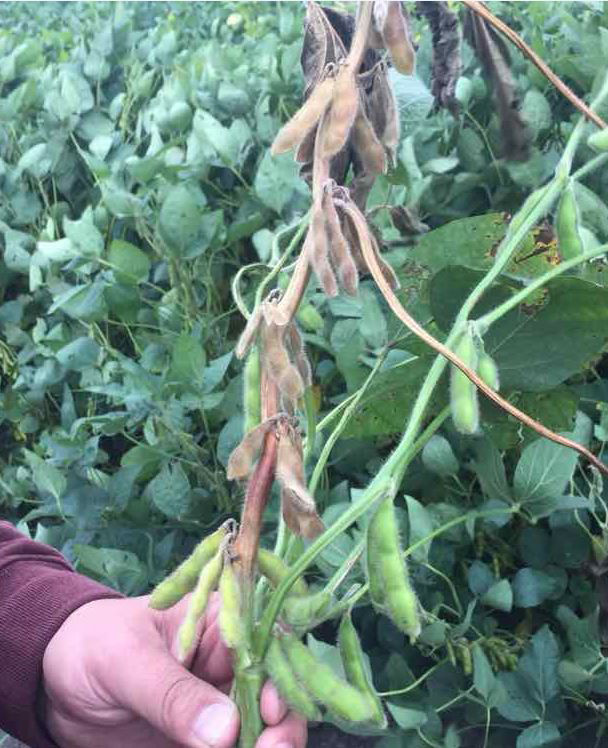
When scouting for this disease, look for soybean plants or areas of the field where there is wilting, senescence, or dying plants. Evaluate individual soybean plants and look close at the bottom third of the stem for reddish-brown cankers or lesions (Figure 1).1.3 These symptoms lead to the plant senescing early. If you see this in the field, please reach out to your local Channel® agronomist. Soybean stem canker can often be confused with other soybean diseases, such as brown stem rot (BSR) and Phytophthora root and stem rot. However, BSR has brown pith and does not exhibit the lesions that appear with soybean stem canker. Phytophthora exhibits a dark brown stem lesion starting from the tap root and going up the stem.1 If further diagnosis is warranted, soybean samples can be taken to a diagnostic lab for identification.
Soybean Stem Canker Management
For soybean stem canker management, the best option is selecting soybean products that demonstrate tolerance. Your Channel® agronomist or field sales representative can help select the Channel® brand soybean products that have the highest level of tolerance to soybean stem canker. Diaporthe fungi can survive for several years in the soil; therefore, proper planning and product placement is a key for future management of this disease. Rotating to non-host crops such as wheat and corn is recommended.3 Because the pathogen can survive on soybean residue, reduced till soybean fields have a higher risk of disease development.
For additional soybean stem canker information, please visit Diaporthe Diseases of Soybean.
Blake Russell
Channel Agronomist
Sources
1Wise, K., Bradley, C., Chilvers, M., et al. 2025. An overview of stem canker. Crop Protection Network. A Product of Land Grant Universities. https://cropprotectionnetwork.org/publications/an-overview-of-stem-canker
2Hershman, D.E. 2013. Stem canker of soybean. Plant Pathology Fact Sheet. PPFS-AG-S-07. University of Kentucky Extension Service. https://plantpathology.ca.uky.edu/files/ppfs-ag-s-07.pdf
3Malvick, D. 2018. Stem canker of soybean. University of Minnesota Extension. https://extension.umn.edu/soybean-pest-management/stem-canker-soybean
Web sites verified 9/1/25. 1110_642206
Disclaimer
ALWAYS READ AND FOLLOW GRAIN MARKETING AND ALL OTHER STEWARDSHIP PRACTICES AND PESTICIDE LABEL DIRECTIONS.