5 MIN READ
Managing Twospotted Spider Mites in Soybean Fields
August 5, 2026
Key Takeaways
- Twospotted spider mite (TSM) populations are more likely to increase with drought conditions.
- Vegetation surrounding soybean fields can serve as host plants for the spider mites before migrating to soybean plants.
- Population of spider mites can increase very rapidly due to a short life cycle.
- The photosynthetic capacity of leaves can be reduced due to spider mite feeding.
- The potential benefits of chemical control must be balanced with the possibility of flaring mite populations due to the removal of predatory insects.
Twospotted spider mite (Tetranychus urticae) outbreaks are usually associated with drought conditions and populations can increase rapidly as drought conditions become more severe. Over 1200 plant species world-wide are reported to serve as hosts for the mites. Violets, chickweed, pokeweed, wild mustard, henbit, vetch, and blackberry serve as common hosts and are often the source of infestations that develop on adjacent crops.1 If the spider mites move into adjacent soybean fields, injury and potential yield loss may occur. This article will provide guidelines on the identification and life cycle of twospotted spider mite as well as how they can cause injury to soybean fields and management options available to soybean growers.
Twospotted Spider Mite Description
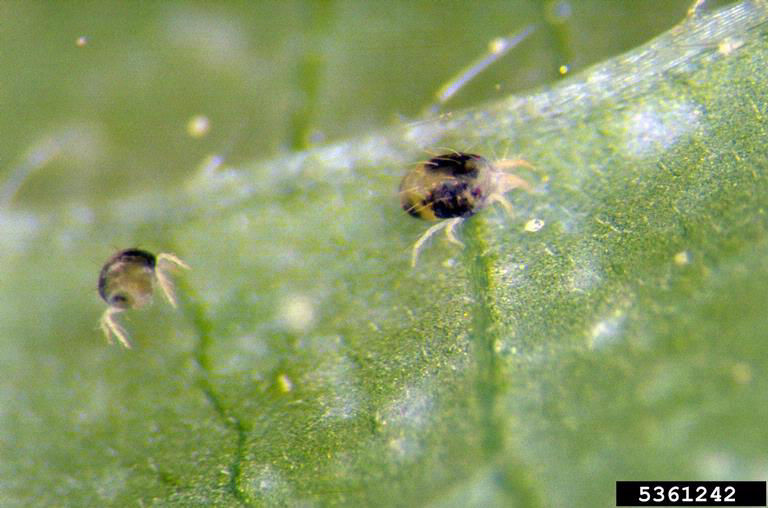
Twospotted spider mite eggs are very small (not visible without magnification), globular and translucent and found on the underside of the leaf. The larva hatch from the egg, pale green with six legs. There are two nymphal instars (protonymph and deutonymph) with a resting stage between them and another resting stage between the deutonymph and adult. The nymphs are pale green with darker markings and have eight legs. The adult female is about 1/60-inch long, pale green or greenish yellow with two darker patches on the body, and oval-shaped with long hairs on the dorsal side (Figure 1). Overwintering females are orange red in color. The male has a smaller (1/80-inch long), narrower, more pointed body than the female. While visible with the naked eye, the detail can only be seen with a hand lens in the field or a microscope.1,2,3
Twospotted Spider Mite Life Cycle and Dispersion into Soybean
In warmer climates, twospotted spider mites overwinter as adults in the soil or in host vegetation. In mild winter weather, they continue to feed and lay eggs, although development is much slower than in the summer. In severe winter climates, the mite overwinters in the soil and begins to feed on weeds or other plant hosts as the weather warms. The development of the mite is rapid, particularly at high temperatures. A female can lay an average of 90 to 110 eggs during its lifetime span of about 20 days. At the optimum temperature for development, 86 to 90 °F, and low humidity, the egg stage lasts three to five days, the larval/nymphal stages four to five days, and a pre-oviposition period of one to two days. The entire life cycle usually takes less than 12 days. When temperatures are near 90 °F, the spider mites have the potential to increase population 70 times within 10 days.3
The mites begin to disperse if the surrounding host vegetation can no longer support them under droughty conditions. They use a technique called “ballooning” where they migrate to the top of a plant, raise their bodies and release a fine strand of silk into the wind. This acts as a parachute by which the slightest breeze can carry them a substantial distance from the original host to the soybean field. This technique, as well as their rapid life cycle, can contribute to population exploding quickly.
Injury to Soybean by the Twospotted Spider Mite
Spider mites feed by piercing individual cells and sucking out the cell’s contents, rendering it non-functional. Not only will the cell that is pierced die, but also those surrounding it. The injury results in white or yellow stippling on the underside of the leaf (Figure 2).
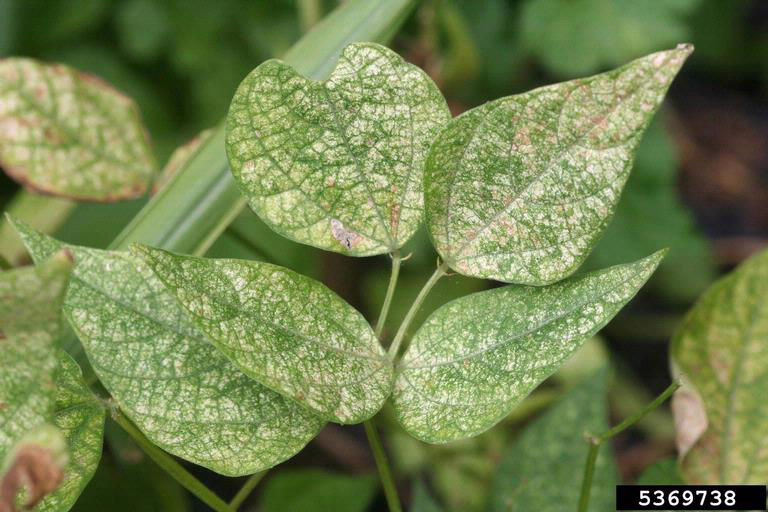
As the injury progresses, photosynthetic capacity of the leaf is reduced, and water loss increases dramatically. If the population continues to increase, leaf color progresses from a gray green, to yellow, to finally copper, prior to dropping from the plant. Economic injury reduces pod set and seed size. Occasionally, symptoms can be confused with actual drought symptoms. Injury often begins on the lower canopy and progresses upward on the plant.
Why do twospotted spider mite populations increase so rapidly in soybean during drought conditions?
Twospotted spider mite populations are subject to a balance in nature including predatory insects, weather and the quality of the host plants. Drought conditions increase the movement of spider mite populations to soybean because the original host plants bordering the soybean dry down or are harvested (in the case of alfalfa). Drought also reduces the naturally occurring fungal pathogen, Neozygites floridiana, that attacks the mite, allowing the spider mite reproduction to out-pace control by its natural predators.
How can twospotted spider mites be sampled in soybean?
Begin by inspecting soybean plants near the field edge or in stressed areas of the field that appear “drought stressed,” particularly edges next to an alfalfa field that has recently been cut. Pull plants and examine the leaves beginning at the bottom of the plant. If stippling or webbing is noticed, examine the surface with a hand lens or tap the leaves over a white piece of paper attached to a clipboard. Exact mite counts are generally less important than determining infestation severity, distribution through the canopy, and rate of population increase. To determine how far the mites have dispersed, move at least 100 feet into the field and walk a U-shaped pattern examining two plants in 20 locations along the route. It is important to check population growth every four to five days when conditions are favorable as populations can quickly reach very high levels.
Is there a treatment guideline for twospotted spider mites on soybean?
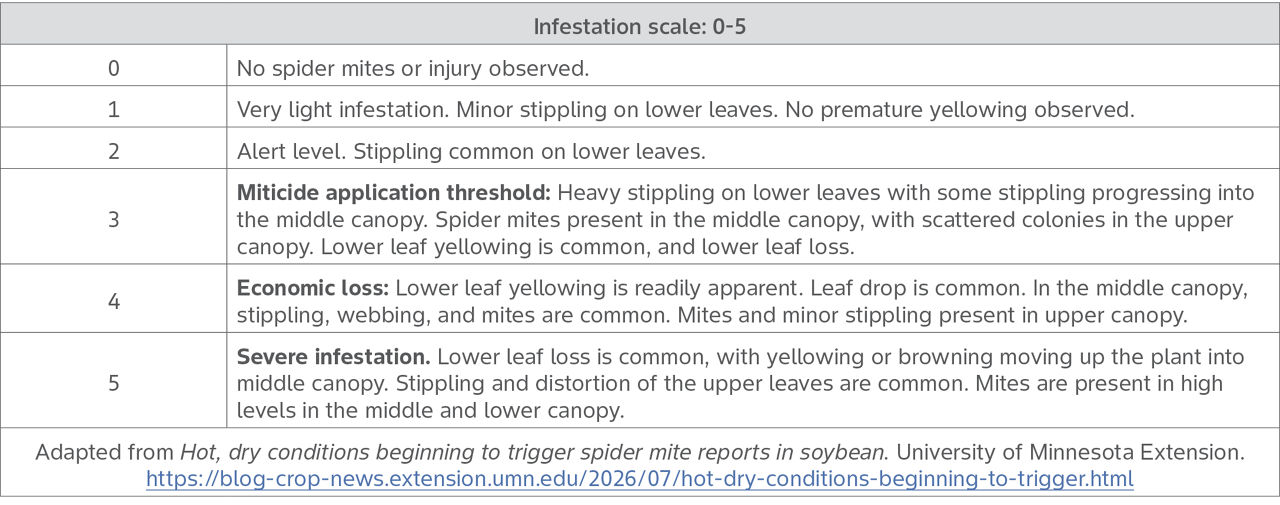
There are no established economic injury levels associated with applying a miticide for control of twospotted spider mites. Table 1 provides guidelines that may be beneficial in reaching a decision.
Table 1. Infestation scale for assisting with spider mite treatment decision making.
Management and Application Guidelines for Soybean Infested with TwoSpotted Spider Mite
Since information on the economic impact of a twospotted spider mite infestation is limited, timely and thorough scouting is important. Using the decision-making guidelines above, treatment may be warranted. The critical window of time for protecting yield is the R4 (full pod) to R5 (beginning seed fill) growth stages.4 If a miticide is applied, the field should be resampled after an application has been made to assess the population as another treatment may be necessary. Be sure to follow re-entry intervals (REI) as outlined in the product’s label.
There are chemical control options for managing spider mite infestations, however, not all products will control all life cycles. Be sure to read and follow label instructions before using a product. Below are several active ingredients (designated group identification from the Insecticide Resistance Action Committee, Insecticide Resistance Action Committee | IRAC) that provide options for controlling spider mites.
- Organophosphates (IRAC group 1B) containing chlorpyrifos or dimethoate are labeled for spider mites in soybean, controlling adults and immatures.
- Pyrethroids (IRAC group 3A) include bifenthrin alone or in a tank mix are labeled for spider mite control. Other active ingredients from this group, such as lambda-cyhalothrin, may flare spider mite populations, so this may not be a good option for control.
- Avermectins (IRAC group 6) and etoxazole (IRAC group 10B) are labeled for controlling eggs and immature stages of spider mites in soybean.
- Isoxazolines (IRAC group 30) are labeled for the control of spider mites in soybean.5
What are the options if both soybean aphid and twospotted spider mites are at damaging levels?
Although uncommon, it may be possible that soybean aphid and TSM are at treatable populations at the same time. What is more common is that one is at treatable levels and the other is present, but below an economic level. In either case, care must be used when deciding on which insecticide or miticide to use. Some insecticides may result in a flare up of TSM populations because they can remove competition from beneficial predatory insects. Consult your chemical provider for recommendations for an appropriate product.
Sources
1Hoover, G. 2026. Twospotted spider mite. PennState Extension. Pennsylvania State University. https://extension.psu.edu/twospotted-spider-mite
2Purdue University. Two-spotted spider mites (soybean). Extension Entomology. Field Crops IPM. Purdue University https://ag.purdue.edu/department/entm/extension/field-crops-ipm/soybean/twospotted-spider-mites.html
3Ostlie, K and Potter, B. 2018. Managing spider mite on soybean. University of Minnesota Extension. https://extension.umn.edu/soybean-pest-management/managing-spider-mite-soybean.
4Reisig, D. 2020. Spider mites on soybean. North Carolina State University Extension. https://content.ces.ncsu.edu/spider-mites-in-soybean.
5Koch, R., Peltier, A., Hanson, A. and Ribeiro, A. 2026. Hot, dry conditions beginning to trigger spider mite reports in soybean. University of Minnesota Extension. https://blog-crop-news.extension.umn.edu/2026/07/hot-dry-conditions-beginning-to-trigger.html
Additional source:
Insecticide Resistance Action Committee. The IRAC mode of action classification of insecticides. https://irac-online.org/mode-of-action/?classification=insecticides&group=6%2C10%2C30
1315_148618
Disclaimer
ALWAYS READ AND FOLLOW GRAIN MARKETING AND ALL OTHER STEWARDSHIP PRACTICES AND PESTICIDE LABEL DIRECTIONS.