Residual Cotton Herbicide Usage
July 27, 2026
Get Year-Round Updates From Our Agronomic Experts
- Soil residual herbicides in cotton should be included in multiple applications from preplant through layby.
- Residual herbicides gradually lose their effectiveness over time if not activated by rainfall or irrigation.
- Consecutive residual herbicides should be applied to overlap the effectiveness interval of the previous treatment to prevent weed escapes.
- Weeds that escape herbicide control should be removed by hand to prevent competition with crops and to prevent the addition of weed seeds to the soil seed bank.
Importance of Residual Cotton Herbicides
Soil residual herbicides are essential when developing a cotton weed management program. Understanding the weed spectrum on the farm and using both preemergence (PRE) and postemergence (POST) herbicides from preplant through layby helps provide the most effective season-long weed control. Achieving optimum weed control in cotton generally requires combinations, or systems, of herbicides that are specific for the predominant weed species. A combination of herbicides with POST, soil residual activity, and multiple sites of action helps limit weed competition and provides a system for herbicide resistance management.
Residual Cotton Herbicide Recommendations at Preplant
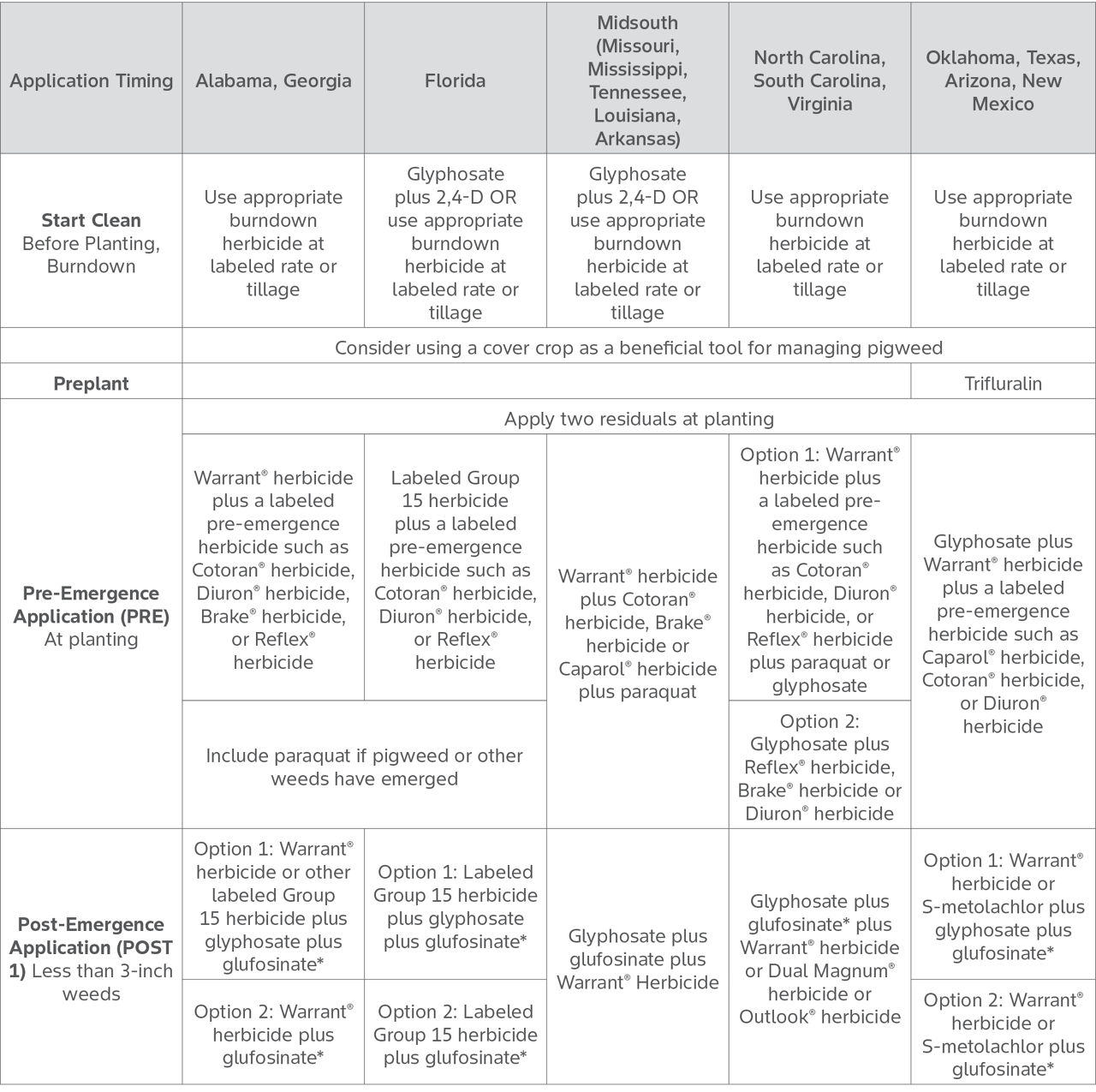
Residual herbicides used for preplant weed control in cotton will vary depending on the geography (Table 1). The use of trifluralin preplant in the fall or at the beginning of the season can help provide a foundation for season-long weed management in southwestern cotton production. The effectiveness of dinitroaniline (DNA) herbicides like trifluralin is related to how well they are incorporated into the soil, either mechanically or through rainfall or irrigation. If poorly incorporated, DNA herbicides can quickly lose their effectiveness for weed control.
There are several weed management options to help ensure a clean start for the season. Applying an appropriate burndown herbicide at the labeled rate, including tillage, or including a cover crop can help minimize weed pressure at the start of the season. Applying a glyphosate herbicide and 2,4-D in a permissible tank mixture at the labelled rate can also be an option for controlling emerged weeds.
Residual Cotton Herbicide Recommendations at Planting
Using PRE herbicides with residual activity to control weeds at planting helps prevent early season weed competition with the cotton crop. The application of two residuals is recommended at planting. Cotoran® herbicide can provide good soil residual control of many large-seeded broadleaf weeds like annual morning glories. Diuron® herbicide provides control of small, emerged Palmer amaranth, and up to several weeks of residual control of weeds including kochia. Warrant® herbicide is another PRE herbicide option for application at planting and can provide up to 30 days of residual activity. If weeds have emerged at planting time, include paraquat to provide burndown.
Residual Cotton Herbicide Recommendations for In-Crop Weed Management
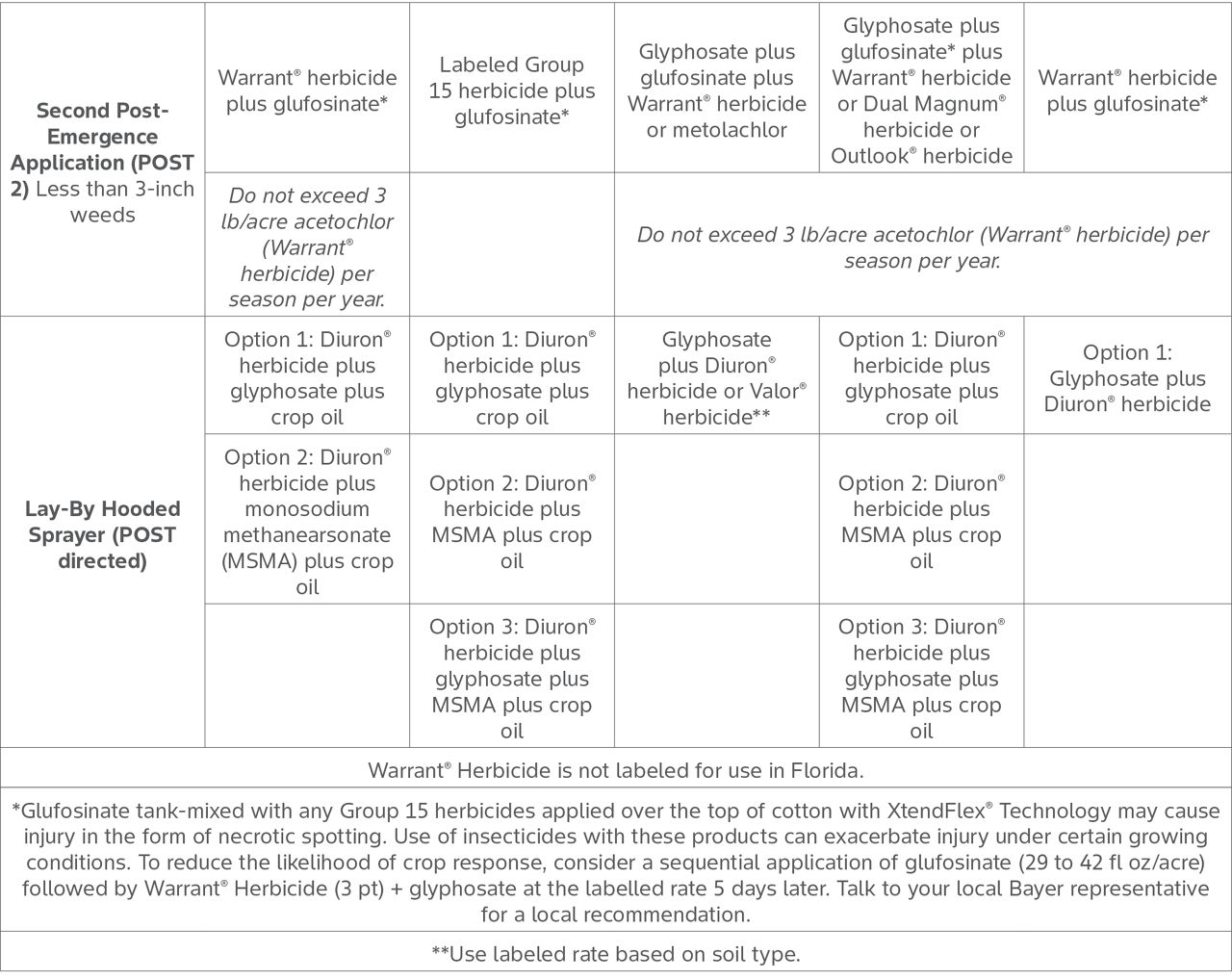
All residual herbicides lose effectiveness over time, allowing weeds to emerge after PRE applications. Additional residual herbicide should be applied before the PRE residual treatment loses effectiveness. To provide an effective overlap of the residual herbicide, a good practice is to apply POST herbicide treatments 14 to 21 days after the PRE treatment. Once cotton has emerged, the options for broadcast-applied residual herbicides become limited. Warrant® herbicide plus glyphosate plus glufosinate can be applied to cotton at the labelled rate with Roundup Ready Xtend® Technology to provide residual control of grasses and small-seeded broadleaf weeds, and for burndown of existing weeds.
Post-directed herbicide applications can be used in taller cotton to control small weed seedlings in the row, and mechanical control can be used to control weeds in the furrows. Layby herbicide applications help prevent the growth of weeds in cotton when it is no longer possible to cultivate. A layby herbicide application should be applied as a directed spray to minimize contact with cotton plants. Finally, escaped weeds should be removed by hand to prevent weed seed being returned to the soil seed bank.
Table 1. Cotton herbicide recommendations for cotton with Roundup Ready Xtend® Technology.
1423_484001
Disclaimer
ALWAYS READ AND FOLLOW GRAIN MARKETING AND ALL OTHER STEWARDSHIP PRACTICES AND PESTICIDE LABEL DIRECTIONS.