The Intersect
Cotton's Legacy, Lifestyle and Innovation
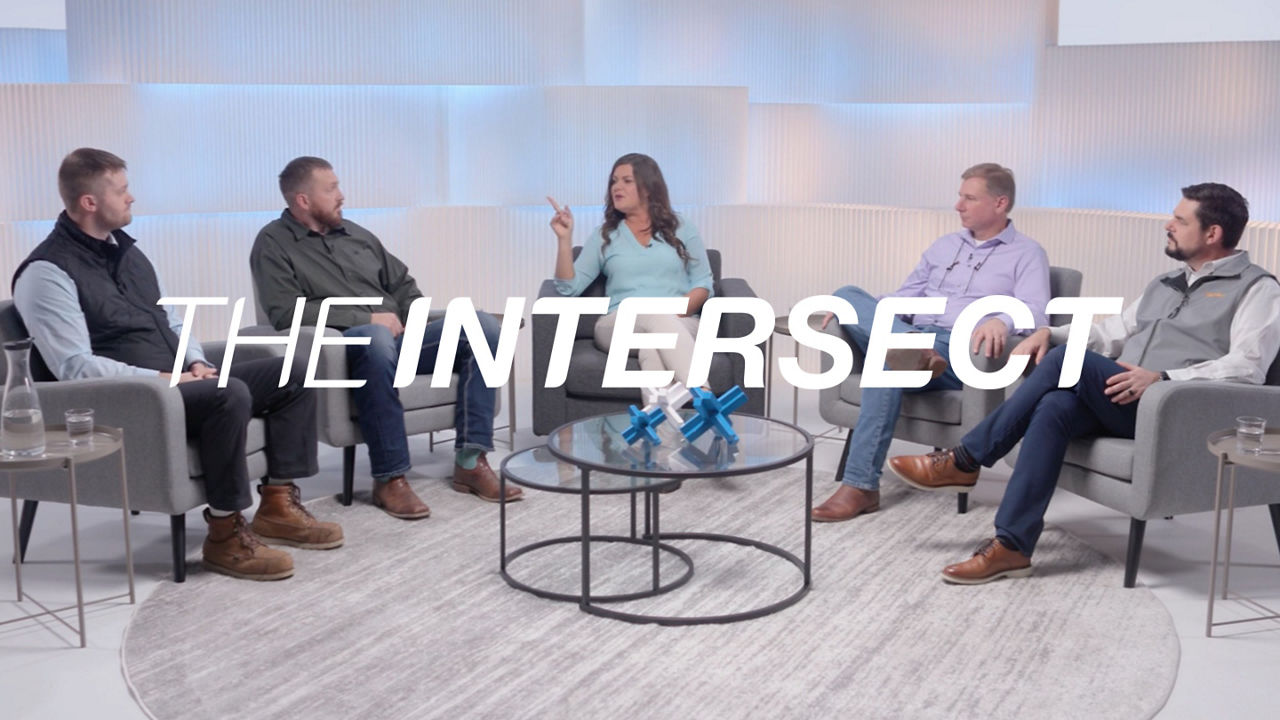
Cotton farms in America are part of a long-standing legacy of innovation dating back to the cotton gin. This group will discuss what it means to be part of the industry, the products that are helping them today — like ThryvOn® Technology — and what the future holds for the next generation of growers.
More ways to listen:
Video Transcript
Read the full video transcript here.
- [Narrator] The Intersect.
- Welcome to The Intersect, where experts from across the industry sit down to exchange their unique insights and opinions. Today, we're talking about cotton farming in America, its longstanding legacy of innovation, and how to build on it for the next generation of growers to thrive. I'm your host, Michelle Miller, and I'm pleased to introduce today's special guests.
- I'm Dave Albers, I'm with Bayer. I'm the cotton germplasm product manager, so I bridge the gap between our breeders and our commercial organization.
- I'm Keylon Gholston, I'm a farmer, Gholston Farms in Baldwyn, Mississippi, and I retired from Bayer a couple of years ago, was with Monsanto, Deltapine, Paymaster before that. So about 40 years in the seed business.
- I'm Ethan Cody, I'm a agronomist for Lee Farms out in Bronwood, Georgia.
- I'm Jonathan Evans, I'm an NPE cotton grower from North Carolina.
- I'm Eric Best, I'm a Deltapine cotton product manager for Bayer, and I live out in West Texas.
- So the cotton industry, compared to its corn and soybean counterparts, is a little bit smaller and a little bit more sense of community. What do you think makes this community unique to growing cotton?
- I had a grower describe it to me one time. He said, "You know, we grow corn and soybeans, but we raise cotton." It was a little bit different perspective. I think the smaller acres allow for that opportunity to know your neighbors, know the growers, know all aspects of the business, whether it's from the planting seed to the manufacturing to the delinting to the gins to the textile piece. Being that small is an opportunity and a blessing, in my opinion, that allows us to get to know everybody in that industry.
- Well, I think cotton's such a high-management crop because you really do farm cotton, or manage cotton, however you wanna say it, from the time you make a variety selection until you harvest it in the fall. You're in cotton at least every three days, hopefully. I've heard a saying for years, I tell people the best thing you can put in your cotton field is your shadow.
- I love that.
- Yeah, I think just like Eric and Keylon have said, it's intensive, and many times what I hear from growers, from consultants, is they're leaning on each other as they're making these management decisions through the year. You know, what's their neighbor doing? What's that other consultant down the road doing? Just to really to learn together each season as they manage their crop.
- There's no two years that are anywhere near the same. And no matter how long, you know, you may say that you've been in the business, you're gonna see something different, something new every year, and relying on your neighbor or relying on somebody, maybe even across the country, to help deal with these problems and figure out the best way to manage it every year. To me, that's one of the better parts of the industry.
- Yeah, growing cotton really is a way of life that's embedded into your regions. How have you guys seen the industry grow alongside the communities that you're such a big part of?
- Well, you know, one thing, I think that's always interested me is that they say a dollar generated in the production of cotton turns over 18 times in the local community. And if you think about it, it kinda makes sense because you've got employees that are working for the growers that are growing the cotton, then it goes to a local gin, there's employees there at the gin, then it goes to a bonded warehouse, there's employees at the warehouse. So cotton really means a lot to a local economy because it's handled so many times in that local economy.
- Yeah, I never thought of that before. That's a really interesting point, of all the different hands that really do make cotton what it is. Anybody else wanna add to that?
- I think the technology, you know, has certainly had a place there. You know, if you go back to when it required more employees you know, to do more hand labor, but now with newer technologies, you know, that's changed, that's morphed, and I think growers have... as we've seen the changes in technology, then, you know, it's required a different kind of employee, somebody that can understand the technology, somebody that can take advantage of it with the grower. So, you know, I think it's also helped just in that sense to bring a higher need for, or a need for a higher technical skill in the field as you grow this crop.
- And how do you guys view growing cotton compared to other crops in your region?
- You know, Michelle, I think, you know, one differentiator on cotton, we probably need to make sure we discuss, or at least throw out there, is to remind folks and probably, you know, everybody sitting here and listening recognizes cotton is a woody perennial and we grow it as an annual. So, I mean, there are some real challenges just from the very start to think about you're putting a seed in the ground, and this plant that grows, yes, we've domesticated cotton, we brought all these great traits there and great quality, but it's still many genes in that plant thinks, it's a woody perennial, it's gonna live forever. So that's really most cases, the basis of the management that we, as a grower and an industry, that we need to think about as we manage. And that's another differentiator from a corn crop, from a soybean crop, or even a high-management crop like peanuts. You know, these guys in the Southeast, there are other high-management crops, but that's a real differentiator for cotton.
- To your point of it being a perennial that we're growing as an annual, I love to say and always hear, it's a pecan tree. It's always gonna be a pecan tree.
- Yeah, when I was new to the industry, when Dr. Albers hired me 27 years ago, I had the world by the tail. I thought I had this crop figured out, and was working an issue with the grower, and I knew I could figure it out, but I wasn't having any success. And the grower finally put his hand on my back and he said, "Let me tell you something." He said, "I've had 45 years of growing cotton, and I've had 45 first years. It's different every year." He said, "You're not gonna figure it out." So to Jonathan and Keylon's point, the best thing that we can do, you know, from our perspective is visit it, visit it often, and put your footprints and your shadows in those fields.
- Yeah, you think all the way back to the innovation, like the cotton gin, you know, I mean, we really have come a long way. What would you guys say as far as the innovation in the industry? How has it helped shaped the cotton over the years that you've seen?
- I think they all worked together. I mean, the bale picker helps with efficiency, but also the technology helps 'cause you don't have to make as many trips across the field. You get plant bug protection. So I think they all kind of work together to make the end profit.
- Well, I tell you, in my opinion, if it weren't for the new technology and the innovations that we've seen, especially since the mid-'90s I think, we probably wouldn't have a U.S. cotton industry today. If you go back all the way to boll weevil eradication. Before boll weevil eradication, we were spraying a lot of summers every three days for boll weevil. Then Monsanto developed Bollgard®, you know, so tobacco budworms become less of a pest. So those innovations just came along when the industry really needed them and allowed us to continue to grow U.S. cotton.
- So on that note, talking about the chemistries changing, and how things have gotten so much better over the years. From an old-school Monsanto/Bayer perspective, tell us a little bit more about Bollgard, like before and after.
- Well, you know, I don't know if this was luck or how it happened, but in 1995, we had a severe outbreak of pyrethroid-resistant budworms. And that's also the first year that Monsanto and Deltapine, well, they had collaborated from a research perspective, but we had test out with Bollgard varieties. And there was almost zero damage. And right beside that, you know, four-row plot or whatever we were able to get out that year, you know, you had cotton that had been sprayed 10, 12, 15, 18 times with a pyrethroid that made 250 pounds, and this cotton made 1,000 pounds and it hadn't been sprayed with pyrethroids. So the adoption rate of Bollgard was totally dependent on how much seed was available. Because everybody in our area planted 100% Bollgard the next year, or, well, no, it wasn't 100, it was 96? 95?
- 96, yeah, they had to have a refuge.
- They had to have a refuge. So the growers just changed like that. And we were able to make a good economic cotton crop with Bollgard.
- And to me, you know, with the early Bollgard varieties then came of course Roundup Ready® stacked with Bollgard. And I think, you know, those two just really fit hand in hand, allowed growers to have, you know, this great early efficiency, you know, when they adopted Roundup Ready with Bollgard to, you know, keep their fields clean, to do less tillage like Jonathan pointed out, and all, you know, these other real advantages, water conservation, etc. So, I mean, to me, those early traits, you know, fundamentally changed how growers went to the field and how they farmed their cotton.
- What's your perspective from the agronomist side of things as far as seeing the changes, you know, Bollgard and Roundup Ready?
- I mean, I do feel like I'm smart enough to realize that we live in a time period where we've got more technology as far as rolling pickers, cotton varieties, different herbicides and chemistries than ever before in the history of cotton all at our fingertips. And to be able to use all of these different tools, and have 'em all in our tool belt throughout a growing season, to me is, I mean, you can't put a price on that.
- And when you think about how much the technology has changed in such a short time, you know, those of us that have seen 25, 26, 28 crops professionally, and you think about some of these management practices and, for example, you go out and you wanna talk to a grower about post directing or shielded sprays or cultivations or things like that, like Jonathan mentioned, you know, he grew up plowing cotton. If you're talking to a producer that's only been in the industry 15, 18, 20 years, all they've known since they've been farming is over the top with Roundup and other herbicides and things like that. So, sometimes we in the industry have to step back and say, hey, we may be talking to somebody about making weed control recommendations that in their 20 years maybe they haven't seen because it has moved so fast to the big sprayers to the GPS guidance to all these other things in plowing. So it's fun to look back and say, "Yeah, I remember the boll weevil, I hope we never go back." But in our role, it's also fun to say, "OK, what's the next challenge? Identify it and how are we gonna fix it?" That's the fun part. And without their insights and their input, and our footprints and shadows in their fields, you know, we would never get to that point. So that's another challenge, it makes it a very fun industry.
- Yeah, for sure. Why do you think it's important to understand where we came from in the history of cotton growing?
- Well, there's an old saying that those who failed to understand history are doomed to repeat it. And so a lot of these things, you know, even in the crop world, it's not only things maybe we don't wanna do again but things we can learn from. You know, I remember the boll weevil days and spraying, you know, like that. And I remember when they became eradicated in the area that I grew up in, and yields overnight almost doubled because you're making something in the top of that plant that normally wouldn't be harvested. And when you save time, you can take on more acres or you can do more with the acres you have or you have money you can use on other things besides protecting the plant that maybe you can help push that plant to do other things. We've seen yield, we've seen quality, we've seen, you know, different management scenarios come into play with no-till and, you know, protecting those resources like water being one of the big ones. But no, it's a challenge, but I think that's why we're all in it.
- And one of the real, well, fun perspectives that I get to participate in, I started my career in Missouri, I was with the university there. If you go back and look at that point in the 1980s when I started my career there, to the most recent years, that area has basically doubled their yields, their yield per acre, lint yield per acre has basically doubled. And many of these technologies have contributed to that. That's one example, you know, where they've been able to take these technologies, take Bollgard, take plant growth regulators, irrigation, put all these pieces together, and now that acre in that market, in that area, instead of making 600-650 pounds, which was what their state averages were then, now they're exceeding 1,200 pound on their state average.
- What about you, Keylon? You've been in the business you said over 40 years? What do you think we've learned? What are some of the biggest things we've learned and how can we move forward with this knowledge?
- Well, I think the really important thing, and maybe I spend too much time looking back, but we have the opportunity today with the germplasm that's available for us to plant with extremely high yield potential, good fiber quality. We have the potential to make those top-end yields. Now, yields vary from one farm to the other, and from one area of the country to another. But when Dave was talking about Missouri, I was 13 years old, the first cotton crop I ever made, and I made 460 pounds, and daddy paid for everything, I had to pay him back at the end of the year, and I had $13 left. That tells you how smart I am. I'm still doing it, right? But today, if you put your management expertise and you really put it into a cotton crop, it has the potential to pay you back exponentially.
- I think the other, the piece we'd be remiss if we didn't discuss is the technologies have been fantastic. They've enabled us to do a lot of things, but the delivery system of those technologies is critical as well, and that's the variety. Our groups across the industry have continued to improve the varieties themselves that carry these traits. So they may be more heat-tolerant, they may be more drought-tolerant. They may be fitting into different maturity groups for these different regions. And then fiber quality, you know, ultimately, you know, that's what we sell. The cotton crop is graded very harshly, more so than any other commodity on its quality. And so the breeding groups have done a very good job of not only keeping up with the traits but making sure the germplasm keeps up as well. 'Cause at the end of the day, you know, that yield piece matters as well.
- Jonathan, you were talking about thrips a minute ago, and we're also talking about some of these other pests you guys are dealing with, like the key tarnished plant bugs. ThryvOn® is the first technology that's really come out about all this I guess since Bollgard. What are your thoughts on this? How does the trait work? And how is it benefiting your operation?
- Well, the first time we planted ThryvOn, we thought we were doing a good job with thrips until we planted the ThryvOn. And with the early vigor and the faster grow-off, when the plant starts off faster, it gets to where it wants to go quicker and better. But it saves trips. You don't have to quit planting to go spray thrips. And I think it does good on plant bugs. I mean, you still have to spray once in a while, but it stops that nickel-and-diming that you get throughout the season when it's just below threshold. You know, you're getting enough where you don't have to go out there and spray.
- Absolutely, and Dave, what's your perspective from the Bayer point of view?
- Very different strategy with ThryvOn. It's not a high-dose strategy. It's a moderate-dose strategy. And what we've seen there is really an advantage and a benefit around a non-preference. The thrips and plant bugs tend not to feed, not to reproduce, and just stay out of those fields. So it's a very different approach in the field. So you can have, you know, if you're sweeping for these insects, you can find these insects there, but they're just not damaging the crop. And even as we've gotten larger and larger blocks, larger and larger fields, you know, we've seen this consistent advantage of this non-preference, so they're just simply not feeding. But I think too back to the carrier that this technology comes in, you know, it's really dependent upon our breeders and Bayer to bring these traits in the best germplasm possible. I mean, that's the driver is let's get the best yield, let's take advantage of all the inputs, and make the most lint, you know, per acre that we can. And our breeders have done a great job. I mean, we've got, you know, new tools in our breeding organization to really, you know, look across broad sets of crosses and germplasm, identify the leading candidates quicker, and bring these high-potential candidates to growers much quicker. And to me, that's one of the most exciting parts of my job, and probably why I haven't retired yet, is just, you know, so much great stuff happening out there to see what our breeders can do and what they've been able to do.
- Right, I mean, ThryvOn was invented for a reason, right? So what do you guys think? When you think about these key tarnished plant bugs and thrips, how big of an issue are they for growers today?
- I think it depends. And it depends on where you are. And I think that's one of the neat things about, to Dave's point, our breeding program, bringing the different germplasms that carry, or the different varieties, whether it's maturity or fit or seed size or heat tolerance to the different environments where we have different pest pressures. As I travel around a lot, it's real interesting if you were to ask a grower the same question you just asked, what's that value of that technology? Depending on where you are, I think you're gonna get different answers. You know, I had a grower two years ago in the Carolinas that made the comment, to your point, he said "That stuff I thought had finished earlier, and I was able to pick it, and a hurricane hit us." And when I went back, he said, "That two weeks of earliness saved me three to four hundred pounds versus what I was able to go back and harvest afterwards." Well, you don't really think about things like that. But the maturity changes, how you manage it changes, whether it's water, fertility, those recognized yield goals. At the end of the day, I'm still, I mean, I could be corrected, but I'm still somewhat confident that pounds matter and yield matters, and those two things go hand in hand. And so, as we get into these different regions and these fits, I think we're very blessed we have a technology that may be tarnished plant bugs in one area, but out West, it may not be the pest that they're targeting. It may be the thrips, or it may be a different species of it.
- Right, why do you think pests don't like ThryvOn technology?
- I don't know, I'm not a thrips, but Dave is correct - they do seem to avoid it. And it's one of those things that 60 miles an hour driving down the road that you can pick out the plots that have the trait, and the plots that don't. You don't have to stop and walk around and look. And when they start healthy, you have a higher likelihood of them staying healthy. And those plants, they just behave differently 'cause we are still dealing with the perennial.
- Yeah, I mean, it's a very finical seedling come outta the ground, but if you can keep the thrips off of it, it'll get a whole lot better start.
- What would you say to that, Dave?
- Yeah, a grower realizes right from the start, here's a benefit that I'm seeing with this technology. It's not anything you have to go and do counts or any kind of detailed analysis. You walk into the field, you see these plants that are almost pristine, like they've been growing in a greenhouse. We just don't see that even with our best chemistries out there. So, you know, to me, that that's an interesting almost psychology, you know, hey, this is working, this is here, it's working, I can see it right from the start.
- It made a huge difference in the early season health and growth of those plants. But when it comes to tarnished plant bugs, I'd go out, I'd sweep, the plant bugs were there. And then I started doing old plant retention counts, and my retention would be 92%. And I'm going, those plant bugs came out of the field, but the retention's still there. And I said, duh, why do I care? You know, why do I wanna spend $16 an acre to kill plant bugs if they're not causing the retention to go down? So I had to start thinking about the way I manage my cotton totally different.
- Yeah, that was what I was gonna ask next is, you know, do you still have to scout? Do you still have to spray? And why is that?
- As the ThryvOn acres have grown, especially for us, you know, we've got whole farms that are all ThryvOn acres on those fields. And obviously you're gonna run into the question of how long will you be able to, you know, keep the plant bugs out of it. It's a preference for 'em to not feed on it, but if there's not another option, at what point does it get to that? And so, you know, you still have to check and look, but for us it's really just been a kind of a little bit of an adjustment, but it's been an easy adjustment.
- When I think about the technology, and you can go out and spray, but you'll never be as timely as a plant that can protect itself. When it's always protecting itself, you can never be out there every day spraying, get a storm come up, but if it's got the technology breeded into the plant, into the seed, it's always protecting itself.
- Right, do you think it's still helping growers though as far as saving time or money?
- Oh, without a doubt. Definitely on the thrips side and on the plant bug side I would say so. And we had a really substantial plant bug year this year in Georgia. One of the worst in my history of looking. And I think that you're probably gonna see a lot more interest in the ThryvOn Technology going forward next year because of that.
- Michelle, I can think one thing that we've seen, or I've seen from academics, you know, that have been taken these very detailed counts is that in ThryvOn with tarnished plant bugs, generally that population just develops a little bit slower. And if you do hit a threshold where you need to spray, OK, well, maybe that spray is delayed a few days. Of course, you're protecting it until you get to that point. Well, if that one's delayed a few days, maybe if you continue to have high populations, the next one's delayed a few days. By the end of the year, then you've saved a spray or maybe two. So I think that's, you know, a general approach, what the data tells us is how it's helping us. Now, as it protects, you know, before you get to that spray, yeah, the retention stays higher, but if, you know, if that population continues to be there and to develop, it's just developing slower than what you would see in a non ThryvOn scenario.
- Sure. What about some of the other interfacing crops? You think about corn or peanuts. How does planting ThryvOn help with some of those other crops?
- I think, you know, there are a lot of strategies that growers are looking at when they think about, you know, "OK, I'm gonna have corn next to the cotton here, or I've got these fields that are farther away from my operation that, you know, OK, it's gonna take me longer to get there to do sprays," etc., etc. So I think there's those kind of benefits that we're really, you know, growers, you know, you give 'em a new toy, a new tool to work with, and they're gonna probably figure it out quicker than sometimes we can, you know, in a structured set of tests. You know, they're gonna take it and go, "Oh my gosh, I can do this and this and this, and here's how it works in my operation."
- What have you noticed about quality as far as the fiber quality as the genetics of the cotton has improved. How has the cotton itself improved as far as quality?
- You know, the MP program that Jonathan referenced a minute ago, growers' involvement in this testing bringing new germplasm has allowed us to really see, you know, these better products in better yielding and better quality. And to me, again, it's been a major shift in how we bring products to the industry, but particularly Deltapine and Bayer bring products to the market. And to me, the real breakthrough, one of the real breakthroughs, besides the pest management traits, has been this combination of yield and quality together.
- One of the things that to me is very important both from a breeding perspective and then the technology, to me, I see as protecting the yield potential and the fiber quality potential within that set of genetics. But if you just think back to where the cotton industry in the U.S. has come to, and it's not just the grower, it's not just the seed company, it's the gins. Ginners have spent a tremendous amount of time and money over the years to improve their ginning capabilities, which has allowed us to, again, maintain the fiber quality that the breeder bred into that specific set of genetics. But it hadn't been that many years ago when all the cotton that Australia grew sold first into the world market, and then your top-quality U.S. cotton would go into the world market. And since we export 96% of our cotton, that's pretty important. But today, we're growing cotton that is just as good a quality as Australian cotton. So we don't have to sit here as an industry and wait till somebody else sells out before we can start selling our cotton into the world market. And it took time, and it was a slow, steady improvement over the years, but, you know, my hat's off to the cotton breeders because we've made that transition now to where both from a micronaire, strength, length, you know, we're where we need to be to compete in the world market.
- Jonathan, tell us a little bit more about one of the biggest success stories you've had on your farm as far as technology is concerned.
- Well, over the winters, you know, you kinda pull through your data, and you start looking at acres or fields of each application and start noticing on our planning, you know, where we were running 4, 12 rows on and off, and then where we were doing individual row sections, it's like 8-10% overlap. And you start running the numbers, and with that cost per acre at the end of the year, you know, you save a whole lot of money, you know, by just, you know, where GPS boundaries, and only spraying when you need to be spraying, not overlapping. I mean, you can save a lot of money, and not putting out harsh new chemicals, you know, double rate.
- Sure, and you use Climate FieldView™, right? How has that helped you?
- That's very good 'cause you always have your notes or your planting maps or your yield maps on your phone or your iPad everywhere you go, and it's easy to access, and you've always got everything right there.
- Eric, earlier you were talking about how it's always something, you know, like Mother Nature is always evolving. What would you guys say are some of the biggest problems you're having on your farms now or foresee in the future?
- Well, I can tie it back to something you were just asking Jonathan around the Climate, you know, the ones that share accounts with us and stuff, if they know we're coming around to look and walk plots, a lot of them will actually take that app and they can be standing in a field and take a picture of something, and they can mark it, they can drop pins, we can go back and look at it, they can share things, they can share real-time data when they're harvesting or spraying, you know. And it's kind of neat to get to use it from that perspective 'cause sometimes, you know, I like to hang around a little bit longer on some of these farms, and maybe they want us hanging out for. So no, it's good that they can send you things that they're seeing, and you can reference that back and go back and look at sometimes the yield maps or things like that and, you know, look at different areas of the fields or soil types or things on some of those apps. And you know, Jonathan shares a lot of that stuff with us a lot of times, so it's helpful, it can be very helpful.
- What would you guys say? You see the problems that are constantly arising on farms. If you could have your magic wishlist, what would be your dream technology to have on the farm?
- You know, if we can continue to push higher yields then though, what is the demand that the plant has for nutrients? You know, I think we really need to get our arms around. And it's a lot of complexity 'cause you have so many different soil textures, so many different rotational crops, so many different scenarios that the plant needs the right nutrition, the right fertility, to support this larger yield number, levels that we're attaining now. And to me, that feels like, you know, the next step. You know, I know Keylon tried some stuff on his farm just trying to support with some fertility strategies, you know, these larger yields that we're pushing toward. To me, that's really, I think, where we need to go next in taking full advantage of these traits and technologies.
- Well, Dave, if you think about it, the oil's the most expensive thing that plant's making. And it's a perennial and it's making lint as a dispersal method, right? And we're interested in kind of the plants one-off. If it's already making the seed, if I had my choice on a dream trait, and you think about that fiber is one little epidermal cell coming off of that seed coat, and very few of them ever initiate a fiber. And very few of those are even a harvestable fiber. If it's already making the seed and has the old demand, what if we could come up with a trait that even if it just doubled the amount of fibers it initiates on a seed coat? It's already made the support structure. You know, when you think about things like that, sometimes our physiology minds get in the trenches, but when you start thinking about all things the plant's already doing, that would be a pretty neat trait.
- I think in Ethan's world down there, though, when I go down there to look at plots, particularly late in the year, and farther south of where you guys are, you know, boll rot is a huge issue, and there's multiple organisms that cause that rot. But, you know, the company or the person that can find a way to help avoid that, to have a broad resistance to those fungal organisms that come in late in the year and cause boll rot, you know, with your humidity and the canopy that's there, that could be huge. I mean, you know, there's scenarios down there where growers typically, they may lose the bottom third of the bolls just to boll rot. I mean, another third on top of some of the yields that you've been getting, that would be huge. So that would definitely be on my wishlist.
- Yeah, I agree, I guess it's something just used to the problem now, this standard. It's almost not looked at as a problem. But I mean, I agree with you 100%. This year we had a very dry August and September. So I'm gonna say on a typical year, you look at rotting anywhere from 25 to 35% off, and especially some of your earlier-planted stuff that's mature around that point because typically, other than this year and last year, we had a very wet August and September going into harvest. And I mean, you look at what you've babysat and managed all year just rottin' off, and there's nothing that you can do about it. But this year, particularly, we had a drier August and a drier September, and that really affected our top crop. We had a lack of top crop that held and made. We had a lot that got set to start off with, but it didn't hold, and if it weren't for that lack of boll rot going into harvest, we really noticed it because there was fields that should have been on a normal year with the lack of the top crop and a normal amount of boll rot being very subpar on yield, and then being able to retain some of that bottom crop because of the boll rot missing. I mean, it really helped us out this year. So that was kind of an eye opener going into what you're saying. And yes, if we could come up with something that would help with boll rot in the future, that would be amazing.
- Yeah, you know, the average cotton plant squares for about six to eight bales of yield per acre. So if we could just figure out how to keep all those on the plant, I'd be satisfied.
- There's an older grower that I used to work with that he's retired now, but good friend of mine, and he's always said that if we could figure out a way for that plant to retain and not rot off just 50% of what it makes, he said, we'd break all the records.
- One of the things I think that we're gonna need to look at as an industry is what Dave was commenting about earlier is, you know, what kind of fertility is it gonna take to make that next yield step? And with potash and phosphate and sulfur, and then a lot of your minor elements, that's pretty easy to figure out from a soil test perspective. The thing in cotton is that if you put too much nitrogen on it, when it reaches cut out, it doesn't cut out because it's a perennial, it'll just keep growing. So we have to kinda hand feed, spoon feed, nitrogen so that when that cotton reaches cut out, it does what we want it to do and cuts out. The node above where flower continues to move up the plant. If you put too much nitrogen on it, that's not gonna happen. This year, I did some tests with ThryvOn to try to get it to make more total nodes, and it worked, but it made it about two weeks later than I wish it had been. Now this year it was extremely dry, so there was no problem with that. But I still got a lot of questions about, does more nitrogen help it make more total nodes? I think the answer's yes, but when do I put it on there so I don't make cotton two weeks later than it needs to be?
- OK, so we're talking about all these different technologies and what's helping you the most. Jonathan, earlier you were talking a little bit about no-till farming, which I thought was really cool. Are you pretty big into no-till and the whole regenerative movement?
- We try to do, you know, plant cover crops in the fall and strip till as much as possible. Our rotation is sweet potatoes where we have to do some tillage, but we always try to plant a cover crop behind that so we can strip till back in there 'cause your weed control is a whole lot easier when you got a good thick cover, and when you do get that rain, it lasts longer, and the ground stays cooler in the hot summer. So if you can keep a good ground cover, you're a lot better off.
- I think that these, particularly our herbicide traits, have let growers like Jonathan and many others, you know, they were no-tilling and doing regenerative ag before it was cool. You know, I mean we've had those traits out there, and that ability, and now I think, you know, hopefully the world will see, you know, the value of what these growers have been able to do, and how they've been able to use cover crops and use these reduced-till systems to really bring, you know, bring sustainable regenerative-type systems out to the forefront. They've been doing it.
- Cotton has had the most potential for sustainability of anything period for the longest time. And it's cool to see now it getting its spotlight put on it for that.
- Yeah, that's awesome. What makes you say it's so sustainable?
- Well, all the tools that he just talked about that we have, that these things that we've had for years, and different practices that have been going on for years. But it's, you know, becoming more popular now, and so more of a spotlight shined on these regenerative practices, and it's, just makes it shine a little bit more.
- And I think as an industry, and this is a broader statement than Bayer, but as a cotton industry, I think we need to go back and rethink how we are telling that story 'cause I don't think we tell that story very effectively.
- I foresee that becoming a problem, though, in the near future, especially on the water. So that's good to be able to have those types of traits and plans going forward that we can use.
- Yeah, so I come from an Iowa farm, right? So very different from cotton. I was a more on the corn and soybean side of things, and, you know, up in the Midwest, everybody's really kind of moving over to this no-till cover crops. You know, we were no-till for 25, 30 years. How have you seen that change in the cotton industry? Have you seen a lot more people moving over to the no-till side of things?
- I think the issue with the resistance to the Palmer pigweed brought a lot of people back to that 'cause that was a very good tool because if you get the ground covered, you can't get the sunlight to germinate.
- I think, you know, again, I think it's an example of how technologies came together.
- But you know, all of these technologies bring benefits, but they also bring consequences. When I first started farming, we'd start planting hopefully the end of April, and our goal was to be done the 1st of June. Now we can plant our whole crop in four days.
- Oh wow.
- If we get four solid days of good weather, we're done. So that whole crop is exposed to an environment that essentially affects it the same.
- [Ethan] Consolidating your risks.
- Yeah, instead of spreading risk, we just kinda put it all together.
- Yeah, that's a really great perspective. This has just been such an amazing, enlightening conversation to talk about the technology, you know, where we've come from, where we are, where are we going. Just to kind wrap up, guys, I just kind of wanna go around the room and just have each one of you answer, you know, what are your thoughts about the cotton industry overall? And do you feel pretty optimistic about the future of cotton? We'll start with you, Dave.
- The cotton industry, you know, has a history of being well organized and well coordinated. So I think, you know, that is certainly a bright point, you know, for the industry. When I look at Bayer too, I think about the investment we are making, you know, and some of the things that our breeders are doing now with these new tools, that's one part that I think we are not even yet seeing the real benefit from, but it's coming. They're doing some amazing things way back in the pipeline that we'll be seeing probably 10 years from now, eight to 10 years from now, continuing to drive improved yield and improved quality.
- Yeah, I think the cotton industry's got an extremely bright future, and I'm gonna give you two reasons. One is it's the only industry that I've ever been involved in that every facet of the industry works together. So it's not one facet of the industry fighting, but we're all working together for the betterment of the whole. So I think that's very positive for the future. The other thing, I think, is cotton is a natural fiber. And if you look at all the things, you know, I had no idea that if somebody wore polyester, which God forbid I'd never do, but if somebody chose to wear polyester, and you wash it, the microfibers go out, and they wind up in the ocean, and there's huge balls of plastic floating around in the ocean. If you wash my cotton shirt, that's not gonna happen. It's a natural fiber, God made it. He gives us the opportunity to grow it, and it's the perfect fiber. And at some point in time, the rest of the world's gonna figure that out.
- That goes back to your sustainability point.
- It does, and to touch more on what he said, I'm being hopeful with this, but I do believe that I'm seeing a shift, especially with my generation and the generation below me, on gearing more towards, you know, a natural fiber, you know, not just with clothing and cotton in general but other things. But I'm hopeful with the industry that I think that it's gonna make cotton in a higher demand, gonna see a lot more of a localized use of the fiber itself. And that's kind of exciting to me going forward for what I hope is the future.
- What about some of the projects that Lee Farms has been involved in with the textile industry?
- One of the latest ones, and I don't wanna misquote anybody here, but there's an outfit out of Swainsboro, Georgia, called Seeds 2 Seams. And it's a pretty neat story on 'em, but their logo on their shirts and other items is a crow. And the reason that is, is everything that happens, and this ties back into sustainability, everything that happens with that product happens within 250 miles of Swainsboro the way the crow flies. So they cut down on trucking and shipping products, not just across the country but overseas. Everything that they do is grown there in Georgia. And it's been pretty neat to be a part of and see it taking place, and that's part of where I'm being hopeful with it, I hope that you're gonna see more projects like that in the future.
- Very cool, I love that. What would you say, Jonathan? You feel pretty optimistic about the future?
- I do, and for all the reasons that's already been said, there's not much more I can add, you know, they kind of kind of said it all, but, you know, trying to use what we grow in the United States. Produce it in United States, and make something out of it here, and use it for our, instead of exporting it to overseas, and then having to bring it back as a final product, you know, use it over here.
- I think they're all very good points. I don't know that I'd have a whole lot to add, but, you know, I remember years ago when a friend of our family said, who's in the beef cattle business said, "We're gonna create our own private label, and we're gonna sell locally." And I thought, well, that's kind of crazy based on where we grew up. But there was demand for that. People wanted to know where the food came from, and they could buy sometimes a little premium, they're willing to pay it to support locally. I think we're seeing that in the cotton industry now. You know, they want to know where their clothing came from. There's ways now that they can use some of the track-and-trace technology and know not only what state but maybe what grower or what farm their shirt came from. And you can tie that, I've seen things done with QR codes now, and you click on something, there's a picture of a family that produced it. I think there's a growing demand to want to know some of that, and hopefully that will, you know, that's exciting if you see that all come back together with all the technologies, and things like they're talking about, coming back and keeping it local, and maybe some of that textile industry, you know, maybe not as grand a scale as it was, but maybe those pieces of that come back and come back to our shores.
- Yeah, I love that. That's like my dream is to do like a farm-to-fashion movement. This has been a really great discussion, guys. Is there anything else you wanna add? Any other final thoughts?
- Wear more cotton.
- Wear more cotton, sounds good. Well, guys, this has been a really enlightening conversation. It's been wonderful to hear about the past, present and future of cotton. And thank you, guys, so much for joining us. Again, I'm Michelle Miller, your host, and this is "The Intersect."
Eric Best
Eric Best, from the Texas Panhandle, has spent over 25 years in the cotton industry. He discovered his passion for cotton cultivation at Texas Tech University under the guidance of Dr. Dan Krieg, where after graduating in 1996, he began his journey with Paymaster Cottonseed. Eric was mentored by industry veterans like Dave Albers and Keylon Gholston, where he had a chance to navigate challenges across the Cotton Belt. As the Deltapine Product Manager, he remains dedicated to learning and sharing wisdom, believing in the importance of humility and dedication in shaping the cotton industry.
More on The Intersect
The Intersect is a collaborative series spanning topics across the agriculture industry including corn, cotton and soybeans. Check back here for our next installment on how innovation is shaping the future of farming.

Discover more about the innovations shaping our future.
Disclaimer
ALWAYS READ AND FOLLOW GRAIN MARKETING AND ALL OTHER STEWARDSHIP PRACTICES AND PESTICIDE LABEL DIRECTIONS.