Application Requirements for Convintro™ Herbicide in Corn and Soybeans
November 10, 2026
Get Year-Round Updates From Our Agronomic Experts
Key Takeaways
- Convintro™ Herbicide is a pre-emergent herbicide containing diflufenican for managing weeds in corn and soybeans.
- Convintro™ Herbicide is especially active on Palmer amaranth, common and tall waterhemp, and redroot, prostrate and smooth pigweeds.
- Convintro™ Herbicide should not be applied alone. At least one herbicide tank mix partner must be used to broaden the spectrum of weed control.
- Maintain continuous tank agitation and spray the mixture immediately to prevent potentially unresolvable sedimentation. Follow labeled rates and restrictions, avoid application overlaps, and promptly rinse the tank and lines after application.
What is Convintro™ Herbicide?
Convintro™ Herbicide is a pre-emergent herbicide for corn and soybean formulated to target pigweed species (Amaranthus family) including Palmer amaranth, redroot pigweed, prostrate pigweed, smooth pigweed, and common and tall waterhemp.1 Convintro™ Herbicide is effective in controlling glyphosate-, triazine-, PPO-, ALS-, HPPD-, and auxin- herbicide resistant populations of Amaranthus weed species. Convintro™ Herbicide is formulated as a suspension concentrate containing 4.17 pounds diflufenican active ingredient per gallon.
Should other herbicides be used with Convintro?
Yes, Convintro herbicide MUST be tank-mixed with a tank mix partner(s) for broad spectrum weed management. Consult the registered label for guidance on tank mix partners and tank mix restrictions.2 Conduct a jar compatibility test to determine if the pesticides form non-useable solids. DO NOT tank mix Convintro with isoxaflutole containing products.
Can Convintro Herbicide be Applied for Pre-emergent weed control?
Yes, Convintro herbicide can be applied during planting or within 3 days of planting corn or soybeans. To broaden the spectrum of weed control, a tank mix partner MUST be included. For enhanced burndown of emerged broadleaf and grass weeds, Convintro herbicide may be tank mixed with glyphosate, dicamba, paraquat, or 2,4-D according to their labeled use rates. DO NOT make more than one application per year. Read and follow all label directions.
What are some Pre-emergent Tank Mix Herbicide Options for Convintro in Corn and Soybean?
Corn
Recommended compatible preemergent herbicides to use along with Convintro in corn include atrazine plus any Group 15 herbicides. Harness® herbicide, Degree Xtra® herbicide, Harness® Xtra herbicide, Harness® Max herbicide, and DiFlexx® herbicide are Bayer Crop Science recommendations. DO NOT tank mix with isoxaflutole containing products.
Soybean
Convintro is compatible with a wide range of preemergent herbicides, allowing for flexible tank mix options, enabling customization of weed control programs to specific field conditions and management practices. Any Group 15 herbicides are recommended. Common options include Warrant® herbicide from Bayer Crop Science, metribuzin, and glyphosate. DO NOT tank mix with isoxaflutole containing products.
Can Convintro be applied in the Fall or Early Spring Following Harvest?
Yes, Convintro may be applied after previous crop is harvested and at least 30 days prior to planting corn or soybeans. Use rates in the preplant section of the rate table from the Convintro herbicide label MUST be utilized. DO NOT make more than one application per year.
Are there specific restrictions for Convintro?
- DO NOT apply aerially.
- DO NOT exceed the maximum labeled rate for any given soil type (Tables 1 and 2).
- DO NOT make more than one application per year.
- DO NOT apply under conditions that favor runoff.
- DO NOT apply if soil is saturated with water or above field capacity.
- DO NOT tank mix with any isoxaflutole containing products.
- DO NOT apply more than 4.1 fl oz/acre per year in CORN (Table 1).
- DO NOT apply more than 4.9 fl oz/acre per year in SOYBEAN (Table 2).
- DO NOT use where the Convintro herbicide label prohibits use.
Table 1. Maximum Rate in Fluid Ounces of Convintro™ Herbicide per Acre for Corn.
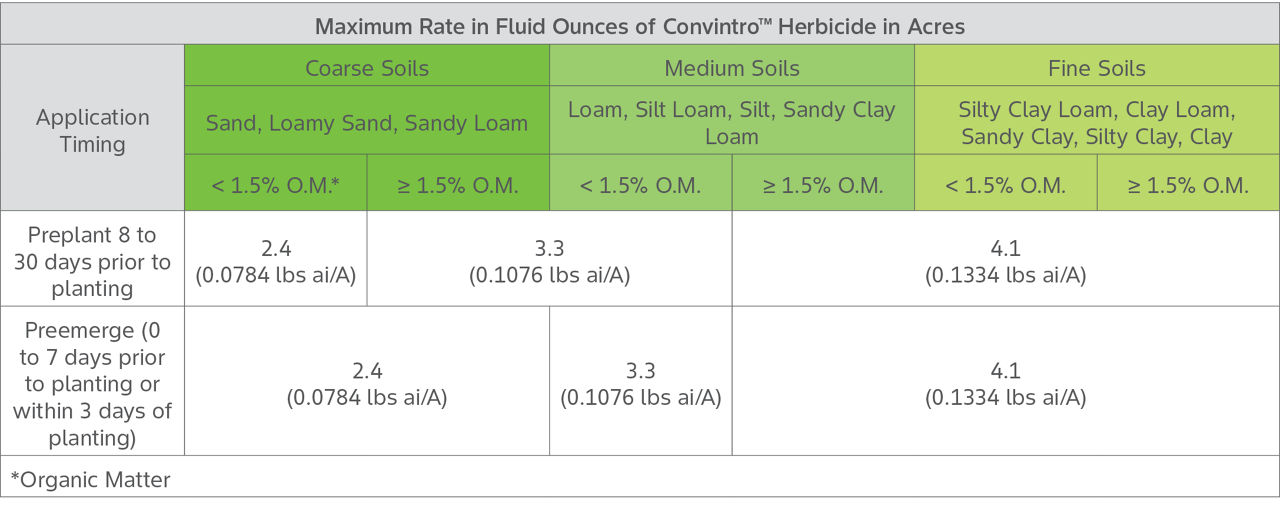
Application of Convintro™ herbicide at less than listed rates for appropriate soil will only provide suppression on sensitive weeds.
Table 2. Maximum Rate in Fluid Ounces of Convintro™ Herbicide per Acre for Soybean.
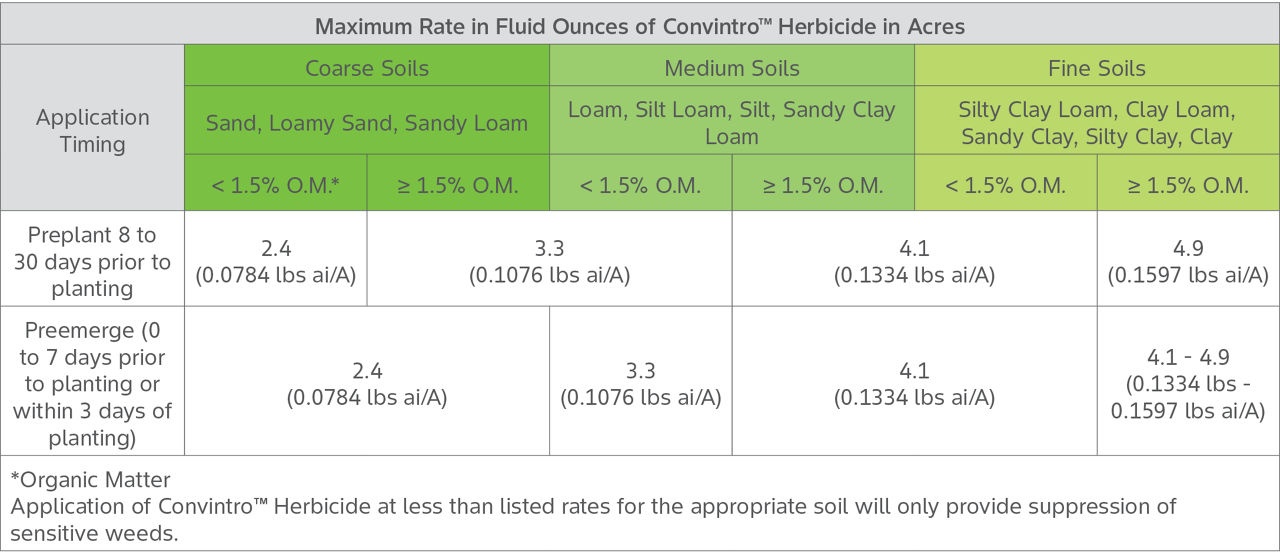
Is Convintro Herbicide compatible with other pesticides or liquid fertilizers?
Yes, Convintro herbicide is compatible with other pesticides or liquid fertilizers; however, the mixture MUST be tested using a jar test prior to mixing as indicated on the label.
Is Tank Agitation Required for Convintro?
Yes, tank mixes containing Convintro MUST be continuously agitated and sprayed out immediately. Even if tank mixtures appear to be compatible, do not let the spray solution stand in the tanks for long periods without agitation. Constant agitation is required to prevent potential unresolvable sedimentation. Once application is complete, it is recommended to immediately rinse the tank and lines.
What is the Proper Mixing Order for Convintro Herbicide Tank Mixes?
The Convintro herbicide label provides guidelines for tank mixing other pesticides, fertilizers, or mixes.
Under What Conditions Might Convintro cause Injury to Corn and Soybean?
- When soils have a calcareous surface or a pH of 7.5 or higher.
- When applied to any soil with less than ½% organic matter.
- When applied less than 8 days before soybean planting.
- When heavy rains occur soon after application, especially in poorly drained areas where water may stand for several days.
- When corn or soybean seeds are planted less than 1.5 inches deep, not completely covered with soil, and the seed furrow is not firmed, particularly in a pre-emergence application.
- Periods of cool/cold, wet conditions (cool/cold daytime/nighttime temperatures, saturated soil conditions, recurring rainfall events, etc.) during corn seed germination and/or early crop development period may result in temporary crop injury.
- When applied in conjunction with soil-applied organophosphate pesticides.
- Over application or boom overlapping may result in stand loss and soil residues.
- An uneven application can decrease the level of weed control and/or increase the level of injury.
- When sprayers are not calibrated accurately.
- See the Convintro herbicide label for additional precautions.
What are the Potential Foliar Responses to Crops when Convintro is Applied?
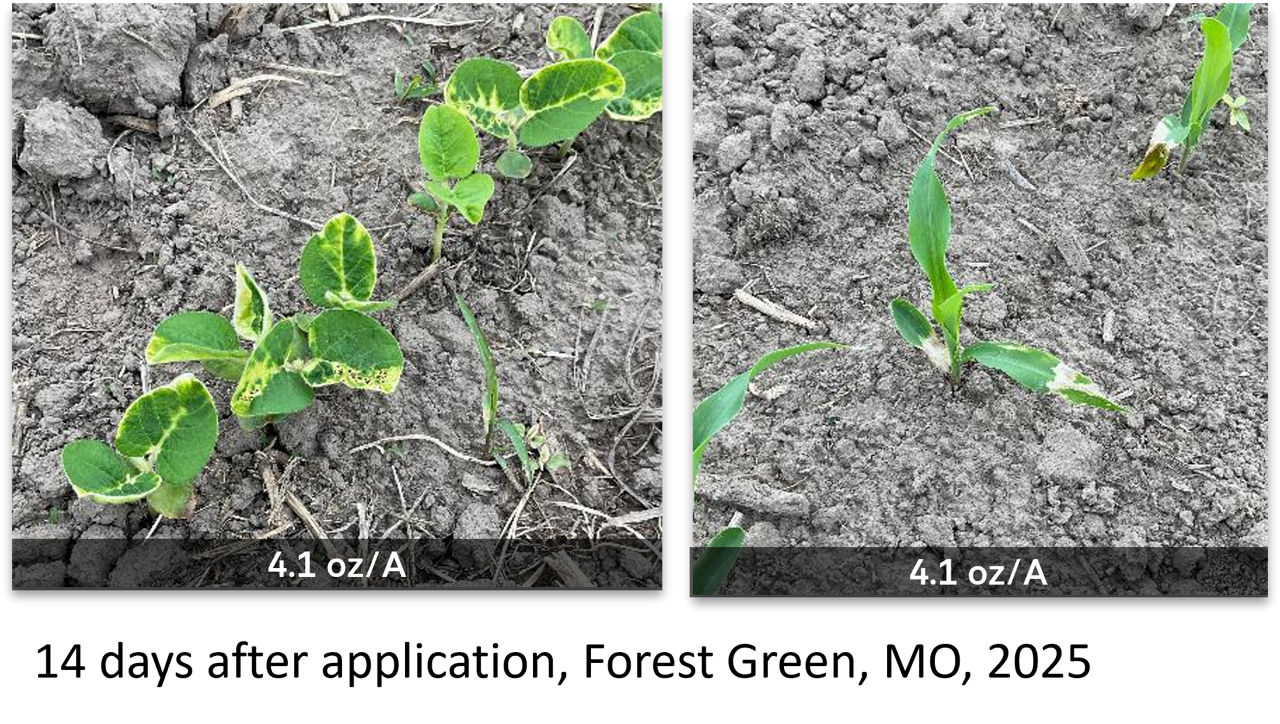
Temporary crop foliar responses may appear as leaf tissue bleaching (whitening) and/or crop stunting (Figure 1). Visually, the response may appear smaller or larger depending on factors such as rainfall, soil type, cropping system, soil temperature, timing of application, and other conditions. In Bayer internal trials, these marks have been shown to dissipate with new crop growth. On average, they have not demonstrated a statistically significant impact on yield.3
Summary
Convintro™ Herbicide offers an option for managing challenging pigweed populations as part of a broader corn or soybean weed control program. Bringing together field conditions, weed management needs, and label requirements can help growers and applicators plan its use appropriately while accounting for factors that influence weed control and crop response.
For more information about Convintro™ Herbicide, visit: https://www.cropscience.bayer.us/brands/crop-protection/convintro
Sources
1Effertz, A. 2021. Investigating the impact of soil type, soil moisture, and soil surface residue cover on the efficacy of diflufenican. Master of Science Thesis. Colorado State University. https://api.mountainscholar.org/server/api/core/bitstreams/3bb5be10-cb41-4481-9e78-851b8daaa6a8/content
2Bayer CropScience LLC. (2026). Convintro™ Herbicide [Pesticide product label]. CDMS. https://www.cdms.net/ldat/ldK83000.pdf
3Bayer internal information.
Web sources verified 10/27/2026. 1123_956252
Disclaimer
ALWAYS READ AND FOLLOW GRAIN MARKETING AND ALL OTHER STEWARDSHIP PRACTICES AND PESTICIDE LABEL DIRECTIONS.