Tar Spot Corn Disease
November 5, 2026
Get Year-Round Updates From Our Agronomic Experts
Key Takeaways
- Tar spot continues its spread into new corn growing areas.
- North Carolina is the latest state to report a positive incidence of tar spot.
- Tar spot development is favored by mean daily temperatures of 64 to 73 °F for 30 days, two to three weeks of relative humidity between 75 and 90%, and prolonged leaf wetness (>7 hours).
- Susceptible corn hybrids have sustained 60 bu/acre yield reductions.
Tar Spot Disease’s Presence Continues to Increase in US Corn Acres
Tar spot has become one of the most discussed corn diseases in the corn producing areas of the United States. Since its first observations in Illinois and Indiana in 2015, it continues to spread into new growing areas. The most recent state to report a positive identification is North Carolina. Eleven of the 12 Midwestern states*, all but North Dakota, have confirmed infections. Other states with confirmed infections are New York, Pennsylvania, Delaware, Maryland, Kentucky, Georgia, and Virginia. To follow tar spot distribution, please see Crop Protection Network which shows a US map indicating the state counties with confirmed infections.1
What is Tar Spot?
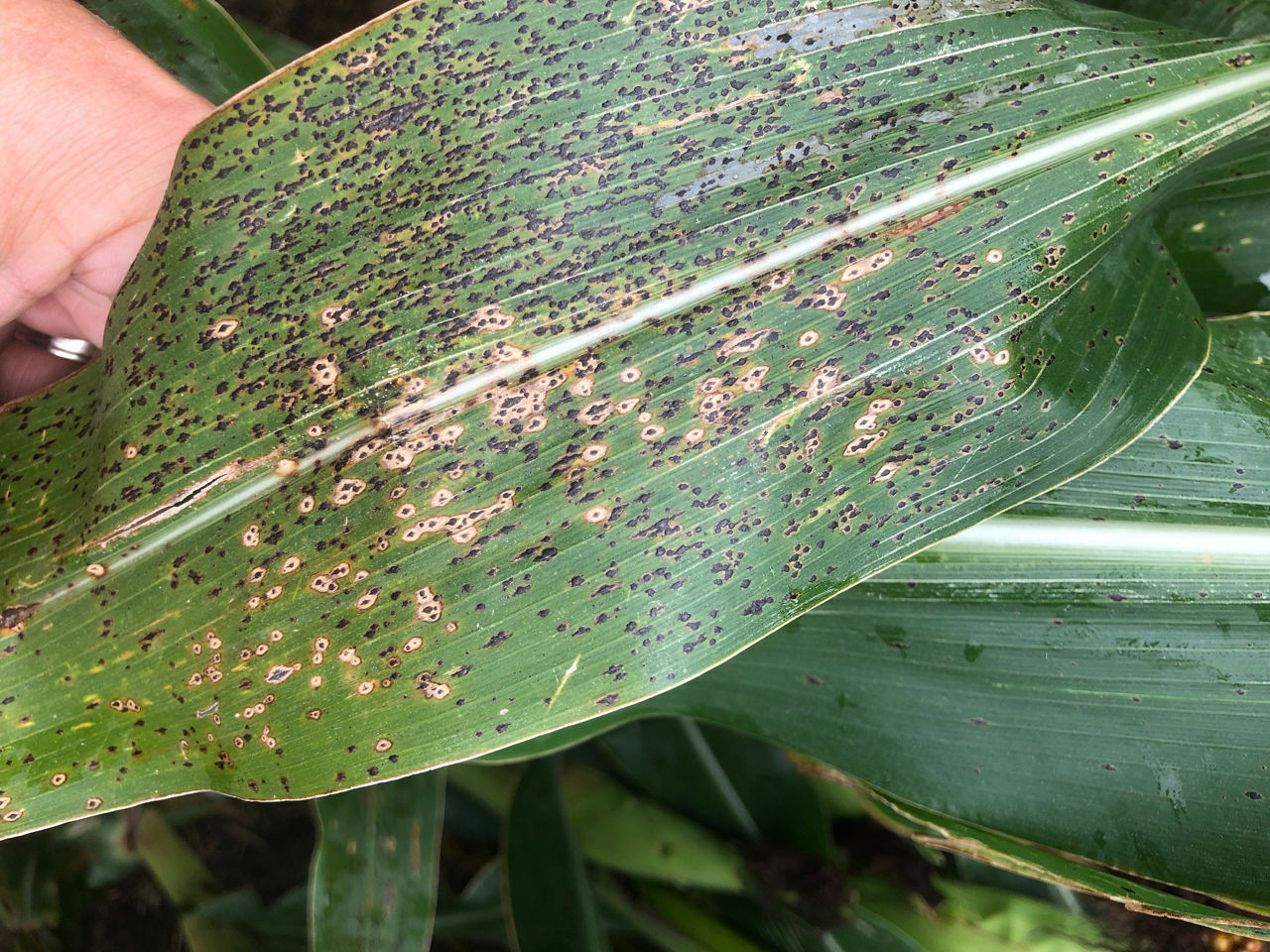
Tar spot is a fungal disease caused by the fungus Phyllachora maydis that is identifiable by the many small, irregular diamond-shaped to round, raised, black spots (stromata) that infection causes on both leaf surfaces (Figure 1). Halos may also form around the stromata (Figure 1). In severe infections, leaf sheaths, husks, and tassels may also have stromata development.2 These raised black spots make tar spot easily identifiable and hard to confuse with other corn diseases. For example, in contrast to common and southern corn rust, the spots cannot be rubbed off. Though infection can occur throughout the corn plant’s lifecycle, tar spot incidence is usually observed from silking (R1) through late grain fill (R6) corn growth stages.3
Conditions Favoring Tar Spot Development
Like many fungal corn diseases, humid conditions favor the development and spread of tar spot. Favorable environmental conditions for tar spot development include mean daily temperatures of 64 to 73 °F for 30 days, two to three weeks of relative humidity between 75 and 90%, and prolonged leaf wetness (>7 hours).2,4 The potential for economic yield loss from tar spot varies with each production year, regional growing environment, field location within a region, crop rotation, tillage utilized, and corn hybrid planted. Historical information has shown that with severe infections, susceptible corn hybrids sustained yield losses of up to 60 bu/acre.2 Early infections that result in leaves being highly covered with lesions during grain development can decrease the plant’s ability to produce photosynthetic energy. The reduced energy can result in poor grain fill and the potential for lodging due to sugar cannibalization from the stalks to help fill grain.
Managing Tar Spot with Scouting and Foliar Fungicides
Tar spot is here to stay, so how do we best manage our fields going forward? Web based resources are available for growers to help track and scout for tar spot. One good resource is the Disease Risk Maps produced by Bayer. The maps provide information on what growing regions are favored for tar spot development based on environmental factors.
In-field scouting, throughout the season, can help identify developing disease situations and aid in planning proactive management. Since tar spot overwinters in soil and residue, fields that have had the disease in prior years or corn-on-corn acres should be scouted. However, first-year corn fields demand attention as well because the pathogen can spread via wind from infested residue in nearby fields.
Fungicide applications and timing are important to help control the spread of the disease. If growing conditions are favorable for infection, two fungicide applications might be warranted. In most cases, a foliar application between VT (tassel emergence) and R2 (blister) corn growth stages should suffice with proper scouting.2 Tar spot tends to appear late in the growing season. However, yield reductions magnify when the disease reaches the ear leaf in early reproductive growth stages, so a second fungicide application may be warranted if the infection intensifies during the early reproductive growth stages. It is important to select a fungicide labeled for tar spot control such as Delaro® Complete fungicide and to control the disease before it moves up the plant.
Corn hybrid selection can also be impactful for managing tar spot. Bayer agronomists, field representatives, dealers, and retailers can help identify corn products that have demonstrated better tar spot tolerance. Tar spot–resistant corn products are currently not available; however, efforts to develop resistant corn products are underway.
For additional information, please see Bayer Crop Science Tar Spot Guide: Understanding Tar Spot: A Comprehensive Guide. The guide provides several agronomic articles addressing the impact tar spot can have on corn yield potential. Understanding Tar Spot: Impact on Midwest Corn Yield is a time lapse greenhouse video that shows how tar spot can overtake a corn plant within four weeks from initial infection.
*The Midwestern states are Illinois, Indiana, Iowa, Kansas, Michigan, Minnesota, Missouri, Nebraska, North Dakota, Ohio, South Dakota, and Wisconsin.
Sources
1Tar spot of corn map. Crop Protection Network, A Product of Land Grant Universities. https://cropprotectionnetwork.org/maps/tar-spot-of-corn
2Quinn, D. and Telenko, D. 2022. Tar spot of corn: What to know and new research. Purdue University Extension Entomology, Pest&Crop Newsletter. https://extension.entm.purdue.edu/newsletters/pestandcrop/article/tar-spot-of-corn-what-to-know-and-new-research/
3Telenko, D., Bish, M., Camiletti, B., et al. 2026. An overview of tar spot. Crop Protection Network, A Product of Land Grant Universities. https://cropprotectionnetwork.org/publications/an-overview-of-tar-spot
4Robertson, A. 2025. Tar spot in central Iowa should not be a surprise. Iowa State University Extension and Outreach, Integrated Crop Management. https://crops.extension.iastate.edu/post/tar-spot-central-iowa-should-not-be-surprise
Additional Resources
Camiletti, B. 2025. Tar spot on the move: Tracking and managing and established corn threat in Illinois. farmdoc daily. University of Illinois. https://farmdocdaily.illinois.edu/2025/07/tar-spot-on-the-move-tracking-and-managing-an-established-corn-threat-in-illinois.html
Telenko, D. and Creswell, T. 2019. Diseases of corn: Tar spot. Diseases of Corn. BP-90-W. Botany and Plant Pathology. Purdue University Extension. https://www.extension.purdue.edu/extmedia/bp/bp-90-w.pdf
Web sources verified 10/22/2026. 1211_992500
Disclaimer
ALWAYS READ AND FOLLOW GRAIN MARKETING AND ALL OTHER STEWARDSHIP PRACTICES AND PESTICIDE LABEL DIRECTIONS.