Palmer Amaranth Management for Corn and Soybean
September 2, 2026
Get Year-Round Updates From Our Agronomic Experts
Key Takeaways
- Palmer amaranth is a highly competitive weed that can significantly reduce corn and soybean yield potential if left uncontrolled.
- Early identification is critical. Palmer amaranth is often mistaken for waterhemp, but one key identifier is a leaf petiole that is longer than the leaf blade.
- A single plant can produce up to 600,000 seeds, allowing infestations to spread rapidly and persist for years.
- Many Palmer amaranth populations are resistant to multiple herbicide groups, making proactive management essential.
- Successful control requires an integrated approach that combines scouting, multiple herbicide modes of action, residual herbicides, and removal of escaped plants.
Palmer Amaranth: A Brief Background
Palmer amaranth (Amaranthus palmeri S. Watson) is an aggressive, invasive, summer annual weed originating from the Sonoran Desert in the United States and northern Mexico. Other common names for Palmer amaranth include Palmer pigweed and careless weed.
The weed spread slowly through the early 1900’s through the southern United States where it adapted readily to the dry environment; however, it did not become a problematic weed in cotton until 1995 in North and South Carolina.1 Over the past decade, it has spread rapidly throughout the Midwest in part through contaminated Conservation Reserve Program (CRP) and other conservation seed mixes.
Identifying Palmer Amaranth
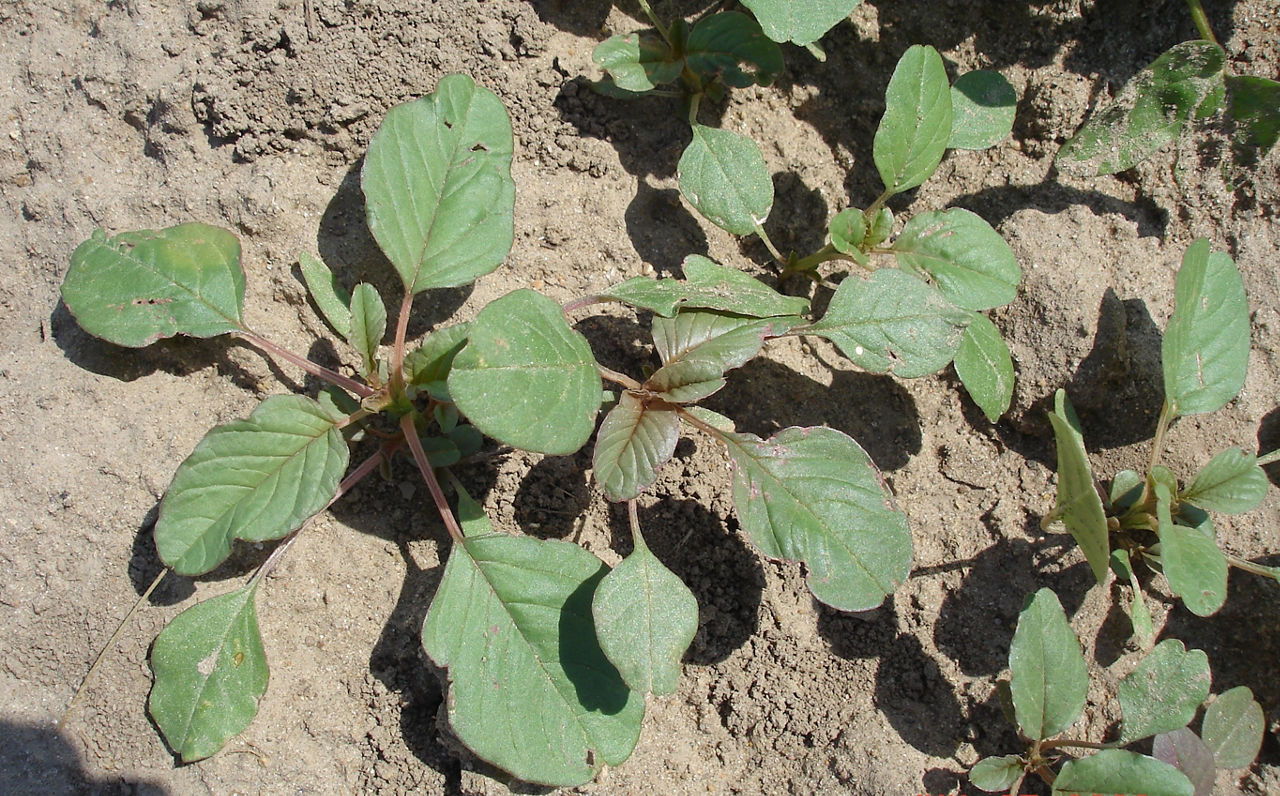
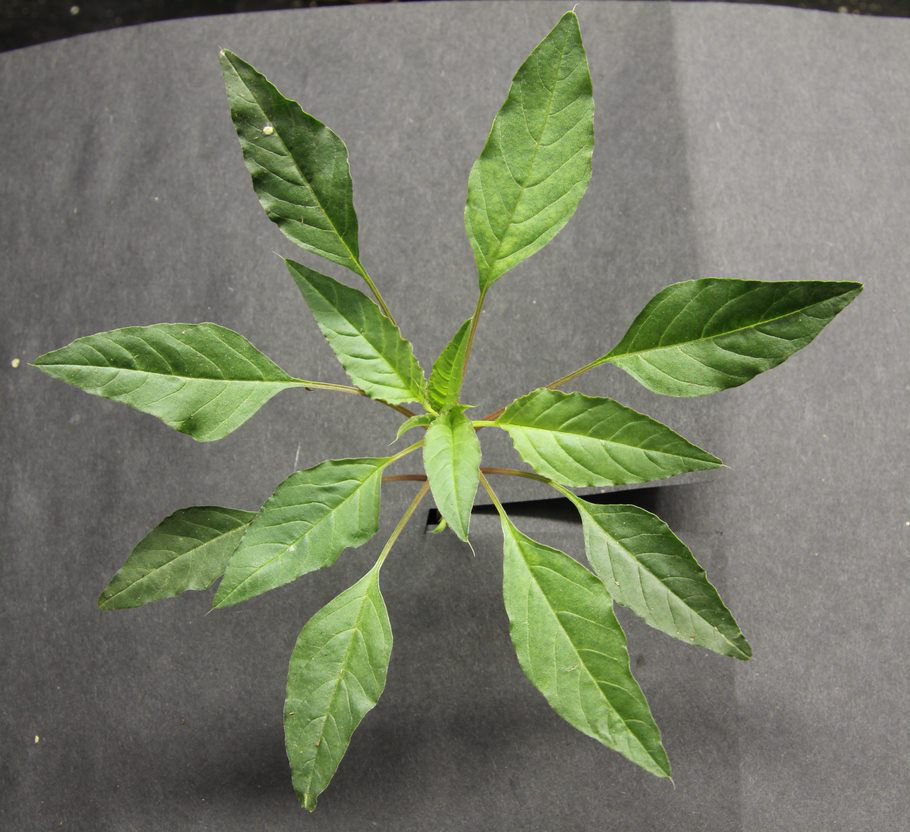
Palmer amaranth is an annual weed in the pigweed family. It has a reddish, smooth central stem that is relatively void of hairs and has numerous lateral branches. The leaves are smooth, hairless, and arranged in an alternate pattern along the stem. A variety of leaf shapes include oval, lance or diamond, and the size can range from about two to eight inches long, and 0.5 to 2.5 inches wide (Figures 1 and 2). Some Palmer amaranth leaves may have a whitish vein on the underside of the leaf, while others may have a whitish V-shaped mark (“watermark”) on the top surface of the leaf and a single spine in the leaf-tip notch.
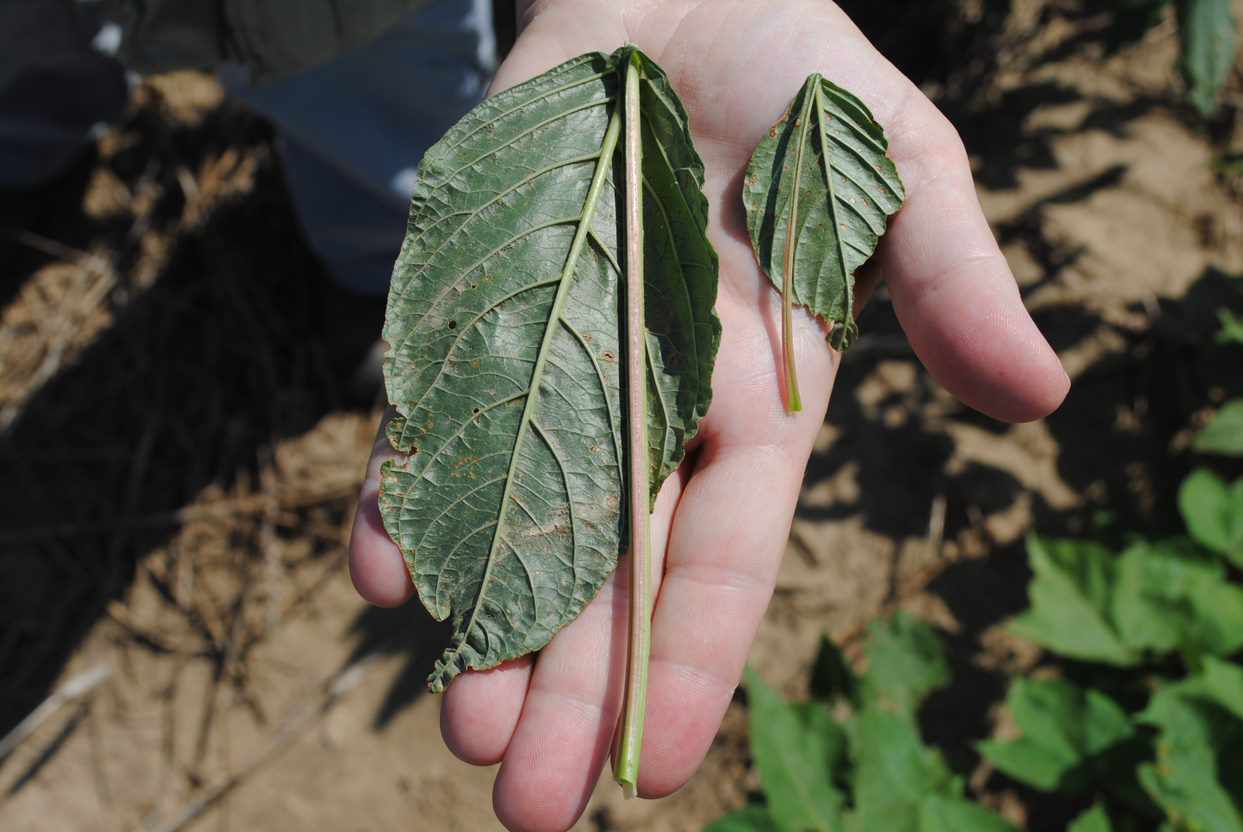
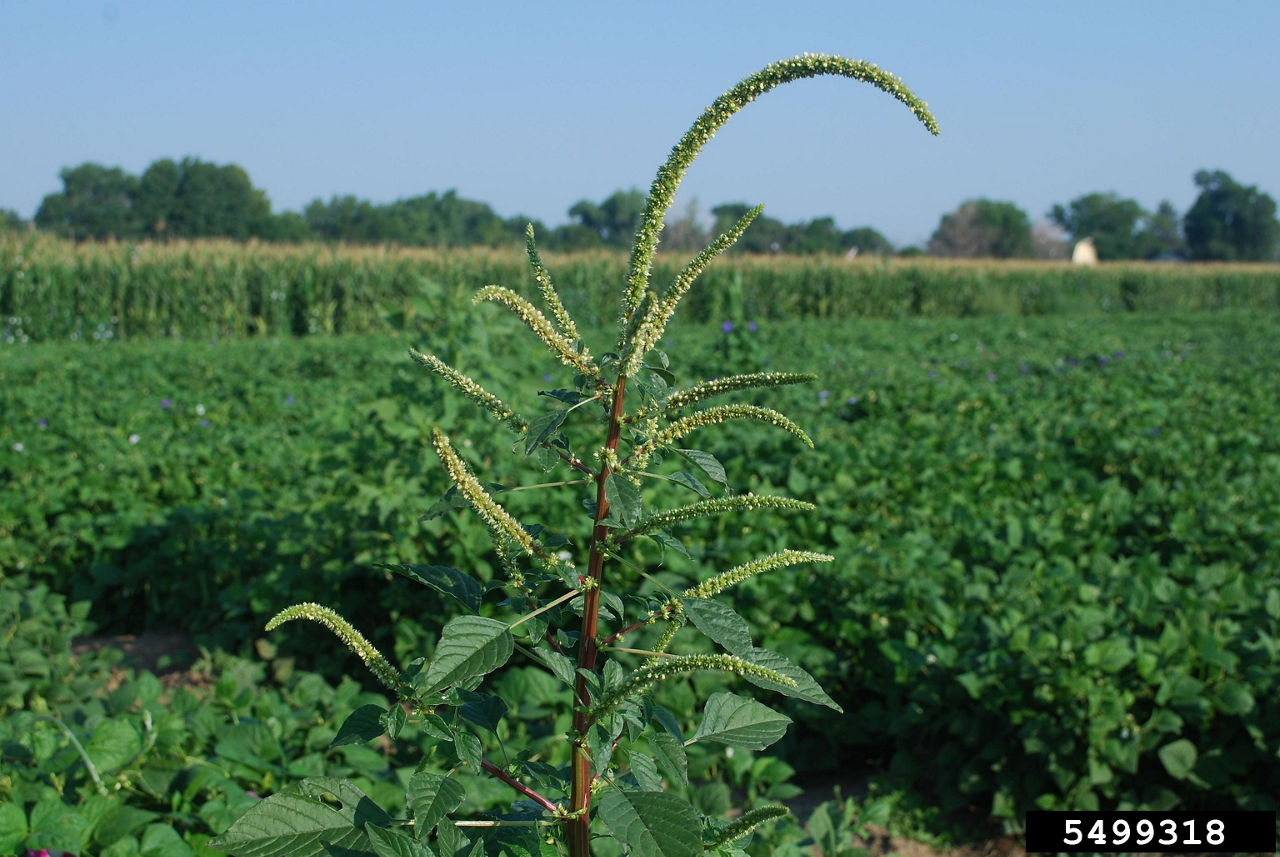
One distinguishing characteristic that helps differentiate Palmer amaranth from common waterhemp (Amaranthus rudis) is the leaf to petiole ratio. The petiole length in Palmer is longer than the leaf (Figure 3), whereas the petiole of a waterhemp leaf is usually short in comparison. The seed heads of female plants have stiff, sharp bracts, and may be up to three feet long (Figure 4).2 Each plant can produce up to 600,000 seeds under low-competition conditions that are viable for three to five years.3 The small seeds can be spread in various ways including animals, birds, wind or farm equipment.
How does Palmer Amaranth Impact Yield Potential in Corn and Soybean?
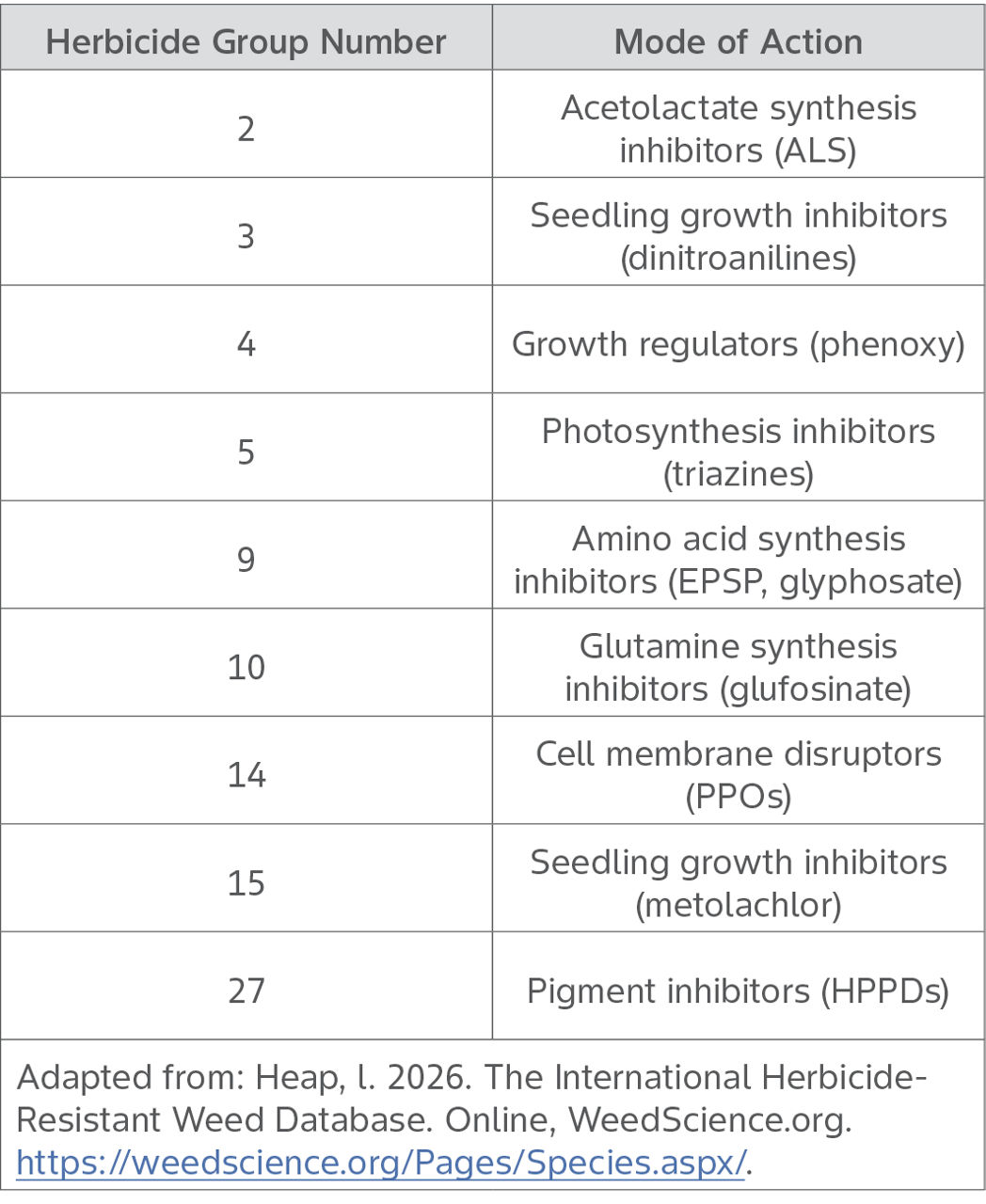
Because male and female plants occur separately, cross-pollination (dioecious reproduction) increases genetic diversity and can accelerate resistance development. Various populations of Palmer amaranth have been documented as having resistance to at least one active ingredient within several herbicide groups (Table 1), with multi-site resistance becoming more common. Herbicide resistance is one of the primary reasons Palmer amaranth has become difficult to manage across many production systems.
Table 1. Herbicide groups with at least one active ingredient to which a population of Palmer amaranth has developed known resistance.
Palmer amaranth is very competitive with crops and can grow to a height of six to eight feet, if competing with a tall crop such as corn, growing at a rate of two to three inches per day. Because of its ability to grow rapidly, Palmer amaranth can quickly become too large for labeled herbicide application timings. Root growth can be five times greater than soybeans, making it highly competitive.3 Additionally, flowering and seed set can occur from early spring all the way through the first frost. Under severe Palmer infestations, yield losses have been documented as high as 91% in corn and 79% in soybean.5
Managing Palmer Amaranth in Corn and Soybean
While there is no single management tactic that consistently controls Palmer amaranth, several integrated pest management (IPM) tools can help growers regain control. The success of any IPM program begins with early scouting and accurate identification. Knowing which weeds are present, where they are emerging, and when they are germinating is critical for selecting effective management tactics and making timely applications. Palmer amaranth populations can increase rapidly, develop herbicide resistance, and are often misidentified as other pigweed species, making early detection especially important.
Compared to many annual weeds that germinate under cooler soil temperatures, Palmer amaranth generally emerges when soil becomes warmer and may continue germinating after corn and soybean planting.3 Because emergence can occur over an extended period, fields should be scouted throughout the growing season to identify new flushes and adjust management plans as needed.6 Understanding when Palmer amaranth is likely to emerge helps growers choose the most effective combination of cultural, mechanical, and herbicide-based management strategies.
Integrated Pest Management for Palmer Amaranth
Integrated pest management methods to help manage Palmer amaranth can include:
- pre- and post-emergence herbicides with herbicide tank mixes of multiple mode-of-action (MOA) herbicides
- tillage
- early crop planting
- crop seeding rates
- crop rotation
- cover crops
- diligent weed management in waste areas (roadsides, fence rows, waterways)
Palmer amaranth plants that are removed by hand weeding should be disposed outside of the field. Do not leave hand-weeded plants lying on the ground as they have the potential to root down again and continue growth.2 If chopping off plants, it is suggested that the stems be cut at least two inches below the soil surface to avoid regrowth.
Below are several recommendations for managing Palmer amaranth in corn and soybean.
Integrated Pest Management for Palmer Amaranth in Corn
- Scout early to determine presence, density, size, and species of early season weeds.
- Start with a clean field. Apply a burndown or preemergence herbicide tank mix with multiple modes of action. Examples of labeled tank mixes include:
- Convintro™ herbicide (Group 12) + Harness® Xtra herbicide or Harness® Xtra 5.6L herbicide (Groups 5 and 15)
- Harness® Xtra herbicide or Harness® Xtra 5.6L herbicide (Groups 5 and 15) tank mixed with DiFlexx® herbicide (Group 4)
- TriVolt® herbicide (Groups 2, 15 and 27) tank mixed with DiFlexx® for management in no-till operations
- Aggressive tillage in conventional fields plus one of the above tank mix options.
- Scout planted fields 10 to 12 days after corn emergence for new weed growth. Non-crop areas should also be scouted.
- Apply postemergence herbicides such as a tank mix of DiFlexx® herbicide (Group 4) and Laudis® herbicide (Group 27) with glyphosate, a Group 9 herbicide, before Palmer amaranth and other weeds are three to four inches in height. A residual herbicide should be included in the application to help manage late emerging weeds.
- Consider walking infested Palmer amaranth fields to remove escapes. Plants should be bagged and removed from the field as immature seeds have the potential to germinate.
- If escapes are not removed, harvest infested fields last to reduce the potential of seed movement to another field via the combine. The combine should be thoroughly cleaned in the infested field before moving to another field.
Integrated Pest Management for Palmer Amaranth in Soybean
- Scout early to determine presence, density, size, and species of early season weeds.
- Start with a clean field. Apply a burndown or preemergence herbicide tank mix with multiple modes of action. Examples of labeled tank mixes include:
- Convintro™ herbicide (Group 12) + metribuzin (Group 5) + Warrant (Group 15)
- Warrant® Herbicide (Group 15) can be used preplant or at planting in a tank mix with active ingredients such as chlorimuron-ethyl, chloransulam-methyl or imazethapyr from Group 2, dicamba (Group 4), metribuzin (Group 5), glyphosate, a Group 9 herbicide, fomesafen (Group 14), or paraquat (Group 22).
- Aggressive tillage in conventional fields plus one of the above tank mix options.
- Scout planted fields 10 to 12 days after soybean emergence for new weed growth. Non-crop areas should also be observed.
- Post emergence: For soybean with XtendFlex® Technology, apply postemergence products such as Stryax™ Herbicide (Group 4) and glyphosate, a Group 9 herbicide, tank mixed with Warrant® Herbicide (Group 15) before Palmer amaranth and other weeds are three to four inches in height. A residual herbicide should be included in the application to help manage late emerging weeds. Glufosinate (Group 10) plus Warrant® Herbicide (Group 15) is also an option to consider for use in XtendFlex® Technology soybean. Stryax™ herbicide is a restricted use pesticide and all applications require a qualified volatility reduction agent and a drift reduction agent in the tank mix as required on the product label.
- Consider walking infested Palmer amaranth fields to remove escapes. Plants should be bagged and removed from the field as immature seeds have the potential to germinate.
- If escapes are not removed, harvest infested fields last to reduce the potential of seed movement to another field via the combine. The combine should be thoroughly cleaned in the infested field before moving to another field.
For additional information on Convintro™ herbicide, Harness® Xtra herbicide, Harness® Xtra 5.6L herbicide, TriVolt® herbicide, DiFlexx® herbicide, Laudis® herbicide, Stryax™ herbicide and Warrant® herbicide, please visit the Bayer Crop Science Crop Protection Product Catalog.
Sources
1Ward, S.M., Webster, T.M., and Steckel, L.E. 2013. Palmer Amaranth (Amaranthus palmeri): A review. Weed Technology, 2013 27:12-27. Weed Society of America.
2Legleiter, T and Johnson, B. 2013. Palmer amaranth biology, identification, and management. Purdue University Extension.https://www.extension.purdue.edu/extmedia/WS/WS-51-W.pdf
3Mohler, C.L., Teasdale, J.R., and DiTommaso, A. 2021. Palmer amaranth. Manage weeds on your farm. SARE Outreach. Sustainable Agriculture Research and Education. United States Department of Agriculture. University of Maryland. https://www.sare.org/publications/manage-weeds-on-your-farm/palmer-amaranth/#Weed-Characteristics-Summary-Table/.
4Heap, l. 2022. The International Herbicide-Resistant Weed Database. Online, WeedScience.org. https://weedscience.org/Pages/Species.aspx/.
5Palmer amaranth. Minnesota Department of Agriculture. https://www.mda.state.mn.us/palmeramaranth
6Steckel, L. 2021. Palmer amaranth has started to emerge. UTcrops News Blog. Institute of Agriculture. University of Tennessee. https://news.utcrops.com/2021/04/palmer-amaranth-has-started-to-emerge/.
Web sites verified 07/08/2026. 1123_27650
Disclaimer
ALWAYS READ AND FOLLOW GRAIN MARKETING AND ALL OTHER STEWARDSHIP PRACTICES AND PESTICIDE LABEL DIRECTIONS.